
Valve fails six months in. Stem is weeping. The line has to come down. The valve passed every paper check – spec, delivery, price. None of that matters now. This is the gap between a valve that looks right and one that actually works. Ahmedabad has a real manufacturing base for industrial ball valves. Not a marketing claim. Foundries, engineering depth, export infrastructure – it is genuinely here. This guide of Quality of ball valve manufacturer in Ahmedabad covers what you need to know before you source.
Ahmedabad’s Ball Valve Manufacturing – What Makes It Different?

Ask any procurement engineer who has sourced valves from Gujarat versus imported alternatives. The answer is usually the same. Lead times are shorter. Customisation conversations actually go somewhere. And when something needs fixing, there is a real team to call.
Three things built this manufacturing base:
- Foundry clusters producing carbon steel, stainless steel, ductile iron, and alloy castings – quality that competes internationally on both grade and price
- Engineering workforce with generational valve-making knowledge. Not just machine operators. People who have been building valves their entire careers and know exactly where failures originate
- Port access that keeps export logistics competitive for customers across the Middle East, Africa, Southeast Asia, and Europe
Ahmedabad sits at the centre of this. Mid-to-large industrial valve producers here cover the full size range – half-inch instrumentation valves right up to 48-inch pipeline isolation valves – across every major material and pressure class. The supplier ecosystem around them is dense. Testing labs, fabricators, material suppliers – all nearby, which keeps quality tighter and timelines shorter than isolated manufacturing setups can manage.
XSIS Valves has operated inside this ecosystem since 2008. ISO 9001:2015 certified. Advanced computer-modelled design capability. Customers across oil and gas, power, chemical, marine, and pharmaceutical sectors globally. The manufacturing strengths of Ahmedabad, combined with documentation standards that international project specifications actually require.
What a Ball Valve Does – And Why It Became the Industry Default?
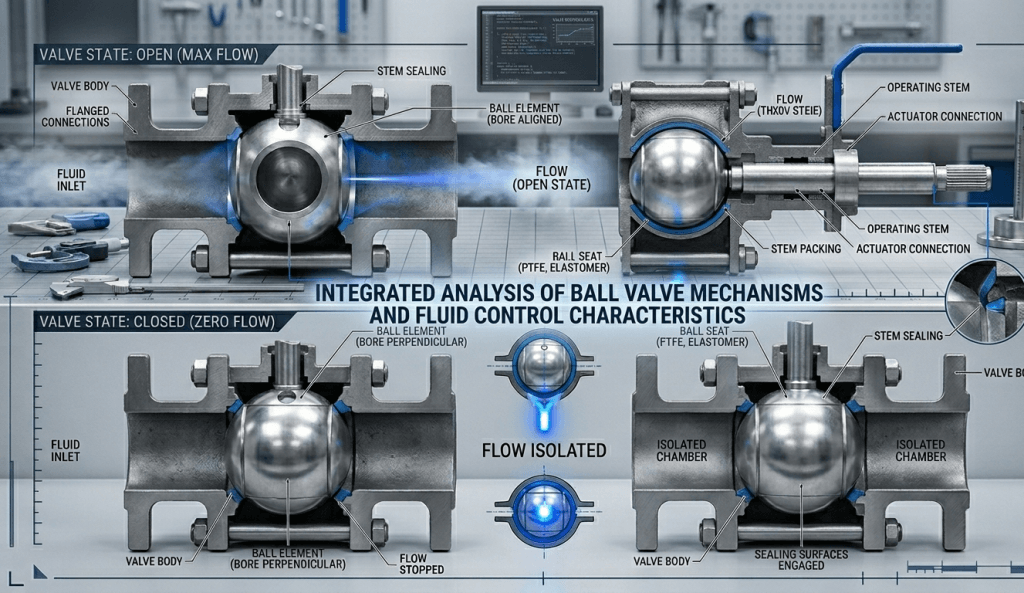
Quarter turn. That is it. A sphere with a bore sits in the body. Bore lined up with the pipe – fluid moves. Rotate the handle ninety degrees – solid wall faces the flow, everything stops.
Simple mechanism. Serious performance advantages:
- One quarter turns from fully open to fully closed. Fast shutoff when a line needs to come down now, not in three handle rotations
- Handle position shows valve status instantly. No walking upstream to check whether something is open or closed
- Bubble-tight seal that holds after years of cycling – not just when it is new
- Minimal pressure drop in the fully open position, especially full bore designs
- Compact body, fits into tight pipeline arrangements without brackets and extra supports
Liquids, gases, steam, slurries, cryogenic media – ball valves handle all of it. Low pressure utility lines through Class 2500 high-pressure service. Low maintenance requirements. Long service life without constant attention. That combination is why industrial ball valves became the default isolation choice across practically every process industry, and why they stayed there.
Types of Industrial Ball Valves and Where Each One Fits
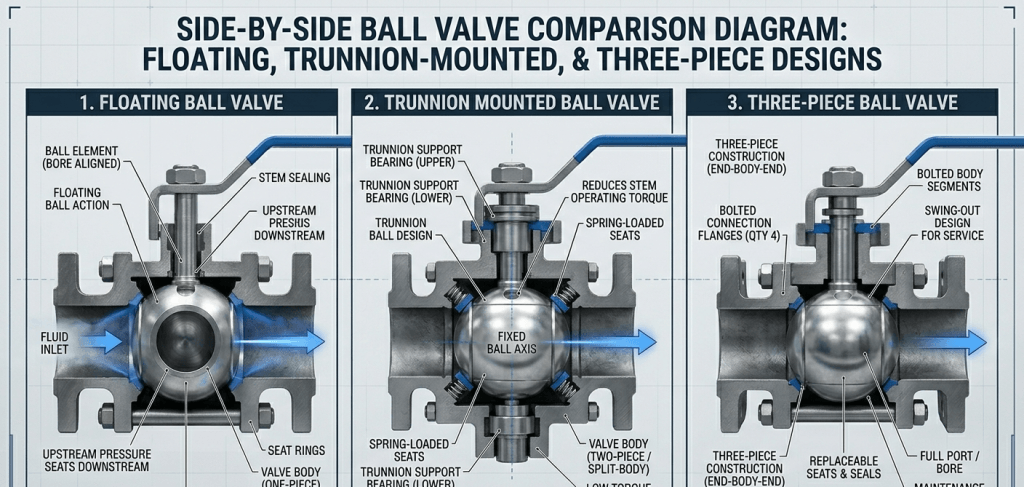
This is where specification mistakes actually happen. Engineers default to one type for everything, or pick based on what is in stock. Wrong choices cost money later.
Floating Ball Valves
The ball is not fixed. It rests between two seats and shifts slightly under pressure, pressing hard against the downstream seat. Pressure-energised seal – gets tighter as line pressure rises.
Compact. Cost-effective. Good for low to medium pressure service. These are the right choice for:
- General water treatment and HVAC systems
- Chemical processing lines at moderate operating pressures
- Utility services throughout industrial plants
- Smaller bore instrumentation and process lines
XSIS manufactures floating ball valves in two-piece and three-piece body designs across multiple materials and pressure ratings. Most general industrial applications land here.
Trunnion Mounted Ball Valves
Different design entirely. The ball is anchored top and bottom by trunnion shafts. Does not move. Spring-loaded seats press against the fixed ball instead. Pressure loads spread across the valve body structure rather than concentrating on the seating surfaces.
Operating torque is dramatically lower compared to a floating ball valve of the same diameter. In large-bore, high-pressure service that is not a minor point – it determines whether a valve can be manually operated at all, and drives the actuator sizing if it is automated.
Where trunnion valves get specified:
- Oil and gas transmission pipelines, onshore and offshore
- LNG terminals and gas processing facilities
- Power plant feedwater, steam, and cooling water systems
- Petrochemical processing wherever large-bore, high-pressure isolation is a daily operational requirement
Double block and bleed is part of the trunnion design – sealing simultaneously against pressure from both sides, with the ability to vent the body cavity in between. In safety-critical lines that is frequently a non-negotiable specification requirement, not an optional feature.
Full Bore vs Reduced Bore – Get This Right Early
Full bore means the internal diameter matches the pipe exactly. No restriction. No velocity change. No additional pressure drop. If pipeline pigging is involved at any point – cleaning pigs, inspection tools, anything that travels through the line – full bore is mandatory. No exceptions.
Reduced bore has a smaller internal diameter than the pipe. Modest velocity increases and pressure drops through the valve. Lighter, more compact, cheaper. Fine when pigging will never be required and the pressure drop is within tolerance for the system.
Specifying reduced bore in a pigged pipeline means pulling the valve after commissioning. That conversation is not one anyone wants to have. Confirm this at specification stage, not during startup.
Three-Piece Body Ball Valves
Centre body between two end caps. End caps bolt directly to the pipeline and stay there. When maintenance is needed, the centre section comes out without touching the pipe connections. No draining long pipe runs. No disturbing connected equipment.
Standard specification in:
- Pharmaceutical manufacturing where clean-in-place procedures are a regulatory requirement
- Food and beverage processing where contamination-free inline servicing is an audit condition
- Chemical service where pulling the full valve assembly would cause disproportionate disruption to surrounding pipework
Materials Used in XSIS Ball Valve Manufacturing
Wrong material. Wrong service life. It is that straightforward. Body material has to handle the fluid chemistry, the operating temperature range, and the pressure class across the full intended service life – not just the first year.
XSIS manufactures across these options:
- Carbon Steel WCB: Oil and gas, steam, water, general chemical service at moderate temperatures. Covers Class 150 through Class 2500. Cost-effective and widely applicable
- Stainless Steel SS304 and SS316: Corrosive media, chemical processing, pharmaceutical and food applications. SS316 adds molybdenum – meaningfully better resistance in marine and chloride-heavy environments where SS304 would corrode
- Ductile Iron: Water treatment, HVAC, utility service. Cast-iron strength with better impact resistance
- Brass and Bronze: Plumbing, marine applications, instrumentation. Lower pressures, compact sizes, corrosion resistance is the priority
- Alloy Steel WC6 and WC9: High-temperature steam and power generation where carbon steel temperature limits are a real constraint, not a theoretical one
- PFA Lined: Severely corrosive chemical service. Carbon steel or stainless body, PFA liner protects every wetted surface from fluids that would destroy bare metal
Half-inch through 48 inches. PN10 through PN25, ANSI Class 150 through Class 600. Higher ratings available on request for specific project requirements.
Standards and Testing – What the Documentation Actually Covers?
A valve without proper test documentation is a project liability. Third-party inspectors, commissioning engineers, regulatory audits – they all ask for the records. The paperwork has the same weight as the hardware at that point.
XSIS Valves operates under ISO 9001:2015 certification governing every stage from raw material procurement through final despatch inspection. Every ball valve manufactured at XSIS is tested against:
- API 598 – Seat leakage tests, shell pressure tests, backseat tests. The standard most procurement specs reference by default
- BS EN 12266-1 – European pressure testing standard for industrial valves
- ISO 5208 – International standard for industrial valve pressure testing
- API 6D – Pipeline service requirements covering full bore design, double block and bleed, and piggability
Material test certificates to EN 10204 3.1, hydrostatic test reports, dimensional inspection records, third-party inspection documents where project specs call for them. IBR and API certifications available where applicable.
None of this is optional at XSIS. Every order ships with the full package. Because procurement engineers and project managers working on serious installations know their projects cannot survive without it.
Visit the XSIS Valves for full details on manufacturing capabilities and quality certifications.
Where XSIS Ball Valves Actually Get Used?
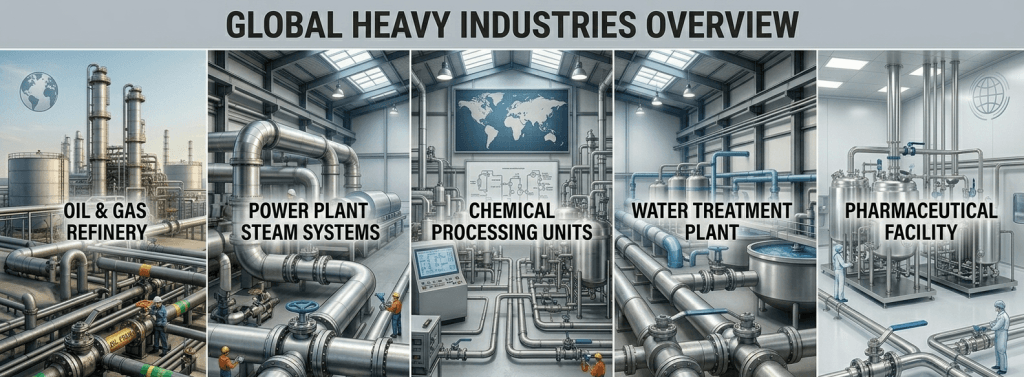
Oil and Gas
Wellheads, gathering systems, refineries, storage terminals, gas distribution networks. Ball valves are the isolation standard throughout. Full bore, trunnion-mounted, fire-safe designs go where API 6D compliance is required. Zero leakage tolerance. From day one through year fifteen of service life.
Power Generation
Steam systems, feedwater circuits, cooling water, boiler blowdown. High-temperature alloy steel handles elevated steam conditions. Stainless steel covers demineralised water and condensate circuits where corrosion is the standing concern and material selection matters more than it appears to on a spec sheet.
Chemical and Petrochemical Processing
Acids, caustics, hydrocarbons, solvents. The range of media in a chemical plant is wide and the margin for material error is narrow. SS316 and PFA-lined ball valves cover this spectrum. Tight shutoff. Service life that justifies the specification effort.
Pharmaceuticals and Food Processing
Three-piece stainless steel with polished internals. Inline cleaning, quick disassembly, hygienic design. These are regulatory inspection requirements, not preferences. The valve either meets them or the facility does not get signed off.
Water Treatment and Wastewater
Ductile iron and stainless steel across pump stations, dosing systems, filter controls, and distribution networks. Wide size and pressure range required. XSIS covers it.
LNG and Cryogenic Service
Extended-stem cryogenic designs keep stem seals away from the extreme cold zone. Standard valves fail here – thermal contraction alone rules them out. The design has to account for conditions that ordinary configurations were never built for.
HVAC and Building Services
Compact two-piece and three-piece brass and stainless steel ball valves. Zone isolation, balancing, maintenance bypass. Frequent operation, easy serviceability – the requirements are straightforward and the valve has to match them consistently.
The API 6D pipeline valve standard sets precise technical requirements for ball valves in pipeline service – full bore design, double block and bleed functionality, piggability. These are technical obligations tied to real operating conditions, not checkbox exercises.
Contact the XSIS Valves engineering team to work through the full specification for your project. Material, pressure class, body design, end connection – the team handles the technical detail so the right valve goes into the right service.
Selecting the Right Ball Valve – Parameters That Actually Drive the Decision
Size and connection type are the starting point. Everything below determines whether the valve performs across its full service life or creates problems before the first maintenance window.
- Fluid: Liquid, gas, steam, or slurry? Corrosive, flammable, abrasive? Fluid properties set the body material, seat material, and seal selection before any other decision gets made
- Pressure and temperature: Maximum conditions under every operating scenario – startup, shutdown, process upsets. Match these to the pressure-temperature rating for the specific body material, not the generic datasheet value
- Bore: Full bore is mandatory for pigging. Reduced bore is fine elsewhere when pressure drop is within tolerance
- Ball design: Floating for smaller diameters and moderate pressures. Trunnion for large bore, high pressure, or wherever operating torque is a hard constraint
- End connections: Flanged for most process service. Screwed for utility and small bore. Socket weld and butt weld for high-pressure and cryogenic applications
- Operation: Manual lever or handwheel for occasional operation. Pneumatic, electric, or hydraulic actuators for remote control, automation integration, or high-cycle duty
- Standards: Know which test standards the project specification calls for before ordering. API 598, API 6D, BS EN 12266-1, ISO 5208 – XSIS meets all of them with full documentation
XSIS supplies fully assembled automated packages – pneumatic and electric actuators, position switches, solenoid valves, limit switches – factory tested before leaving the facility. Browse the complete XSIS Valves product range for full configuration options.
Conclusion
Picking a ball valve manufacturer in Ahmedabad is not purely a price decision. The product has to hold up under real service conditions. The documentation has to survive a project audit. The team behind it has to understand what different applications genuinely demand from a valve.
XSIS Valves Pvt. Ltd. brings 17 years of manufacturing experience, ISO 9001:2015 certification, floating and trunnion ball valves across all major materials and pressure ratings, and full quality documentation on every order. Standard stainless steel ball valve for a water system or fire-safe trunnion-mounted ball valve for an oil and gas pipeline – the XSIS team is ready for your specification, supply, and project requirements.
Frequently Asked Questions
What is the difference between floating and trunnion ball valves?
Floating designs let the ball shift under pressure to seal against the downstream seat. Trunnion designs anchor the ball with top and bottom shafts while spring-loaded seats press against it – dramatically lower operating torque for large-bore, high-pressure service.
What materials does XSIS offer for ball valves?
Carbon steel WCB, SS304, SS316, ductile iron, brass, bronze, alloy steel WC6 and WC9, and PFA-lined configurations. Selection depends on fluid chemistry, temperature, pressure class, and corrosion exposure.
Which testing standards do XSIS ball valves meet?
API 598, BS EN 12266-1, and ISO 5208 as standard. API 6D for pipeline service. Full documentation – material test certificates, hydrostatic test reports, dimensional inspection records – ships with every order.
What size range is available?
Half-inch through 48 inches with custom sizes on request. Pressure ratings cover PN10 to PN25 and ANSI Class 150 to Class 600, higher ratings available for specific project needs.
Does XSIS supply automated ball valve packages?
Yes. Pneumatic, electric, and hydraulic actuator assemblies, pre-built and factory tested. Compatible with SCADA, DCS, and PLC systems. Solenoid valves, position switches, and limit switches included as standard.
Why buy from a ball valve manufacturer in Ahmedabad instead of importing?
Shorter lead times, better pricing, real customisation capability, and local technical support you can actually reach. XSIS products meet the same international standards as imported alternatives with complete certification documentation.