
Choosing between a ball vs a gate valve is one the most frequently-asked questions procurement and engineers face when creating or maintaining a pipeline system for industrial use. If you choose the wrong one, you could be facing the possibility of pressure drops and frequent maintenance, early failure, and in the worst situations, total system shut downs. If you’ve ever sat before a catalogue and tried to figure out the flow control valve that is best suited for your particular application then you’re well aware of the complexities of this decision be. This guide explains everything in simple terms, easily and without the technical jargon so that you can make a sound decision the first time around.
What is a Ball Valve and how does it Function?
Ball valves are half-turn Rotary valves that make use of perforated, hollow balls to regulate the flow of fluid in an underlying pipeline. If the ball’s hole is aligned to the pipeline, the fluid flows freely. When it rotates 90 degrees and the flow is completely blocked. This simple, yet highly efficient process makes ball valves among the most frequently used kinds of industrial valves around the world.
The most important feature of the ball valve is its efficiency and dependability. One 90-degree turn will allow you to switch from completely open to fully closed, making it perfect for situations that require quick shut-off. This is the reason you’ll see ball valves extensively employed in gas and oil pipelines and LNG facilities, in chemical plants and other areas that require an inseparable leak-proof seal at high pressure. The design with a full bore of a majority of ball valves guarantees a minimal drop in pressure across the valve which is an important benefit in industrial systems with high flow.
What is a Gate Valve and How Does It Function?
The gate valve can be described as a linear motion device which uses the wedge-shaped or flat gate disc that is moved across and down perpendicularly towards the direction of flow in order to regulate the flow of fluid. Once the gate has been completely elevated, fluid flows smoothly through the valve with virtually no obstruction. If the gate is completely reduced, it forms an absolute seal that blocks the flow completely. That’s why gate valves are specifically designed to be fully open or completely closed positions. They are not suited for throttles or partial flow control.
Gate valves are the best choice for applications where the valve is in one place for prolonged durations — either shut or open with no regular operations. Industries such as water treatment plants refineries for oil, chemical manufacturing or fire-protection systems depend in large part on gates valves due to their capacity to handle huge pipe diameters, large pressures, as well as a broad variety of fluid types, such as viscous fluids, slurries and steam. XSIS Valves manufactures a wide variety of Gate Valves in Ahmedabad and Forged Steel Gate Valves designed for harsh industrial environments.
Ball Valve vs Gate Valve The Core Differences Defined
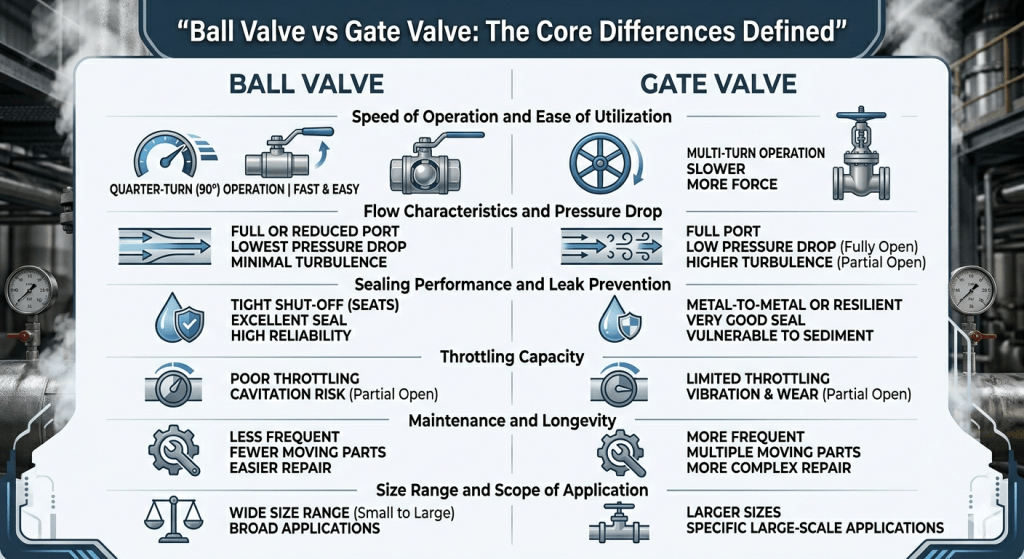
Understanding the key difference between a ball or gate valve goes far beyond simply examining their form. They differ in many ways -in everything from their operation and how quickly they react to the industries that prefer their use and the reasons for that. This is a comprehensive analysis of the most crucial differences:
Speed of operation and ease of Utilization
A ball valve is operated by an easy quarter-turn mechanism, that means the valve can open and close in less than one second. This is extremely convenient when you need to have quick on-off flow control, like emergency shut-offs in pipelines for gas and oil as well as LNG pipelines. A gate valve, however, requires several full handwheel rotations to completely open or close. In valves with large diameters it can take a lot of time and physical exertion making them unsuitable for applications where speed of operation is important.
Characteristics of Flow and Pressure Drop
One of the major technical advantages of the ball valve is the fact that its full bore design lets fluid traverse through with virtually no pressure drop once it is fully opened. The inside diameter of the valve is equal to the diameter of the pipe, which means the flow is unimpeded. A gate valve can also offer extremely low pressure drop when it is fully open since the gate completely retracts away from the flow route. Both valves work well in this regard, however the ball valve has a slight edge due to its smooth, circular bore that produces less turbulence as well as resistance to flow when compared with the body chamber of gate valves.
Sealing Performance and Prevention of Leaks
Ball valves are renowned for their bubble-tight shut-off capabilities. The design of the seat and ball provides a metal-to-metal or soft-seated seal that’s extremely robust even after countless operating cycles. This is among the primary reasons why ball valves are favored in chemical pipelines and gas pipelines systems, where even the tiniest leak could pose grave risk to the environment or safety. Gate valves provide an effective seal even when they are new. However, as time passes the gate and seat may wear out particularly in the event that the valve is operated frequently or the fluid is contaminated with solid particles that strike the seats.
Throttling Capacity
There is a distinct difference in the 2. Gate valves shouldn’t be used for throttle control which means they shouldn’t be kept in an open position. If a gate valve is only partially closed, fluid’s high velocity causes severe turbulence which rapidly causes erosion of the gate and seat surfaces, causing premature failure. Ball valves aren’t optimal for continuous throttles, however they can manage partial positions much more effectively than gates that are used in medium to low pressure systems. If your project needs precise flow control then a Globe Valve is the better option.
Maintenance and Longevity
Ball valves typically need less maintenance throughout their lifespan because of their easy rotating mechanism, and also because the valve is exposed to the flow path only when the valve is closed. The seals and seats are adequately secured. Gate valves typically require maintenance since the stem and gate threads are exposed to fluids which makes them more susceptible to scaling, corrosion, and wear — especially in chemical and water treatment plant applications. If a gate valve experiences leaks, it’s typically caused by gate or seat wear, which requires removal and replacing.
Size Range and Scope of Application
Gate valves are offered in larger dimensions than ball valves, and are typically employed in pipelines with large diameters that range between 2 inches to 48 inches and more. They are the ideal option to be used in water distribution systems for municipalities as well as fire protection networks and pipelines that are large-scale for oil refineries. Ball valves are most commonly utilized in smaller and medium diameter pipes, but large bore ball valves also exist. For projects that require very large pipe dimensions gate valves are typically the only option.
When to Select the Ball Valve?
There are some specific situations and scenarios in which a ball valve is definitely the best choice knowing about this will help you save time in the long run, as well as cash and troubleshooting.
- Quick shut-offs in any process where you have to stop or begin flow quickly this ball valve with a quarter turn is the best and effective choice to choose from. Stop-off points for emergency shut-offs within gas supply lines, LNG terminals and the chemical dosing system are instances of when the velocity of the ball valve isn’t simply preferred, but frequently required by safety regulations.
- Vapour and gas servicesThe ability to seal bubbles of the ball valve is what makes it a preferred option for gas pipelines, compressed air systems, as well as vapour handling systems. Even the tiniest leak in a gas line could cause catastrophic damage and the ball valve’s sealed seal tackles this issue directly and consistently.
- High-purity or corrosive fluid systems in food processing, pharmaceutical manufacturing and chemical facilities where the purity of the fluid is important ball valves made of stainless steel, SS316 is the most preferred due to the smooth surface of their internal surfaces. can be cleaned easily and resistant from corrosion, as well as doesn’t hold in bacteria or deposits which could affect the stream of product.
The Right Time to Select the Gate Valve
Gate valves have a distinct advantage in particular industrial situations in which their distinctive characteristics make them the best option.
- Large diameter completely open serviceWater supplies mains, sewer systems, fire hydrant systems, and large pipelines for distribution of oil The gate valve will be the most common option due to its ability to handle massive pipe diameters with ease and does not cause any obstruction to flow once it is completely open. Low pressure drops and the ability to handle flow that is high-volume make them ideal for these types of situations.
- High pressure and high temperature steam service – Gate valves, specifically gate valves made of forged steel are specifically designed to handle extreme pressures and temperatures which are commonly found in boilers, power plants systems and steam distribution systems. The sturdy body structure and the metal seating of forged gate valves are among the few valves capable of handling superheated steam with no degradation.
- Applications that require frequent operation — when the valve is placed and left in a single position for a period of months or years at a period of time, like isolation valves in storage tanks or buried pipeline isolation points gates are the preferred choice due to its design for long-term static use. Ball valves that are left in one position for long time periods may experience seat deformation. A gate valve is usually more robust in these circumstances.
XSIS Valves supplies both Gate Valves and a wide selection of industrial valves in Mumbai, Delhi, Chennai as well as other important industrial cities in India.
Ball Valve vs Gate Valve A Quick Comparison Table
| The Feature | Ball Valve | Gate Valve |
| Operation | Quarter-turn (90 degree) | Multi-turn (full rotations) |
| Shut-off Speed | Very quick | Slow |
| Pressure Drop | Extremely low (full bore) | Extremely low (fully open) |
| Sealing | Bubble-tight | New and good |
| Throttling | Not advised | Never suggested |
| Best For | Gas, chemical, quick shut-off | Water, steam, large pipelines |
| Maintenance | Low | Moderate to high |
| Size Variation | Small to medium | Small to extremely large |
| Temperature Variable | Moderate to high | Very high |
| Cost | Moderate | Low to moderate |
Which industries use Ball Valves in comparison to Gate Valves?
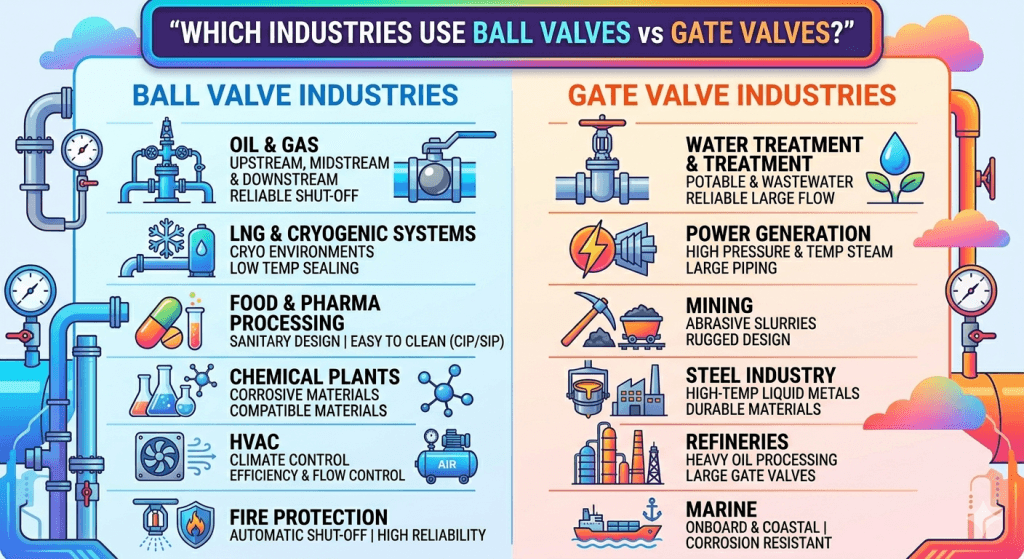
Knowing which industries utilize ball valves, and which ones rely on gate valves will give you real-world experience that surpasses technical specifications.
Ball valves are a major component within the industry of oil and gas to control wellheads and pipeline isolation as well as in LNG or cryogenic equipment because of their capacity to keep sealed seals even at low temperatures as well as in food and pharmaceutical processing due to their clean design and ease of cleaning, as well as in chemical plants where leak-proof and corrosion resistance performance are not a matter of debate. They are also extensively employed in HVAC systems and compressed air networks and fire protection systems.
Gate valves are among the most important components of distribution and treatment systems, as well as power generation facilities, mining operations, steel plants, oil refineries for big diameter isolation, as well as marine applications in which robust long-service valves are required for bilge systems and seawater. XSIS Valves serves all of these industries, and more and has certified products to customers throughout Bangalore, Pune, Hyderabad as well as Kolkata.
Conclusion
In the case of ball valves vs gate valves there isn’t a universal winner. The ideal choice will depend on the particular situation, operating conditions such as fluid type and the operational needs. Ball valves are the ideal choice when you require quick and reliable shut-offs that are leak-proof for chemical, gas as well as high-purity systems. Gate valves are a good choice for dealing with pipelines of large diameter as well as high-temperature steam service or in situations in which the valve is in place for long durations. Understanding the distinctions between these valves will not just assist you in selecting the appropriate valve- it can help you create a more secure, efficient and long-lasting pipeline system. If you’re unsure of which industrial valve will work best for your particular needs, talking with an experienced industrial valve manufacturer who knows the industry you work in is the best option.
Most Frequently asked questions (FAQs)
The most significant difference lies in how they operate and the purpose they’re made for. Ball valves use an elongated ball mechanism that works with just a quarter-turn which makes it perfect for quick shut-offs in chemical and gas systems. A gate valve is an ascending or falling gate mechanism that takes several turns to open and close, making it best to be used for pipelines of large diameter and other applications that require the valve to remain in a single position for lengthy durations. Both are flow control valves. However, they both excel in various situations and industries.
In certain applications Yes, however, not always. A gate valve is a good substitute for the ball valve in larger diameter, low-frequency operating scenarios like water mains or the isolation of storage tanks. However, for applications that require rapid shut-off times, gas tight sealing, or resistance to corrosion for chemical processes, using a ball valve is the most efficient choice and should not be replaced. Making the wrong choice of valve in the wrong place can lead to premature wear, leakage and expensive maintenance which would have been avoided by making an appropriate selection at the beginning.
For the majority of gas and oil pipelines the ball valve would be the ideal option, particularly because of its seal that is bubble-tight quick operation and the ability to handle high pressure gas with no leakage. Gate valves are commonly used for larger diameter oil transmission lines where the size and frequency of operations are the main factors. The final decision will depend on the pressure ratings of pipelines, the fluid diameter, type and the frequency at which the valve is required to be used under normal or emergency circumstances.
In general, ball valves tend to be a bit more expensive than gate valves with the same dimensions and material, mostly due to the high-end engineering needed for the seat and ball assembly. But, when you factor in the lower maintenance cost as well as the longer life of service and a shorter downtime for ball valves, their total cost of ownership can turn out to be equivalent or lower than gate valves for the entire life span of installation. For critical or high-frequency applications choosing a top-quality ball valve will almost always pay dividends.
Ball valves that are standard with seats made of PTFE tend to be restricted by moderate temperature, generally between 200 and 200degC, based on the material used for seating. Gate valves, particularly gate valves made of steel that are forged with metal-to-metal seats are able to handle much higher temperatures, and are the preferred option for superheated steam boiler systems, as well as applications involving high temperatures for power plants. For service that requires high temperatures, check the valve’s pressure temperature rating with the manufacturer prior to installation.
Ball valves are typically simpler and less expensive to maintain due to their simplicity of operation, less parts that wear out, and less exposed internal parts to the flow. Gate valves require frequent inspections and maintenance particularly when they are used in conjunction with hard particles, corrosive fluids or frequent cycling due to the fact that the stem and gate parts are exposed flow fluids. In plants with a limited amount of resources for maintenance or where the downtime can be costly and costly, ball valves are usually more low-maintenance options in the long run.