
Nobody warned me how expensive a single valve failure could get.The first time I saw it happen, a critical control valve seized up mid-process. The valve itself cost maybe forty thousand rupees to replace. The unplanned shutdown it caused cost the facility somewhere north of eighteen lakhs before everything came back online. The worst part? There were warning signs for weeks. Torque readings drifting. Cycle times slightly off. Nobody caught it because nobody was watching those numbers.
Smart industrial valves exist precisely because of situations like that. Earlier warnings, fewer surprises, less of that sick feeling when a process line dies at 3am and you’re trying to explain it to management by morning.
Smart Industrial Valves: What’s Actually Different Inside?
The valve body itself isn’t some new invention. A ball valve is still a ball valve. A butterfly valve still does what it’s always done.
What changed is everything sitting on top of that mechanical foundation. Three things working together:
- An automated actuator, pneumatic, electric, or hydraulic, responding to digital signals without anyone physically at the valve
- Sensors that never stop measuring, pressure, temperature, flow rate, position, actuator torque, every second, not just during operator rounds
- A communication module pushing that data upstream to your control platform and receiving instructions back

Put those three together and your valve stops being something you occasionally walk past and check. It becomes something that talks back.
Your control room can see what every smart industrial valve is doing right now. Not what it was doing when someone walked past it two hours ago. Right now. They can adjust it remotely. They notice when something starts behaving oddly. Before it turns into a breakdown nobody planned for or budgeted.
How Automated Flow Control Got to Where It Is Today?
For most of industrial history, valve operation meant someone walking to the valve, eyeballing a local gauge, turning a handle. It worked until it didn’t. Someone wasn’t where they needed to be. A gauge got misread. An operator was dealing with something else on the floor at the wrong moment.
Pneumatic and electric actuators came along and let you operate a valve remotely through a basic on/off signal. Better. But the valve itself was still completely passive. You told it what to do. Nothing came back the other way. No data. No health information. Nothing.
The shift toward genuinely smart industrial valves happened when three separate things matured at roughly the same time:
- Field communication protocols got reliable enough for real harsh industrial environments, not just controlled lab conditions
- Sensors got cheap and small enough that putting them on every valve became something you could actually budget for without a business case crisis
- SCADA systems and DCS platforms got powerful enough to handle data volumes from hundreds of field devices simultaneously without falling over
When those three converged, smart valve technology stopped being something written about in trade journals and became something plants were actually ordering.
Today a properly configured automated valve with a smart positioner tracks its own health, flags problems before they become failures, and connects to analytics platforms that can model remaining useful life. Twenty years ago that would have sounded like a marketing copy. Now it’s just Tuesday.
XSIS Valves builds automation-ready valve solutions for exactly this kind of connected plant environment.Browse the complete product range across pneumatic, electric, and hydraulic actuator options.
What Smart Industrial Valve Systems Actually Deliver Day to Day?
A lot of vendor content stays vague here. Let me be more specific about what actually changes once these are running.
Visibility that genuinely wasn’t there before
- Every smart industrial valve in your network pushes live data to your control platform continuously
- Position, upstream pressure, downstream pressure, actual flow rate, deviations from normal, all visible all the time, not just when someone walks past
- A plant with three hundred valves spread across a big site used to mean three hundred data gaps between inspection rounds
- Running smart industrial valves closes those gaps
- Anomalies get flagged without waiting for an operator to radio back from the field
- Shift supervisors managing complex operations find this changes how they work more than almost anything else they’ve added in recent years
Keeping workers out of places they really shouldn’t need to go regularly
- Certain valves in refineries, chemical plants, offshore platforms sit in locations that are genuinely unpleasant and often dangerous to access
- High-temperature lines, confined spaces, toxic atmospheres, high-pressure headers
- Before smart valve automation, getting those valves to respond meant sending someone in
- Operators now handle adjustments from a control room position
- Emergency shutdowns trigger centrally without relying on someone physically reaching a handle in time
- The people working those shifts notice this change. It matters to them in ways that don’t show up in ROI spreadsheets.
Flow control that stops varying by whoever happens to be on shift
- Manual valve adjustment has always been inconsistent and anyone who’s worked a plant floor knows it
- One operator applies more torque than another. Positions get estimated.
- In processes where mixing ratios or exact flow rates affect product quality that variation accumulates quietly and shows up eventually in quality data
- Smart control valves with digital positioners hold an exact position identically across every shift every day, no variation
- Pharmaceutical plants and food processors and chemical manufacturers care about this quite a lot and for very good reason
Energy waste that was always present but invisible on paper
- A valve sitting slightly wrong wastes energy every minute it’s in that position
- Slightly open when it should be modulating means wasted compressed air, unnecessary pump loading, pressure drops that spread through the whole system
- Smart industrial valves self-correct constantly against real-time system conditions rather than waiting for someone to notice and adjust manually
- Individually each correction looks trivial. Multiply it across a whole plant over twelve months and the utility bill reflects it.
Predictive Maintenance: Why This Part Usually Ends the Conversation?
I’ve talked about smart industrial valves with a lot of plant engineers over the years. Conversations nearly always end up arriving at the same place. Predictive maintenance is what actually moves people from interested to committed.
Specifically what the data catches before failures develop:
- Actuator torque gradually creeped upward to achieve movement it used to manage with noticeably less effort. Seat wear. Internal buildup. Showing in the numbers weeks before the valve causes any actual trouble in the process.
- Cycle times drifting from where they’ve always been. Opens slower than last month. Closes slower than last quarter. That drift has a physical cause inside the valve and the data surfaces it.
- Vibration signatures shifting during operation. Early cavitation. Loose internals. Information a clipboard-and-torch inspection round would walk straight past.
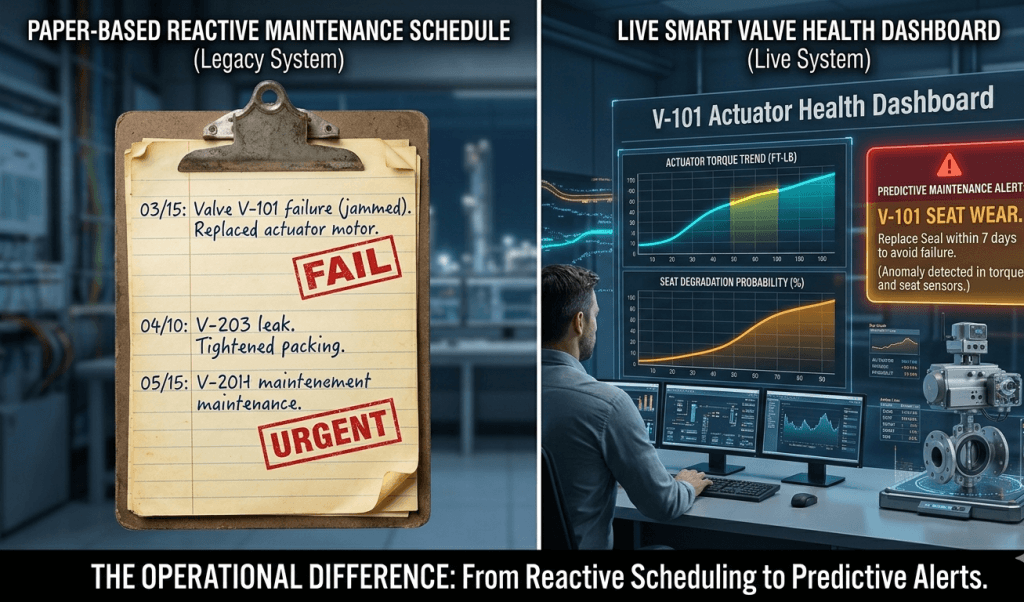
None of it appears during morning rounds. All of it appears in the continuous data stream from a smart industrial valve doing its job. The maintenance team gets the alert while the problem is still manageable. Books a repair slot during a planned window. Valve gets sorted. Nobody has to explain an emergency shutdown to anyone.
Compared to a seventy-two-hour unplanned outage that blows the quarterly maintenance budget and triggers uncomfortable conversations at every level of the organisation, a planned repair feels almost boring. Boring is good.
XSIS Valves’ actuation and control solutions are built around this kind of predictive maintenance capability. Talk through what it looks like for your specific plant via the XSIS Valves contact page.
Connecting Smart Valve IoT Automation to SCADA, DCS, and PLC Systems
Smart industrial valves don’t operate independently. They plug into the control architecture the plant already has running.
Most process plants use some combination of three systems:
SCADA pulls field data from across the plant into a centralised monitoring interface. Smart industrial valves feed directly into that picture. Every valve becomes a visible real-time point on the screen operators already watch every day, not a separate system they have to go looking for.
DCS platforms run closed-loop process control through distributed controllers. Smart valves in a DCS environment take automated setpoint commands, continuously report status back, hold positions without someone manually stepping in. Intervention only happens when something flags as unusual.
PLCs handle machine-level automation and sequencing. Smart valves tied to PLCs respond to real-time system conditions, timers, signals from other instruments, without a person involved in each individual step.
Communication runs through protocols the industry has used for years and already trusts:
- HART covers most smart positioners and transmitters in process environments
- Modbus and PROFIBUS handle most manufacturing and process automation setups
- Wireless options are increasingly practical in remote areas where cable runs simply cost more than they’re worth
More detail on how XSIS Valves supports plant-level integration is on their industrial solutions page.
Industries Where Smart Industrial Valve Automation Is Already Working
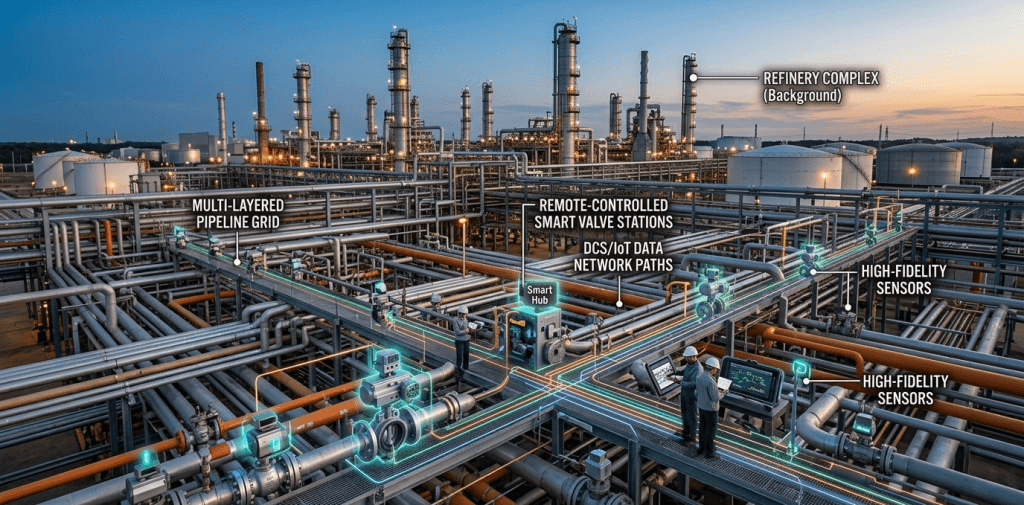
Oil and Gas
- Valve failure consequences in oil and gas are immediate and severe, which explains why this sector led adoption from the start
- Smart industrial valves cover wellhead isolation, refinery process control, pipeline distribution
- Offshore and remote upstream locations benefit most from remote operability because getting someone physically to a valve involves cost and personal risk that’s genuinely hard to keep justifying
Water and Wastewater
- Utilities use smart valves for distribution pressure management, chemical dosing automation, early leak detection, pump station optimisation
- Plants that previously needed constant manual monitoring now run from central control rooms with smaller teams and better data than they ever had before
Chemical and Pharmaceutical
- Flow rates and mixing ratios that drift even slightly affect product quality or batch compliance in these sectors
- Smart control valves hold positions precisely and generate the documentation trail that auditors and regulators want to see during inspections
- Manual valve control cannot match that consistency reliably over time, regardless of how experienced the operators are
Power Generation
- Steam, cooling water, feedwater, fuel gas systems all run through valves
- One valve failing in the wrong control loop at the wrong moment can force a full plant shutdown
- Predictive data from smart industrial valves helps power plant operators protect the uptime numbers that grid reliability depends on
LNG and Cryogenic
- Manual operation in cryogenic environments is both hazardous and operationally impractical in most terminal configurations
- Smart automated valves let terminal operators control everything from one room
- Emergency shutoff responses are faster than any manual process could manage when conditions change suddenly
Things Worth Getting Right Before You Start
- Protocol compatibility before anything else: Know what your existing SCADA, DCS, or PLC supports before buying anything. Smart valve components that don’t speak the same protocol language as your control system create retrofit problems that cost more to fix than getting it right upfront would have.
- Actuator selection deserves more thought than it usually gets: Pneumatic where compressed air is available and fast cycling is needed. Electric where it isn’t or where precise positioning is the priority. Hydraulic for large valves with serious torque requirements. Don’t pick one type and apply it across the whole plant without thinking through each application individually.
- Don’t instrument every valve identically: Some locations need full sensor packages. Others really don’t. Deciding what data you actually need from each location before specifying saves budget and avoids data overload in the control system.
- Wired versus wireless isn’t obvious everywhere: Wired is more reliable. Wireless costs less to install in remote spots and is increasingly reliable in industrial environments. Neither is automatically the right answer for every location in the plant.
- Start where failure hurts most: Pick your most critical or highest-risk valve stations first. Prove the payback. Then expand the programme. Trying to automate everything simultaneously usually ends in a messy implementation and a frustrated team.
Conclusion
Smart industrial valves aren’t a pilot program still finding its feet. They’re running in refineries, chemical plants, water treatment facilities, and power stations right now and the plants using them are dealing with fewer unplanned shutdowns, lower maintenance bills, and a much better picture of what’s actually happening inside their processes day to day.
What you get when smart industrial valves are implemented properly:
- Real-time visibility across every valve in the system without waiting for manual rounds
- Remote operation keeping workers away from hazardous zones during normal operations
- Consistent automated flow control not varying by who’s on shift
- Predictive maintenance alerts arriving weeks before failures develop into shutdowns
- Clean integration with SCADA, DCS, and PLC platforms already running in your plant
Fewer surprises. Better uptime. Safer plant. None of that is complicated to understand, it’s just hard to get without the right equipment in place.
XSIS Valves Pvt. Ltd. has been building ISO 9001:2015 certified valve and automation solutions since 2008. If smart industrial valves are something your plant needs to think seriously about, their engineering team is worth a conversation.
Frequently Asked Questions
What is a smart industrial valve in plain terms?
It’s a normal valve body with an automated actuator, sensors, and a data communication module added. Instead of just opening and closing on command, it watches itself constantly and sends live readings to your control system. Operators see what it’s doing and adjust it remotely without going anywhere near it physically.
Which industries benefit most from smart valve technology?
Oil and gas, water treatment, chemical and pharma manufacturing, power generation, LNG. Anywhere flow precision and uptime are genuinely non-negotiable rather than just preferred. Mid-sized process plants see solid returns too, especially once you add up what avoided shutdowns are actually worth.
How does it reduce downtime in practice?
Torque, cycle time, vibration, position, the valve tracks all of it without stopping. When something starts drifting from where it normally sits, your maintenance team gets flagged well before anything actually fails. You schedule the fix during a planned window instead of scrambling through an emergency shutdown at midnight on a public holiday.
Will it work with the control system my plant already runs?
Almost certainly yes. HART, Modbus, PROFIBUS cover most modern SCADA, DCS, and PLC platforms in current use. You’re typically adding smart valves to an existing infrastructure rather than replacing it. Most plants don’t need a control system overhaul to start.
How do I choose the right actuator type?
Pneumatic where compressed air is available and fast cycling matters. Electric where it isn’t or precise positioning is the main requirement. Hydraulic for large valves needing high torque. If it genuinely isn’t clear from the application requirements, get a valve engineer involved before committing to a spec.
Is this financially worth it for a mid-sized plant?
Usually yes, and quicker than most people initially expect. Avoiding a single unplanned shutdown often recovers the full cost of the upgrade by itself. Add energy savings and lower ongoing maintenance spend and the numbers tend to land clearly on the side of doing it sooner rather than later.