
I’ll be honest with you. I’ve sat in procurement reviews where someone pointed at a Class 150 rating and said “that’s roughly PN16, close enough” and everyone nodded and moved on. I’ve also seen what happens three months later when the flanges don’t line up in the field and you’re looking at a four day shutdown extension, an emergency re-order, and a project manager who isn’t particularly happy with anyone in that original meeting.Close enough is not a specification strategy. Not with valves. Not in pressurized systems.
The annoying thing is that valve pressure rating genuinely isn’t complicated once someone sits down and explains it without assuming you already have ten years of piping experience. Most explanations I’ve come across do exactly that, assume too much, skip the basics, and leave you more confused than before. So let me try a different approach.
What Valve Pressure Rating Is Actually Saying?
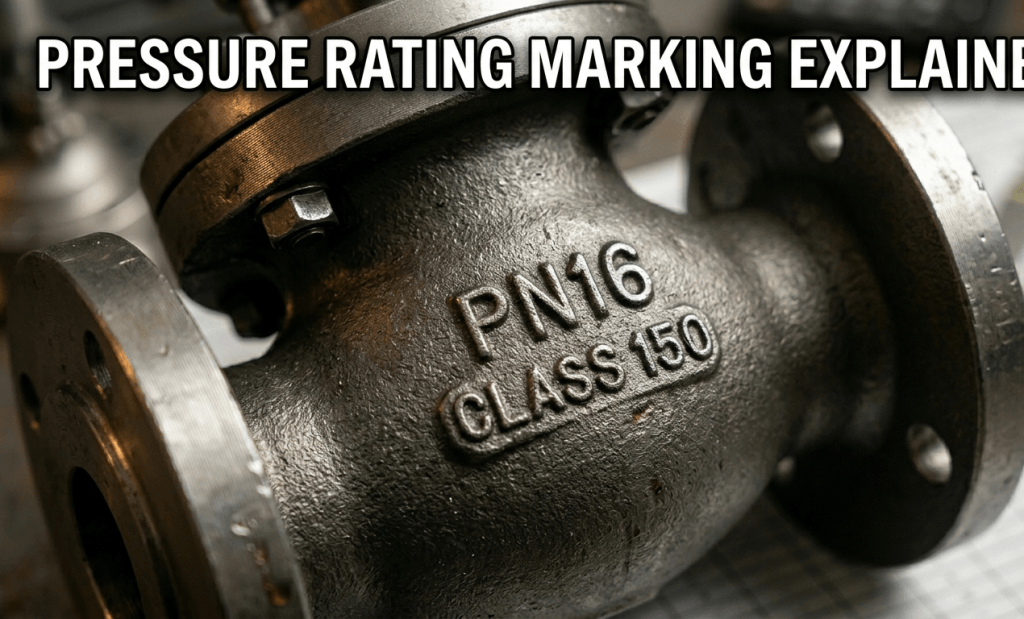
It’s answering one question: how much pressure can this valve safely hold at a given temperature?
That last bit, at a given temperature, is the part that disappears from most procurement conversations. And it’s also the part that causes the most real-world failures.
Here’s what’s actually happening physically. Metals get weaker as they heat up. Not dramatically at first, but measurably, and in pressurized systems even a small reduction in material strength matters. Take a valve rated at 20 bar at 20 degrees Celsius. Run your process up to 250 degrees and that same valve might only safely handle 12 bars now. Nothing changed about the valve. The material just behaves differently at heat and that difference is significant enough to matter.
This is why P-T charts exist. Pressure-temperature charts. Every responsible manufacturer produces them and they show you exactly how a valve’s safe pressure limit changes as temperature rises. The rating stamped on the valve body is the nominal figure at baseline conditions. The P-T chart is the actual working document. Treating these two things as the same is one of the more common and more costly mistakes in valve specification.
Three things determine what a valve can genuinely handle:
- What the body is made of. Carbon steel, stainless, cast iron, ductile iron. Each material has a different strength curve across the temperature range.
- Which standard it was built to. EN/DIN or ASME/ANSI. This matters more than people think.
- The real temperature in your system includes the worst upset scenario you can imagine, not just the average steady-state figure that looks comfortable on the process flow diagram.
Get any one of these wrong and the spec has a hole in it, even if everything else looks fine on paper.
The PN Rating System
PN is short for Pression Nominale. French. Means Nominal Pressure. You’ll find it on valves built to EN, DIN, ISO, and BS standards, which covers most of Europe and a significant portion of international projects.
The number is the easy part. PN16 means the valve holds 16 bars at roughly 20 degrees Celsius. PN40 means 40 bars at that same starting point. Once your process temperature crosses that 20 degree reference, the allowable pressure starts coming down. The P-T table from the manufacturer shows you exactly how much, which is why reading it before ordering matters considerably more than most people give it credit for.
In terms of where these ratings actually show up day to day:
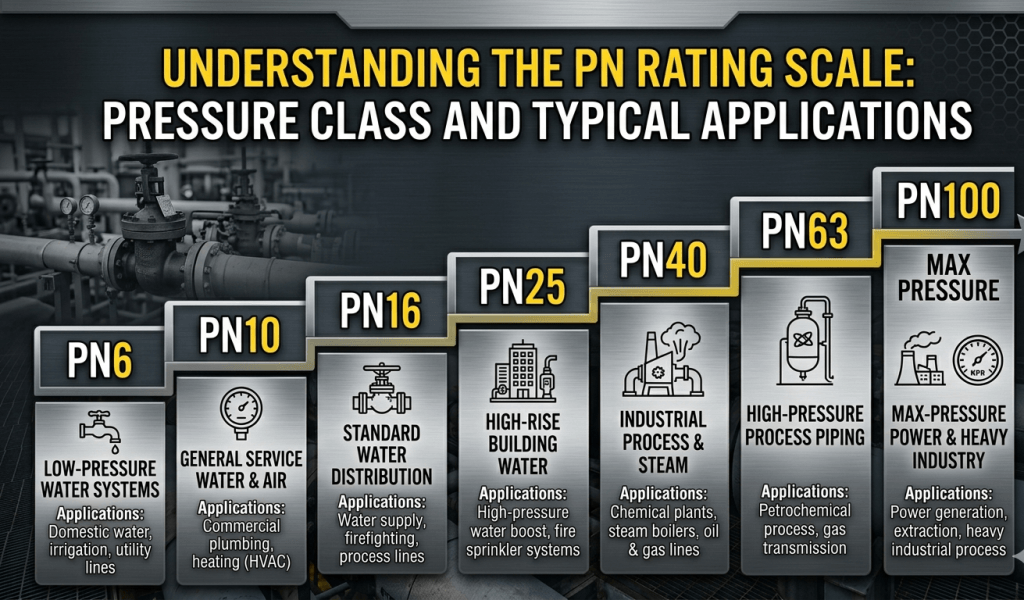
PN6 is your low-pressure drainage work, large bore plumbing. PN10 is general water supply, cooling circuits, and irrigation. PN16 is everywhere, it’s the most common rating across industries and handles HVAC, water treatment, and standard process piping. PN25 comes in when PN16 isn’t quite enough for medium-pressure chemical lines. PN40 handles steam service and the higher-pressure oil and gas side. Above PN100 you’re in specialist high-pressure territory.
XSIS Valves manufactures across this full range. Standard water treatment through to demanding process industry requirements. You can browse product range and filter by the PN rating your project needs rather than guessing from a catalogue.
For moderate pressure and temperature work, PN is clean and practical. When your process temperatures start climbing significantly, the ANSI Class system becomes more useful because it was designed from the beginning with a full temperature range in mind rather than derating from a single reference point.
ANSI Class Ratings and the Number That Isn’t a Pressure
Look, this one catches people constantly. Including experienced people who’ve been doing this for years and wouldn’t necessarily admit it.
The Class number is not a pressure in psi. I want to be clear about this because the confusion around it is widespread. Class 150 does not mean 150 psi. Class 300 does not mean 300 psi. These are reference designations, identifiers that point to a pressure-temperature table. The actual pressure the valve can handle depends on body material and operating temperature together. You find that number on the P-T chart for the relevant material group. Not by reading the Class designation literally.
To put real figures to it: a Class 150 carbon steel valve in WCB material handles around 285 to 290 psi at roughly 38 degrees Celsius. That number falls as temperature rises. A Class 300 valve in the same material manages around 740 psi at ambient, again dropping with heat. Class 600 is roughly double the Class 300 capacity under the same material and temperature conditions.
Class 150 in general process piping, water systems, lower-pressure oil and gas. Class 300 in medium-pressure oil and gas, steam service, chemical plant. Class 600 in high-pressure refinery and petrochemical work. Class 900 and above in power generation, high-pressure gas transmission, and specialist applications.
Worth knowing directly from ASME B16.34: two valves with identical Class designations but different body materials won’t necessarily hold the same pressure at the same temperature. Class and material are a pair. You need both.
XSIS Valves supplies from Class 150 through Class 600 and higher, built to ASME B16.34 and tested to API 598. If your project needs full documentation, material test certificates, hydrostatic test reports, the XSIS Valves engineering team can work through exactly what your project needs.
PN vs ANSI Class: What Actually Differs?
Here’s a rough pressure comparison at near-ambient temperatures, because people always want this table even though it comes with caveats.
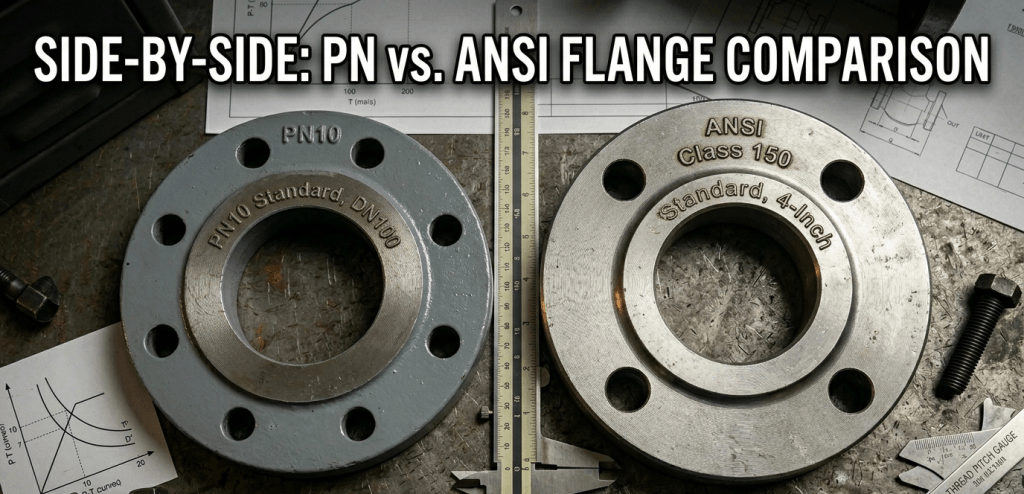
PN10 broadly lines up with Class 150 at lower temperatures. PN16 sits in general Class 150 territory. PN25 lands somewhere between Class 150 and Class 300. PN40 is roughly comparable to Class 300. PN100 broadly corresponds to Class 600.
Those are approximations. Not engineering equivalents. Not interchangeable at the same pipe joint. I need to say that clearly because the table above has caused its share of misspecifications.
What actually differs between the two systems on a real project:
Where they come from matters. PN is a European EN/DIN/ISO system. ANSI Class is American ASME. International projects should specify one governing standard from the start. Mixing them halfway through creates documentation problems and physical connection problems that cost money to resolve.
How pressure is communicated differs too. PN gives one bar figure at 20 degrees. ANSI Class ties a reference number to a full pressure-temperature table. Neither approach is more precise. They just speak different engineering languages.
And then there are flanges, which is where things get physically expensive if you get it wrong. PN and ANSI flanges aren’t interchangeable. Bolt hole count, bolt circle diameter, gasket face dimensions, all different. Connect a PN flange to an ANSI flange and you don’t have a sealed joint. You have a leak path sitting there waiting for the system to come up to operating pressure. The story I opened with came from exactly this situation.
Temperature: The Detail That Quietly Breaks Specifications
Every valve pressure rating is anchored to a reference temperature. Above that reference, safe pressure falls along a documented curve. Both PN and ANSI Class work this way.
Here’s the example I always come back to. A Class 300 carbon steel valve in WCB material holds around 740 psi at ambient temperature. At 400 degrees Celsius that same valve is rated for roughly 450 psi. Same valve. Same Class marking. Temperature alone has pulled the safe limit down by nearly 40 percent.
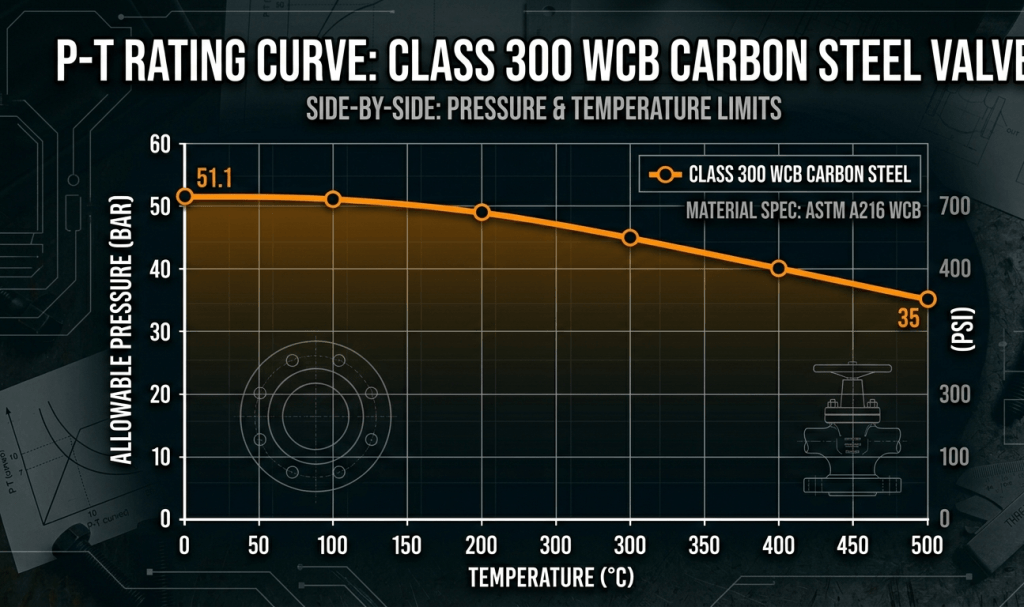
That’s not a niche scenario. It happens in steam systems and chemical processing plants on a fairly regular basis. And it specifically causes problems when the engineer specifying the valve read the Class number, felt satisfied, and never opened the P-T chart for the actual operating temperature range.
What I’d suggest doing instead:
Find the maximum temperature the system will ever reach including upsets and transient spikes, not just the comfortable design average. Find the maximum pressure including surge events. Cross-reference both on the P-T chart for the specific material and class. Confirm the rated pressure at that temperature has genuine headroom above the system maximum, not just barely above it. If it doesn’t clear comfortably, move up a Class or look at a different material with better high-temperature performance.
XSIS Valves includes complete P-T documentation with every order. Your team gets the actual data needed to verify safe operation across real conditions, not just the nominal baseline figures. You can explore the XSIS Valves industrial solutions range for valves built and documented across both PN and Class rating systems.
How to Actually Pick the Right Rating?
There’s a sequence to this. Follow it and most common mistakes disappear before they reach the purchase order.
Start with maximum operating pressure and use the worst-case figure, not the average. Startup surges, shutdown events, transient spikes all count. The comfortable steady-state number is not the right input for valve selection.
Maximum operating temperature comes second, and again worst case. If the system can reach 320 degrees during an upset, 320 degrees is the design temperature regardless of what the normal running condition looks like.
Establish which standard governs the project before anything else. ASME or EN/DIN. That decision drives whether you specify Class or PN on every valve datasheet from the first line.
Select body material before committing to Class or PN. Material choice changes how the pressure-temperature curve behaves and drives everything downstream.
Open the P-T chart and use it properly. Match worst-case pressure and temperature to the correct material and class. This is not a step you estimate or skip.
Build in real safety margin. A valve specified exactly at system maximum has nowhere to go when conditions spike. Leave headroom that actually means something.
Check full flange compatibility end to end. Rating, face type, bolt pattern, governing standard. All of it needs to match the mating connections on both sides of the valve.
Conclusion
Valve pressure rating is the specification detail that sits between a pipeline running reliably for twenty years and one that becomes a recurring problem or something more serious. PN works well for European-standard applications at moderate pressures. ANSI Class gives you a more temperature-aware framework for ASME-governed projects with a wide operating range.
Which one belongs on your spec depends on your project standard, your pipeline, and your real operating conditions. Not what was ordered last time. Get those three things aligned and the valve pressure rating decision stops being a source of field problems.
XSIS Valves Pvt. Ltd. manufactures a complete range of PN and Class-rated industrial valves to ISO 9001:2015 standards, with full technical documentation and engineering support behind every order. When the next project needs valves specified correctly from day one, the XSIS team is worth talking to.
Frequently Asked Questions
What does PN16 mean on a valve?
PN16 means the valve is rated to hold up to 16 bar at a reference temperature of approximately 20 degrees Celsius. Once process temperature goes above that baseline the allowable pressure starts dropping, sometimes by a significant amount depending on the material. Always check the manufacturer’s P-T chart against your actual operating temperature before treating the PN number as the final specification figure.
Is ANSI Class 150 the same as PN16?
They sit in similar pressure territory but they’re not engineering equivalents. A Class 150 carbon steel valve in WCB material typically handles around 19 to 20 bar at ambient conditions, which is slightly above PN16. More importantly PN and ANSI flanges have different bolt patterns and gasket face dimensions, so connecting them directly at the same pipe joint creates a leak path rather than a sealed connection.
Why does valve pressure rating drop at higher temperatures?
Heat reduces the mechanical strength of the valve body material in a predictable, measurable way. A carbon steel body that safely contains a given pressure at room temperature can’t do the same at 350 or 400 degrees because its tensile properties have weakened. P-T charts document the degradation curve for every material and Class combination, which is why they belong in the specification process rather than the filing cabinet.
What’s the actual difference between PN and ANSI Class systems?
PN ratings come from European EN/DIN/ISO standards and express nominal pressure as a bar value at 20 degrees Celsius. ANSI Class ratings follow ASME standards and use a reference class identifier linked to a full pressure-temperature table across the operating range rather than a single temperature point. They come from different engineering traditions and shouldn’t be mixed within the same pipeline system at any bolted connection point.
Can a PN flange be bolted directly to an ANSI flange?
No, and it’s worth being firm about this. Bolt hole count, bolt circle diameter, and gasket contact face dimensions all differ between the two systems. Forcing a connection creates alignment gaps and a direct path for leakage once the system reaches operating pressure. Flange standard needs to stay consistent throughout each pipeline section without exception.
Which ANSI Class suits oil and gas service?
Class 150 handles lower-pressure oil and gas applications. Class 300 and Class 600 cover medium to high-pressure refinery and upstream work. High-pressure gas transmission pipelines may need Class 900, 1500, or 2500 depending on conditions. Whatever Class you’re considering, verify it against the P-T chart for your specific body material and worst-case operating temperature before it goes on the purchase order.