
Industrial valves play an essential role in manufacturing facilities, processing plants and infrastructure projects by regulating the flow of liquids, gases and steam. Choosing from the Top Industrial Valve Suppliers in Ahmedabad helps businesses find reliable flow-control solutions for their operations. Ahmedabad is an important industrial hub in Gujarat, with manufacturing areas such as Vatva, Narol, Odhav, Rakhial and Kathwada creating demand for quality industrial valves. Local manufacturers offer different products, including ball valves, gate valves, butterfly valves, globe valves and check valves.
However, selecting the right supplier requires evaluating product quality, manufacturing capabilities, material specifications, pressure ratings and testing facilities. Industry experience and after-sales support are equally important for long-term performance. This guide explores leading industrial valve suppliers in Ahmedabad, their product specialisations and the key factors businesses should consider when choosing a dependable manufacturer for their industrial requirements.
Why Is Ahmedabad an Important Hub for Industrial Valve Manufacturers?
Ahmedabad has developed into a major industrial and manufacturing centre in Gujarat, supporting sectors such as chemicals, pharmaceuticals, engineering, textiles and infrastructure. Industrial areas such as Vatva, Narol, Odhav, Rakhial and Kathwada create demand for reliable pipeline equipment and flow-control solutions. This growing industrial activity provides opportunities for industrial valve manufacturers to serve different business requirements. As a result, buyers can explore various valve products and manufacturing capabilities within the region.
Another advantage is the availability of specialised manufacturers offering ball valves, gate valves, butterfly valves, globe valves and automated industrial valves. Some suppliers also provide stainless steel products and PTFE-lined valves for specialised applications. Ahmedabad’s industrial ecosystem supports connections between manufacturers, engineering companies and equipment distributors. This makes it easier for businesses to compare suppliers, discuss technical specifications and identify suitable industrial valve solutions.
Top Industrial Valve Suppliers in Ahmedabad
Businesses searching for the Top Industrial Valve Suppliers in Ahmedabad can explore manufacturers offering different valve technologies and industrial applications. The following companies have an established or publicly listed presence in Ahmedabad and nearby industrial areas. They are presented as a research shortlist rather than a certified ranking because product suitability depends on individual project requirements.
1. XSIS Valves
XSIS Valves Pvt. Ltd. is an industrial valve manufacturer and exporter based in Narolgam, Ahmedabad. Established in 2008, the company provides flow-control solutions for different industrial applications. Its product portfolio includes ball valves, gate valves, globe valves, butterfly valves, check valves, non-return valves, dual-plate check valves, strainers and automatic valves. This range makes the company relevant to businesses looking for multiple valve categories from one manufacturing source.
2. Aira Euro Automation Pvt. Ltd.
Aira Euro Automation Pvt. Ltd. is an Ahmedabad-based manufacturer associated with automated valve systems and industrial actuators. The company operates in the Vatva industrial area and offers solutions designed for applications where remote or automatic flow regulation is required. Its product range includes actuated ball valves, actuated butterfly valves, pneumatic rotary actuators, control valves and solenoid valves.
3. Cair Euromatic Automation Pvt. Ltd.
Cair Euromatic Automation Pvt. Ltd. is another company identified in Ahmedabad’s industrial valve manufacturing ecosystem. Its specialisation includes electric and pneumatic actuators and automated process valves. These products are relevant to facilities that need controlled valve operation as part of their manufacturing or pipeline management systems.
4. Oswal Industries Ltd.
Oswal Industries Ltd is listed among Ahmedabad’s industrial valve manufacturers and exporters. Its product portfolio includes cast and forged steel valves used in demanding industrial applications. The company is associated with gate valves, globe valves, check valves, ball valves, butterfly valves and plug valves. Its products are relevant to industries requiring different configurations of steel flow-control equipment.
5. Flowinox Valves LLP
Flowinox Valves LLP is identified as an industrial valve manufacturer operating in Vatva GIDC Phase 4, Ahmedabad. Its listed product range includes gate valves, globe valves, check valves, ball valves, forged steel valves and butterfly valves. This variety makes it relevant to buyers looking for conventional flow-isolation and pipeline control products.
6. Flowchek Valves
Flowchek Valves, a brand of Paras Enterprise, is an Ahmedabad-based manufacturer of industrial valves and related pipeline components. The company states that it has been manufacturing valves since 1994. Its product range includes stainless steel and carbon steel ball valves, strainers, sight glasses, non-return valves, needle valves and other flow-related products.
What Types of Industrial Valves Are Available from Ahmedabad Suppliers?
Industrial valve manufacturers in Ahmedabad offer different valve designs to meet the flow-control requirements of manufacturing plants, processing facilities and infrastructure projects. Each valve type performs a particular function, such as isolating a pipeline, regulating flow or preventing reverse movement. Understanding these differences helps procurement teams identify the right products for their applications.
Common industrial valve categories
1. Ball Valves: Ball valves use a rotating spherical disc to control fluid movement. They provide quick shut-off and are widely used in water, gas, chemical and general industrial pipelines.
2. Gate Valves: Gate valves are primarily designed for complete flow isolation. Their design allows relatively unrestricted flow when fully open, making them suitable for pipelines requiring on-off operation.
3. Butterfly Valves: Butterfly valves use a rotating disc to regulate or isolate flow. Their compact construction makes them suitable for large-diameter pipelines, water distribution and industrial utility systems.
4. Globe Valves: Globe valves are designed for flow regulation and throttling. They are commonly considered in applications where operators need to adjust the flow rate rather than simply open or close a pipeline.
5. Check Valves: Check valves automatically prevent reverse fluid movement. They are used in pump discharge lines, water distribution systems and industrial pipelines where backflow protection is necessary.
6. Diaphragm and Plug Valves: Diaphragm valves use a flexible membrane to control flow, while plug valves use a rotating plug. Both designs can be considered for specialised industrial processes depending on the medium and operating conditions.
Which Industries Depend on Industrial Valve Suppliers in Ahmedabad?
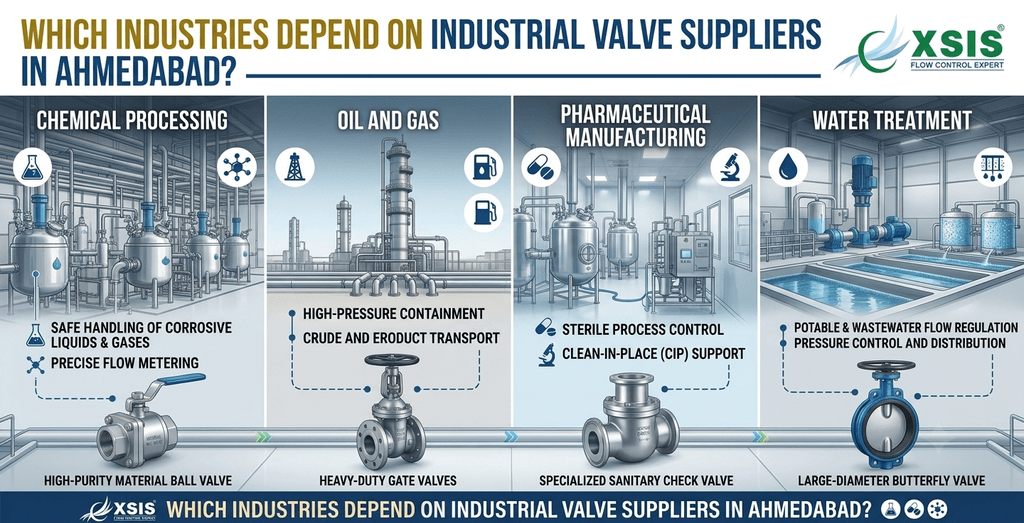
Industrial valves are essential for controlling the flow of liquids, gases, steam and other process materials across different industries. Manufacturing facilities depend on reliable valves to maintain safe operations, regulate pressure and manage pipeline systems. Ahmedabad’s industrial sectors require different valve types based on their production processes and operating conditions.
Industrial valve manufacturers in Ahmedabad supply products designed for various applications, including flow isolation, pressure regulation and backflow prevention. Industries select valves according to their material requirements, operating temperatures and pressure ratings. Choosing suitable industrial valves helps businesses maintain operational efficiency, reduce leakage risks and minimise unexpected downtime.
Major Industries That Use Industrial Valves
- Chemical and Petrochemical Industries: These industries use ball, diaphragm and PTFE-lined valves to handle different chemicals. Corrosion resistance and material compatibility are important selection factors.
- Oil and Gas Industries: Oil and gas facilities use gate, ball, globe and check valves for pipeline operations. Valves must meet the required pressure, temperature and safety specifications.
- Pharmaceutical Industries: Pharmaceutical plants require suitable valves for process fluids, water systems and utility applications. Material quality, cleanliness and reliable flow control are essential.
- Water and Wastewater Treatment: Treatment facilities use butterfly, gate and check valves for water distribution and wastewater management. These valves help regulate flow and prevent unwanted backflow.
- Power Generation Industries: Power plants use industrial valves in steam, cooling water and auxiliary systems. Suitable pressure and temperature ratings are essential for reliable performance.
- Food and Beverage Industries: Food processing facilities use valves to control liquids and other processing materials. Hygienic construction and compatible materials are important for maintaining product quality.
How Do You Choose the Right Industrial Valve Manufacturer in Ahmedabad?
Selecting a suitable manufacturer is essential for maintaining the performance and reliability of industrial pipelines. Different manufacturers offer different product ranges, material options, engineering capabilities and quality-control procedures. Businesses should compare suppliers based on their actual manufacturing capabilities rather than choosing exclusively on price or promotional claims.
A reliable industrial valve supplier should understand the application’s technical requirements and provide appropriate product recommendations. Buyers should also consider whether the manufacturer can handle customised orders, provide technical documentation and support future maintenance requirements. The following factors can help businesses evaluate potential suppliers.
Important factors to evaluate
- Manufacturing Experience: Check how long the manufacturer has operated in the industrial valve sector. Experience across relevant applications can help buyers assess its understanding of different industrial requirements.
- Product Range: Choose a supplier offering the valve categories required for your project. A broader catalogue may simplify procurement when multiple valve types are needed.
- Material Quality: Check whether the manufacturer offers suitable cast iron, ductile iron, carbon steel, stainless steel or other materials. The material must be compatible with the process fluid and operating conditions.
- Quality Certifications: Review relevant quality management certifications and manufacturing approvals. Confirm their validity, scope and applicability to the particular products being purchased.
- Testing Facilities: Ask about hydrostatic testing, pneumatic testing, seat leakage testing and other applicable inspection procedures. Testing requirements should match the valve design and relevant standards.
- Customisation Capabilities: Some industrial installations require non-standard dimensions, special materials or particular end connections. A manufacturer with suitable engineering capabilities may help address these requirements.
- Delivery and After-Sales Support: Confirm production schedules, dispatch timelines, warranty conditions and technical assistance. Reliable communication can help reduce procurement delays and maintenance difficulties.
What Quality Standards Should Industrial Valve Suppliers Follow?
Quality standards play an important role in industrial valve manufacturing because they establish requirements for design, construction, dimensions, pressure ratings and testing. A valve that does not meet the required specifications can create operational problems, leakage risks and unnecessary maintenance expenses. Businesses should therefore understand the relevant standards before selecting an industrial valve manufacturer.
Different valve categories may require different international or industry-specific standards. For example, API standards are commonly relevant to certain oil and gas valve applications, while ASME and ANSI specifications are frequently used for pressure equipment and pipeline components. ISO quality management certification can indicate that a manufacturer follows an established quality management system, but it does not automatically certify every individual product.
Common standards and inspection requirements
1. API Standards: API specifications are used for various valve applications in the petroleum and natural gas industries. Buyers should identify the particular API standard applicable to their valve type and service conditions.
2. ASME Standards: ASME standards address engineering requirements for pressure-related equipment and components. Relevant specifications may apply to valve design, dimensions, pressure-temperature ratings and connections.
3. ANSI Specifications: ANSI-related dimensional and pressure-class specifications are commonly referenced in industrial valve procurement. Buyers should confirm the exact standard required by their project.
4. ISO 9001 Certification: ISO 9001 provides a framework for quality management systems. Buyers should verify the manufacturer’s current certificate, scope and issuing certification body.
5. Material Test Certificates: Material test certificates provide information about the material composition and mechanical properties of supplied components. They help procurement teams verify whether materials match the purchase specification.
6. Pressure and Leakage Testing: Industrial valves may require hydrostatic shell testing, seat leakage testing or other specified examinations. The testing procedure should be appropriate for the valve design and applicable standards.
Why Are Material Selection and Valve Design Important?
Material selection directly affects an industrial valve’s service life, reliability and compatibility with the process medium. Different industrial applications expose valves to different temperatures, pressures, chemicals and environmental conditions. A material that performs well in a water pipeline may not be suitable for an aggressive chemical processing application.
Manufacturers generally offer several construction materials depending on their product range and engineering capabilities. Carbon steel may be considered for many general industrial applications, while stainless steel is often selected where corrosion resistance is important. Cast iron and ductile iron are also used in suitable water and utility applications. However, the final choice must account for the actual process conditions rather than relying on material names alone.
Common valve materials
- Carbon Steel: Carbon steel valves are commonly used in industrial pipelines and process systems. Their suitability depends on the required pressure, temperature and fluid characteristics.
- Stainless Steel: Stainless steel is often selected for applications requiring improved corrosion resistance. Different grades, including SS304 and SS316, have different chemical and mechanical properties.
- Cast Iron: Cast iron valves are commonly considered for suitable water distribution and general utility applications. Buyers should verify their pressure and temperature limitations.
- Ductile Iron: Ductile iron offers different mechanical properties from conventional cast iron. It is used in various water supply and infrastructure applications.
- Alloy Steel: Alloy steel valves may be required for specialised temperature, pressure or process conditions. The appropriate grade depends on the engineering specification.
- PTFE-Lined Construction: PTFE-lined valves can be useful in selected chemical applications where resistance to particular corrosive media is required. Chemical compatibility and operating temperature must be verified.
Why valve design matters
Valve design determines how a product controls flow, handles pressure and performs during operation. Ball valves provide quarter-turn shut-off, while gate valves are generally used for isolation. Globe valves support throttling, whereas check valves help prevent reverse flow. Butterfly valves offer compact construction and are frequently considered for larger pipelines.
Industrial buyers should also examine the valve’s internal components, sealing arrangement, stem design and end connections. These features influence installation compatibility, operating performance and maintenance requirements. A suitable design should match the pipeline layout and the actual operating conditions of the plant.
How Can Industrial Valve Suppliers Help Reduce Maintenance and Downtime?
Industrial downtime can affect production schedules, operational costs and customer commitments. Valve-related problems such as leakage, corrosion, damaged seats, stem failure and improper operation can interrupt pipeline performance. Choosing suitable products from experienced industrial valve suppliers can help businesses reduce avoidable maintenance issues.
However, product quality alone cannot guarantee long-term reliability. Correct installation, appropriate operation and regular inspection are equally important. Maintenance teams should follow the manufacturer’s recommendations and establish inspection schedules based on the operating environment, valve type and process requirements.
Effective maintenance practices
1. Conduct Regular Inspections: Examine valve bodies, stems, seals and connections for visible damage or leakage. Early identification of problems can help prevent unexpected equipment failure.
2. Check for Internal Leakage: Seat damage, debris accumulation and wear can affect shut-off performance. Appropriate inspection and testing can help identify internal leakage.
3. Monitor Corrosion: Check external and internal surfaces for corrosion, particularly in chemical and water treatment applications. Replace unsuitable or damaged components when necessary.
4. Maintain Actuators: Automated valves require suitable actuator inspection and maintenance. Check connections, operating signals and movement to identify potential faults.
5. Follow Correct Installation Procedures: Improper installation can create stress, alignment problems and leakage. Follow the manufacturer’s instructions and pipeline design requirements.
6. Maintain Spare Parts: Keep suitable seals, gaskets and other critical replacement components available. Confirm compatibility with the original valve model before using replacement parts.
What Are the Benefits of Buying Industrial Valves from Ahmedabad Manufacturers?
Purchasing industrial valves from manufacturers located in Ahmedabad can offer several practical advantages to businesses operating in Gujarat and nearby regions. Local procurement may simplify supplier communication, technical discussions, product inspections and logistics coordination. Buyers can also explore different manufacturers based on their specific valve requirements and project schedules.
One important advantage is access to a regional engineering and manufacturing network. Ahmedabad has companies specialising in conventional valves, automated systems, stainless steel products and specialised lined equipment. This gives businesses an opportunity to compare different technical capabilities and identify suppliers suited to their applications.
Major procurement advantages
- Regional Supplier Access: Buyers can communicate with manufacturers and suppliers within Ahmedabad’s industrial areas. This may simplify meetings, inspections and technical discussions.
- Product Variety: Local manufacturers offer different valve categories and construction options. Buyers can compare products according to their project specifications.
- Technical Communication: Direct interaction with suppliers can make it easier to discuss pressure ratings, materials, connections and operating requirements.
- Customised Solutions: Manufacturers with appropriate engineering facilities may support special dimensions, materials and automation requirements.
- Logistics Coordination: Regional procurement may simplify transportation planning and order coordination for businesses operating in Gujarat.
- Long-Term Relationships: Working with a suitable supplier can support repeat procurement, maintenance planning and future industrial expansion.
How Can Businesses Compare Industrial Valve Suppliers Before Placing an Order?
Comparing suppliers systematically helps procurement teams avoid selecting products that do not meet their technical or operational requirements. Before requesting quotations, businesses should prepare a detailed specification covering the valve type, nominal size, pressure class, material, end connection and operating conditions. Providing complete information helps manufacturers recommend suitable products and prepare more accurate quotations.
Businesses should also compare the supporting documents offered by each supplier. Product datasheets, material certificates, inspection reports and test certificates can help verify whether the proposed equipment meets the purchase specification. For critical installations, buyers may also require third-party inspection or project-specific quality documentation.
A lower quotation should not automatically be considered the best purchasing option. Buyers should compare the complete technical and commercial offer, including product specifications, documentation, expected service life and maintenance requirements. This approach helps businesses identify industrial valve suppliers in Ahmedabad that can support both immediate procurement and long-term operational needs.
Supplier Comparison Before Placing an Order
A structured comparison can help businesses identify the most suitable industrial valve manufacturer for their operational requirements. Instead of relying on a single quotation, procurement teams should request offers from multiple suppliers and evaluate their technical specifications side by side. This makes it easier to identify differences in materials, pressure ratings, product configurations and quality documentation.
For example, a chemical processing facility may prioritise PTFE-lined valves and corrosion-resistant construction, while a water treatment plant may require butterfly valves, gate valves and check valves. Similarly, an automated manufacturing facility may need pneumatic or electrically operated valve assemblies. Understanding these differences helps buyers shortlist manufacturers based on application suitability rather than simply choosing the lowest-priced option.
Documents to Request from Manufacturers
- Product Datasheet: Check the valve dimensions, construction materials and pressure ratings. Review the technical specifications to ensure the product meets your application requirements.
- Material Test Certificate: Verify the material grade and relevant mechanical properties. Ensure the supplied materials match the specifications mentioned in your purchase order.
- Pressure Test Report: Review the pressure testing details and acceptance criteria. Confirm that the valve meets the required pressure and leakage performance standards.
- Quality Certificate: Check the manufacturer’s applicable quality management certifications. Verify their validity and scope before finalising your supplier.
- Inspection Documents: Request inspection records and third-party reports wherever required. These documents help verify product quality and compliance with project specifications.
- Warranty Information: Understand the warranty period, coverage and applicable conditions. Check exclusions and replacement procedures to avoid issues after purchasing.
Conclusion
Choosing from the Top Industrial Valve Suppliers in Ahmedabad requires a clear understanding of your industry’s operating conditions, technical specifications and long-term maintenance requirements. Ahmedabad offers access to several manufacturers specialising in conventional industrial valves, automated solutions, stainless steel products and specialised chemical-process equipment. Businesses should evaluate each supplier’s product range, manufacturing experience, quality procedures and ability to meet project-specific requirements.
XSIS Valves Pvt. Ltd. is one company worth considering because of its established presence in Ahmedabad, broad industrial valve portfolio and experience serving multiple sectors. Its offerings include ball valves, gate valves, globe valves, butterfly valves, check valves, strainers and automatic valves. Buyers looking for dependable industrial flow-control solutions can explore its product range and discuss their technical requirements directly with the company.
Explore Our Recent Blog
- Top Valve Manufacturers for Pharmaceutical Industries in Ahmedabad
- Top Valve Manufacturers for Oil and Gas Industries in Ahmedabad
- Top Valve Manufacturers for Power Plants in Ahmedabad
- Top Valve Manufacturers for Water Treatment Plants in Ahmedabad
- Top Valve Manufacturers for Petrochemical Industries in Ahmedabad
Frequently Asked Questions
1. Who Are the Top Industrial Valve Suppliers in Ahmedabad?
Ahmedabad has several industrial valve manufacturers and suppliers, including XSIS Valves, Aira Euro Automation, Cair Euromatic Automation, Oswal Industries and Flowinox Valves. Other companies, such as Flowchek Valves, Sun Valves Industries and Hi Tech Applicator, offer different valve products and specialisations. Buyers should compare their product ranges, technical capabilities and certifications before selecting a supplier.
2. Which Industrial Valves Are Commonly Manufactured in Ahmedabad?
Manufacturers in Ahmedabad offer different types of industrial valves for flow regulation and pipeline isolation. Common products include ball valves, gate valves, globe valves, butterfly valves, check valves and diaphragm valves. Some manufacturers also specialise in automated valves, strainers and PTFE-lined products.
3. How Do I Select a Reliable Industrial Valve Manufacturer?
Start by checking the manufacturer’s experience, product portfolio and manufacturing capabilities. Review the material specifications, applicable quality standards, pressure ratings and testing procedures before placing an order. You should also compare delivery schedules, documentation and after-sales support.
4. Which Valve Materials Are Suitable for Chemical Industries?
The appropriate valve material depends on the chemical composition, concentration, temperature and pressure of the process medium. Stainless steel, suitable alloys and PTFE-lined construction may be considered for different chemical applications. Always verify material compatibility with the manufacturer or a qualified process engineer before purchasing.
5. Are Industrial Valve Manufacturers in Ahmedabad Suitable for Bulk Orders?
Several manufacturers and industrial suppliers in Ahmedabad cater to business and project-based procurement requirements. However, bulk-order suitability depends on production capacity, product availability, material sourcing and delivery schedules. Buyers should confirm manufacturing lead times, minimum order quantities and inspection arrangements before finalising large orders.
6. Why Should Businesses Choose XSIS Valves for Industrial Valve Requirements?
XSIS Valves Pvt. Ltd. is an Ahmedabad-based manufacturer and exporter established in 2008. Its product portfolio includes ball, gate, globe, butterfly, check and automatic valves, among other products. The company serves several industrial sectors, including oil and gas, pharmaceuticals, chemicals, power generation and water treatment, making it a company worth considering for different flow-control requirements.