
Talk to anyone who’s worked maintenance on an LNG terminal for more than a year. Ask them which component causes the most grief. It’s not the compressors, not the heat exchangers, not the instrumentation. Nine times out of ten it’s a valve that failed, seized, or started leaking when it shouldn’t have and usually because whoever specified it didn’t fully account for what -160°C actually does to materials.
Cryogenic valves aren’t just regular valves with a cold-weather rating stamped on them. The entire engineering approach is different. Materials that perform perfectly at ambient temperature behave in completely unexpected ways once you drop below -110°C, and a lot of those unexpected behaviors lead to failures that are expensive at best and catastrophic at worst.
If you’re specifying valves for cryogenic service, or trying to understand why the ones you have keep causing problems, this is the guide worth reading first.
What Standard Valves Actually Do Wrong at Cryogenic Temperatures?

Here’s the thing that catches engineers out who haven’t worked in this service environment before. The failure isn’t obvious until it happens.
A standard ball valve on a liquid nitrogen line at -196°C doesn’t announce that it’s about to fail. The NBR seat has been contracting since commissioning. It’s been losing its elasticity slowly, pulling away from the ball surface in ways you can’t see from the outside. Then one day – usually when you least want it – the seal fails. The valve leaks. Or the packing has frozen so gradually that the actuator has been working harder and harder against it until eventually something gives.
Carbon steel goes brittle. That’s not a performance reduction, it’s a phase change in material behavior. A component that would bend and deform under stress at ambient temperature will crack suddenly at cryogenic temperatures without warning. Lubricants that keep moving parts running smoothly freeze solid. Standard elastomers, the ones in virtually every general-purpose valve sold, stop working altogether below temperatures that cryogenic service hits routinely.
These failure modes stack on each other. It’s not one problem, it’s several happening simultaneously.
Cryogenic valves address all of them through specific design features:
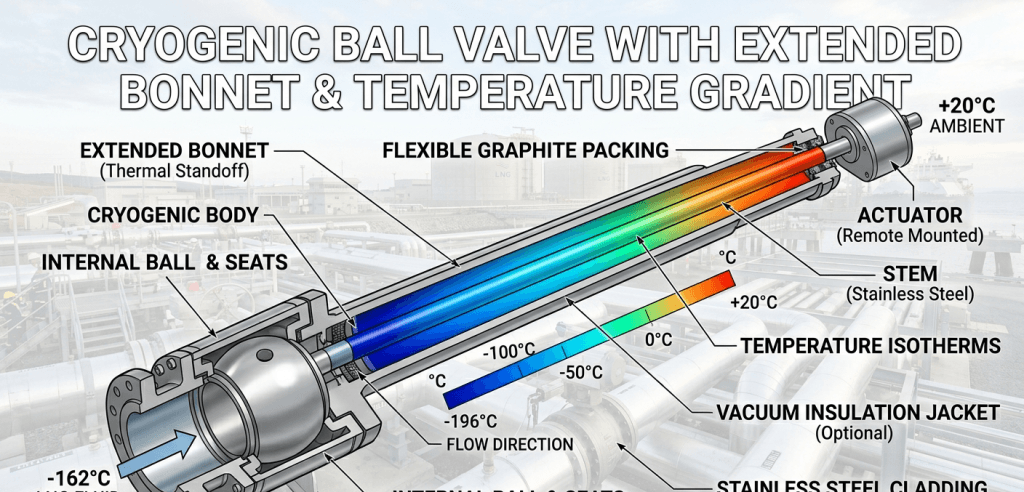
- Extended bonnets that move the stem packing far enough from the cold fluid zone that a temperature gradient develops along the stem – by the time you reach the packing, the temperature has climbed enough for sealing materials to function
- PTFE, modified PTFE, and PCTFE seats instead of elastomers, because these materials stay flexible and maintain dimensional stability through deep thermal cycling that would crack any standard seal
- Austenitic stainless steel bodies in SS304 or SS316 that keep ductility and toughness at low temperatures rather than transitioning to brittle behavior
- Pressure relief built into gate valve designs to handle the thermal expansion when liquid gets trapped inside a closed valve cavity, warms slightly, and builds dangerous pressure – this detail gets left out of a lot of general coverage but it causes real failures when not addressed
BS 6364, the British Standard for cryogenic service valves, requires physical testing at actual operational temperature before any valve clears for service. Not ambient testing extrapolated to cold. Actual cold testing. Because the failure modes only show themselves at temperature.
The Extended Bonnet: The Design Feature That Does the Most Work
Worth spending more time on this than most guides do, because it’s often misunderstood.
The bonnet on a standard valve sits close to the body. Makes sense – compact, simple, no reason to make it longer than it needs to be under normal conditions. But in cryogenic service, that proximity becomes the problem. The cold from the process fluid travels up the stem. At some point along that stem, you hit the packing area. If that packing is cold enough, it stops functioning.
Maybe it freezes entirely and the valve becomes physically impossible to operate. Maybe it just contracts enough to lose sealing integrity. Either way, you have a problem.
The extended bonnet solves this by creating distance. Anywhere from 150mm on a modest design to 500mm or more on large valves in very cold service. That distance means the temperature gradient along the stem is doing its job – cold at the body end, progressively warmer toward the packing, so the packing stays at a temperature where sealing materials actually work.
There’s a second benefit worth knowing. The extension also cuts down on heat transfer from ambient conditions into the cryogenic fluid. In storage and transfer applications, heat ingress drives boil-off rates. Keeping it low has direct operational and economic consequences that show up in running costs over time.
The extension length isn’t guessed at. It’s calculated based on minimum operating temperature, ambient temperature range, valve size, and sealing material properties. Getting it wrong short means valve underperformance or failure. Getting it wrong long means unnecessary cost and weight. On a serious project neither outcome is acceptable.
Cryogenic Valve Types: Matching the Type to the Duty
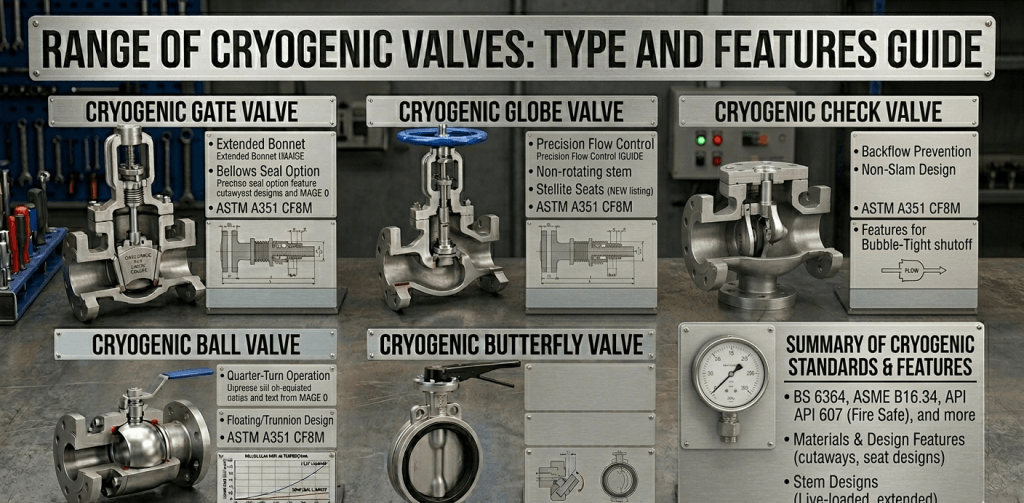
Cryogenic Ball Valves
Ball valves dominate in LNG and industrial gas applications for practical reasons. Quarter-turn operation is fast and reliable. Full-bore design means minimal pressure drop when open. Shut-off is positive and repeatable.
Two main configurations. Floating ball designs work well at smaller sizes and moderate pressure ratings – line pressure assists sealing by pushing the ball against the downstream seat. Trunnion-mounted designs have fixed support at top and bottom of the ball, which means the seat sealing force doesn’t scale with line pressure. That matters on large diameter, high-pressure service where the forces in a floating ball design get too high for practical seat life.
Typical locations in LNG systems:
- Storage tank isolation
- Loading arm and jetty pipeline connections
- Main pipeline isolation
- Pump skid inlets and outlets
Cryogenic Gate Valves
Gate valves in cryogenic service have one job. Fully open or fully closed. That’s it.Running a gate valve partially open in cryogenic service is a mistake that shows up faster than most engineers expect. Turbulence at a partially open gate creates erosion at the seat that would take years to develop in full-open or full-closed service. Cryogenic materials have less tolerance for that kind of surface damage.
Where gate valves belong: main isolation at LNG terminals, large-bore process line isolation in air separation units, industrial gas distribution headers.
Cryogenic Globe Valves
Globe valves are for flow control. Not isolation, not on/off switching – throttling. Accurate, repeatable positioning.
Hydrogen production plants use them for process line flow control. Air separation units put them on lines that need regulation rather than isolation. Pharmaceutical gas applications where dosing precision matters use them alongside purity requirements.
Cryogenic Check Valves
Backflow in a cryogenic pipeline isn’t just a process disturbance. Reverse flow through a compressor or pump at -196°C causes physical damage to equipment not designed for it. Check valves prevent that automatically – no actuation, no control signal, no operator action.
Safety components in this service, not convenience components. The specification needs to match actual service temperature. Not an estimate.
Cryogenic Butterfly Valves
Large diameter cryogenic lines create practical problems for ball and gate valves. The physical size and weight of a full-bore ball valve at 24 inches is substantial. Butterfly valves solve the space and weight problem while still delivering throttling and isolation capability.
LNG bunkering systems, fuel gas supply on LNG-powered vessels, terminal offloading lines – natural territory for cryogenic butterfly valves.
Industries That Actually Run on Cryogenic Valves
LNG
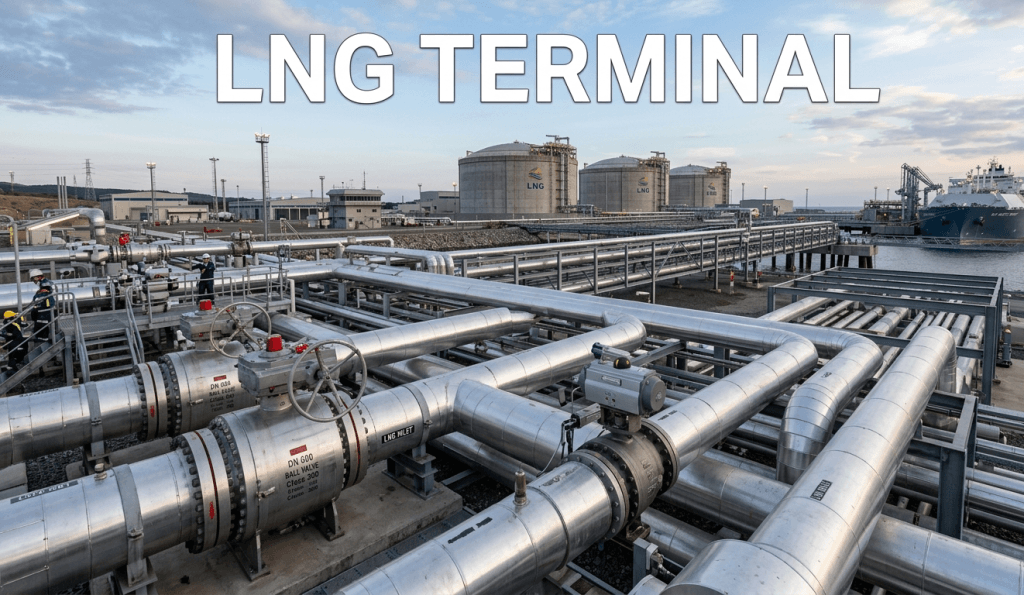
The LNG supply chain is probably the largest single buyer of cryogenic valves globally. Liquefaction plants, export terminals, vessels, import terminals, regasification facilities, distribution systems – cryogenic valves are at every stage. Cooling natural gas to -160°C reduces its volume to roughly 1/600th of its gas-phase size. That’s the physics that makes LNG transport economically viable. Everything that makes that transport possible runs on cryogenic valves.
XSIS Valves manufactures LNG-grade cryogenic valve solutions for these service conditions.
Air Separation
Air separation units run continuously. Not intermittently, not in batches – continuously. They cool air to cryogenic temperatures and separate it into liquid oxygen, liquid nitrogen, and liquid argon. The valves inside cycle constantly without extended shutdown windows for maintenance. High reliability doesn’t begin to cover what’s required here.
Petrochemicals
Ethylene, the base feedstock for most plastics, is stored and transported at -104°C. That alone creates substantial cryogenic valve requirements across the petrochemical supply chain, entirely separate from LNG. Natural gas processing adds more.
Pharmaceuticals
Liquid nitrogen in pharmaceutical manufacturing is used for biological preservation, freeze-drying, and reactor cooling. Valve requirements here layer strict purity and leakage standards on top of the cryogenic performance requirements. A contamination incident from a leaking valve isn’t a maintenance problem. It has regulatory implications that go well beyond equipment replacement costs.
Aerospace
Rocket propulsion runs on liquid hydrogen and liquid oxygen. Valves on those propellant lines operate near -253°C. That’s the most extreme cryogenic service condition in regular industrial use, and the requirements go beyond what standard cryogenic specifications address. Research facilities working with superconducting systems have similar requirements.
Marine
LNG-powered vessels need cryogenic valves throughout fuel gas supply systems and storage tank connections. Cryogenic temperature performance and saltwater corrosion resistance are both mandatory requirements simultaneously. Specifying for one while ignoring the other doesn’t work.
Material Selection: What the Differences Mean in Practice?
Getting material selection wrong in cryogenic service doesn’t produce slow degradation you manage around. It produces sudden failure.
Body materials:
Austenitic stainless steel is the default. SS304, SS304L, SS316, SS316L. Keeps ductility and toughness at cryogenic temperatures, good corrosion resistance, well understood from a welding and fabrication standpoint. SS316L specifically when cleaning chemistry or process fluids create chloride exposure.
Nickel alloys for applications where austenitic stainless doesn’t meet strength or chemical compatibility requirements. Aluminum alloys in aerospace where weight overrides other considerations.
Sealing materials:
No elastomers. That’s the short version. What actually works:
- PTFE and modified PTFE for seats and packing across most standard cryogenic applications
- PCTFE where dimensional stability through thermal cycling is the critical requirement – holds shape better than PTFE through repeated deep cold cycles, which matters on applications with frequent startup and shutdown
- Reinforced graphite in specific high-pressure cryogenic applications
Governing standards:
- BS 6364 – design, manufacture, inspection, and testing for cryogenic service valves. Mandatory for LNG and most gas service.
- API 6D – pipeline ball and gate valves in gas service.
- ASME B16.34 – pressure-temperature ratings, materials, dimensions.
XSIS Valves manufactures under ISO 9001:2015 certified processes. The full industrial valve range covers the complete lineup across valve types and service conditions.
Specifying Correctly: What to Lock Down Before Ordering
Wrong specification in cryogenic service doesn’t give much opportunity to correct after the fact.
- Minimum operating temperature – upset conditions and startup transients included, not just steady-state. Materials and design need to handle the actual worst case.
- Pressure class – matched to operating and surge pressures. No correcting an undersized pressure class after installation.
- Valve type – ball for isolation and fast shut-off, gate for fully open or closed service only, globe for flow regulation, check for backflow prevention, butterfly where large diameter and space constraints rule out other options.
- End connections – in cryogenic service, leakage requirements often drive this choice more than piping configuration does. Butt-weld on critical services where flanged joints introduce additional leak potential.
- Actuation – manual for infrequent cycling, pneumatic or electric where cycling is frequent or remote operation is needed.
- Standards compliance – verify what applies to your jurisdiction and application. Don’t assume.
XSIS Valves supplies customised solutions from 0.5 inch to 48 inches, PN10 to Class 600 and beyond. Contact the XSIS Valves team to work through your project requirements.
Testing and Documentation: Where Projects Cut Corners and Regret It?
LNG valve failures create fire and explosion risks. Liquid oxygen leaks produce oxygen-enriched atmospheres that increase ignition risk for surrounding materials dramatically. Pharmaceutical valve failures produce contaminated batches with regulatory consequences. These aren’t theoretical scenarios – they’re the actual consequences that drive the testing requirements.
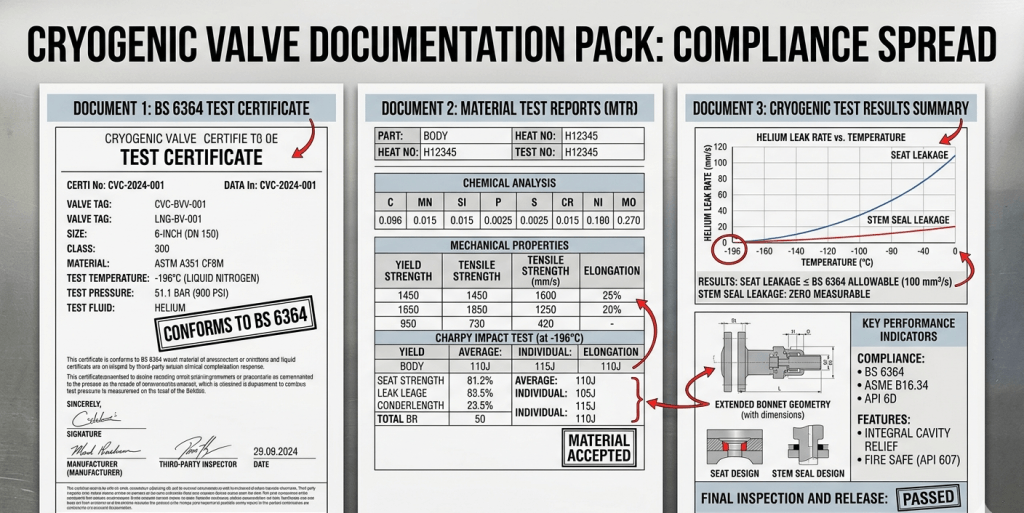
Testing at ambient temperature and certifying for cryogenic service is not acceptable. Seat leakage, body integrity, stem seal performance – all of it needs verification at actual operational temperature. Helium leak testing catches leakage paths that hydrostatic testing cannot detect. Microscopic paths that are invisible at hydrostatic test pressures but become significant leak sources at the very low operating pressures some cryogenic systems run at.
Documentation from every supplier, on every valve:
- Material test certificates to EN 10204 3.1 for all pressure-containing components
- Hydrostatic test reports
- Dimensional inspection records
- Cryogenic test certificates with actual test temperature documented
XSIS Valves includes complete documentation with every product, third-party inspection reports included where applications require them. Explore cryogenic and LNG valve solutions at XSIS Valves to find the right match for your application.
Conclusion
Cryogenic valves exist because standard industrial valves fail in multiple simultaneous ways at low temperatures. The extended bonnet, the austenitic stainless body, the PCTFE seats, the pressure relief features – each one addresses a specific failure mode that will occur without it.
Specification, material selection, testing at temperature, and documentation aren’t optional elements of a cryogenic valve procurement. They’re the difference between valves that serve their full design life and valves that become incidents. For ISO 9001:2015 certified cryogenic valve solutions built to international standards, reach out to XSIS Valves to discuss what your application actually needs.
Frequently Asked Questions
What temperature range do cryogenic valves handle?
Standard designs cover below -110°C down to -196°C for liquid nitrogen and liquid oxygen service. Specialised designs for liquid hydrogen handle temperatures near -253°C, which pushes material and design requirements well past what standard cryogenic specifications cover – those applications need separate treatment entirely.
What is an extended bonnet and why does it matter?
It’s a deliberately lengthened section between the valve body and the stem packing. The length creates a temperature gradient up the stem so packing reaches a temperature where sealing materials can work, rather than freezing at the same temperature as the process fluid. Without it, the packing seizes and the valve becomes inoperable.
Why won’t standard industrial valves work in cryogenic service?
Carbon steel goes brittle at low temperatures and cracks rather than deforming under stress. Standard elastomer seals contract and lose their sealing ability. Lubricants freeze. None of these are gradual performance reductions you manage around – they’re failure modes that happen suddenly.
What materials are used in cryogenic valve construction?
SS304 and SS316 austenitic stainless steel for bodies because they keep toughness at low temperatures. PTFE, modified PTFE, and PCTFE for seats and seals because they stay flexible through deep thermal cycling where standard elastomers crack and fail.
Which industries use cryogenic valves most?
LNG is the largest application by volume, followed by air separation, petrochemical processing, pharmaceutical manufacturing, aerospace propulsion, and marine LNG applications. Any process handling liquefied gases below -110°C needs them.
What standards should cryogenic valves be tested to?
BS 6364 for cryogenic service valve design and testing – mandatory in most LNG and gas service. API 6D for pipeline ball and gate valves. ASME B16.34 for pressure-temperature ratings. Testing must happen at actual operational temperature, documented in a cryogenic test certificate. Ambient temperature testing does not satisfy the requirement.