

Industrial facilities across manufacturing, processing, utility, and infrastructure sectors use valves as some of their most essential components. Industries in Ahmedabad depend on valves to regulate, control, direct, and isolate the flow of liquids, gases, steam, and chemicals throughout their operations. From textile mills and pharmaceutical plants to chemical processing units and water treatment facilities, the right valve selection plays a crucial role in maintaining efficiency, safety, and productivity.
Choosing the appropriate valve type can help reduce operational costs, improve process performance, and extend the lifespan of industrial equipment. This Complete Guide to Industrial Valve Types for Ahmedabad Industries explores the most commonly used industrial valve types, their working principles, applications, material options, and maintenance requirements.
Understanding how different valves function allows industries to select solutions that meet their specific operational needs and regulatory standards. Whether you are upgrading an existing system or planning a new industrial installation, this guide provides valuable insights into selecting the right industrial valves for reliable and long-term performance.
What Are Industrial Valves, and Why Are They Important?
Industrial systems use industrial valves to regulate, start, stop, and control the flow of fluids within a system. Engineers install them in pipelines, processing plants, machinery, and utility systems to ensure smooth and safe operations. Without properly functioning valves, industrial processes would face flow disruptions, pressure imbalances, and safety risks.
Ahmedabad’s industrial ecosystem includes textile manufacturing, chemical production, pharmaceutical facilities, food processing plants, and engineering industries. Each of these sectors depends on specialized valve solutions to maintain operational efficiency. The right valve improves process control while reducing maintenance costs and energy consumption.
Key Functions of Industrial Valves
- Flow Regulation: Industrial valves control the rate and volume of fluid flowing through pipelines and processing equipment. This helps maintain consistent production conditions and improves overall process efficiency.
- Pressure Management: Valves help regulate and maintain safe pressure levels within industrial systems. Proper pressure control prevents equipment damage and supports safe operating conditions.
- Isolation Capability: Valves can completely stop fluid flow to specific sections of a pipeline when required. This allows maintenance teams to perform repair and maintenance work without shutting down the entire system.
- Safety Protection: Industrial valves play a critical role in preventing leaks, overpressure situations, and system failures. They help protect personnel, equipment, and the surrounding environment.
- Direction Control: Certain valve types can redirect fluid flow between different process lines or system components. This improves operational flexibility and supports complex industrial processes.
- System Efficiency: Properly selected and maintained valves contribute to smooth system operation and reduced energy consumption. They help minimize downtime while improving productivity and reliability.
Which Are the Most Common Industrial Valve Types Used in Ahmedabad Industries?
Industrial valves play a vital role in controlling the flow of liquids, gases, steam, and chemicals across various manufacturing and processing sectors. Ahmedabad is home to diverse industries such as textiles, pharmaceuticals, chemicals, food processing, and water treatment, all of which depend on reliable valve systems for efficient operations. Selecting the right valve type helps improve productivity, safety, and process control.
Different industrial applications require specific valve designs based on pressure, temperature, flow rate, and fluid characteristics. From simple on-off isolation to precise flow regulation, each valve type serves a unique purpose within industrial systems. Understanding the most commonly used valve types enables industries to make informed decisions regarding installation, maintenance, and long-term operational efficiency.
Common Industrial Valve Types Used in Ahmedabad Industries
- Gate Valves: Industries primarily use gate valves for complete flow isolation in pipelines. They provide minimal pressure loss when fully open, making them suitable for water and utility systems.
- Ball Valves: Ball valves provide quick quarter-turn operation and excellent sealing performance. Chemical processing plants, pharmaceutical facilities, and manufacturing units widely use them.
- Butterfly Valves: Butterfly valves feature a compact and lightweight design for efficient flow control. They are commonly installed in HVAC systems, water treatment plants, and large-diameter pipelines.
- Globe Valves: Globe valves are designed for precise flow regulation and throttling applications. They are frequently used where accurate control of fluid flow is required.
- Check Valves: Check valves automatically prevent reverse flow within a piping system. They help protect pumps, compressors, and equipment from damage caused by backflow.
- Needle Valves: Needle valves offer highly accurate flow adjustment for critical processes. They are commonly used in instrumentation systems and applications requiring precise control.
How Do Gate Valves Work in Industrial Applications?
Gate valves operate by raising or lowering a flat or wedge-shaped gate inside the valve body to control fluid flow. When the gate is fully lifted, the passage becomes completely open, allowing fluids to flow with minimal resistance and pressure loss. When lowered, the gate creates a tight seal that stops the flow entirely, making gate valves ideal for isolation applications rather than flow regulation.
In Ahmedabad industries such as water treatment, chemical processing, power generation, and textile manufacturing, gate valves are widely used in pipelines that require dependable shut-off capability. Their simple design, durability, and ability to handle high-pressure systems make them a preferred choice for industrial operations where uninterrupted flow or complete isolation is necessary.
Benefits of Gate Valves in Industrial Applications
- Full Flow Capacity: Gate valves provide a straight-through flow path when fully open. This minimizes pressure drop and ensures efficient fluid movement through the system.
- Reliable Shut-Off: These valves create a strong seal when closed, preventing leakage. This makes them suitable for maintenance operations and emergency isolation requirements.
- Suitable for Large Pipelines: Gate valves are commonly installed in large-diameter piping systems. Their design supports efficient operation in industrial distribution networks.
- Durable Construction: Manufactured from materials such as cast iron, carbon steel, and stainless steel, gate valves can withstand demanding industrial environments and long-term use.
- Bidirectional Operation: Gate valves can generally function effectively regardless of the direction of fluid flow. This provides greater installation flexibility for industrial systems.
- Low Maintenance Requirements: With fewer moving parts and a simple operating mechanism, gate valves often require less maintenance and deliver a long service life.
Why Are Ball Valves Popular Across Ahmedabad Manufacturing Industries?
Ball valves are among the most widely used industrial valves because of their simple design, reliable performance, and excellent sealing capabilities. They operate using a rotating ball with a hole through its center, allowing fluid to pass when aligned with the pipeline and stopping flow when turned perpendicular. This quarter-turn mechanism enables quick operation and reduces the time required to control process flow.
Manufacturing industries across Ahmedabad, including chemical plants, pharmaceutical facilities, textile units, food processing plants, and water treatment systems, prefer ball valves for their durability and low maintenance requirements. Their ability to handle high-pressure applications, corrosive fluids, and automated systems make them an ideal choice for modern industrial operations seeking efficiency and reliability.
Advantages of Ball Valves in Manufacturing Industries
- Quick Quarter-Turn Operation: Ball valves open and close with a simple 90-degree turn. This allows fast flow control and improves operational efficiency.
- Excellent Sealing Performance: The ball and seat design creates a tight shut-off when closed. This helps prevent leakage and enhances system safety.
- Low Maintenance Requirements: Ball valves have fewer moving components than many other valve types. This reduces wear and lowers maintenance costs over time.
- Suitable for Various Fluids: They can handle water, steam, gases, oils, and chemicals effectively. Their versatility makes them suitable for multiple industrial applications.
- Long Service Life: Constructed from durable materials such as stainless steel and carbon steel, ball valves provide reliable performance in demanding environments.
- Easy Automation Integration: Ball valves can be fitted with pneumatic or electric actuators for automated process control. This supports modern industrial systems and smart manufacturing operations.
When Should Industries Use Butterfly Valves?
Butterfly valves are an excellent choice for industries that require efficient flow control in large-diameter pipelines. These valves use a rotating disc mounted on a shaft to regulate or stop fluid flow, making them lightweight, compact, and easy to operate. Their simple design allows for quick opening and closing, which is particularly beneficial in systems where space is limited and operational efficiency is important.
Industries in Ahmedabad commonly use butterfly valves in water treatment plants, HVAC systems, cooling water networks, chemical processing facilities, and wastewater management systems. They are especially suitable for applications where moderate pressure conditions, cost-effectiveness, and easy maintenance are key considerations. Their ability to handle large volumes of fluid makes them a practical solution for many industrial operations.
Benefits of Using Butterfly Valves
- Compact and Lightweight Design: Butterfly valves require less installation space compared to many other valve types. Their lightweight construction also simplifies transportation and handling.
- Ideal for Large-Diameter Pipelines: These valves are widely used in large piping systems where other valve types may be heavier and more expensive. They provide efficient flow control without adding excessive weight.
- Cost-Effective Solution: Butterfly valves are generally more affordable than many alternative valve designs. This makes them a budget-friendly option for large-scale industrial projects.
- Quick Operation: The quarter-turn mechanism allows fast opening and closing of the valve. This improves process efficiency and enables rapid system control.
- Low Maintenance Requirements: With fewer components and a simple operating structure, butterfly valves typically require less maintenance. This helps reduce downtime and operating costs.
- Versatile Industrial Applications: Butterfly valves can handle water, air, gases, and certain chemical fluids. Their adaptability makes them suitable for a wide range of industrial sectors and processes.
What Is the Role of Check Valves in Industrial Systems?
Check valves play a crucial role in maintaining the safety, efficiency, and reliability of industrial piping systems. These valves are designed to allow fluid flow in one direction while automatically preventing reverse flow. Unlike manually operated valves, check valves function without external controls, making them an essential component in systems where backflow could damage equipment or disrupt operations.
Industries in Ahmedabad, including water treatment plants, chemical manufacturing facilities, power generation units, and HVAC systems, rely on check valves to protect pumps, compressors, and pipelines. By preventing reverse flow, these valves help maintain system pressure, reduce equipment wear, and improve overall operational stability. Their simple yet effective design makes them indispensable in a wide range of industrial applications.
Key Functions of Check Valves in Industrial Systems
- Prevents Backflow: Check valves automatically stop fluid from flowing in the reverse direction. This protects the integrity of the entire piping system and prevents operational disruptions.
- Protects Pumps and Compressors: Reverse flow can cause serious damage to pumps and compressors. Check valves help extend equipment lifespan by preventing such conditions.
- Enhances System Safety: By controlling flow direction, check valves reduce the risk of pressure surges and equipment failures. This contributes to a safer industrial environment.
- Supports Efficient Operations: Maintaining proper flow direction helps systems operate smoothly and consistently. This improves process efficiency and overall productivity.
- Requires No External Control: Check valves operate automatically based on fluid pressure and flow conditions. This eliminates the need for manual intervention or automation systems.
- Reduces Maintenance Costs: Preventing backflow-related damage minimizes repair requirements and equipment downtime. As a result, industries can achieve lower maintenance expenses and improved reliability.
Which Valve Materials Are Best for Different Industrial Applications?
Selecting the right valve material is just as important as choosing the correct valve type. Industrial valves operate under varying conditions involving pressure, temperature, corrosion, and chemical exposure. The material used in valve construction directly affects its durability, performance, maintenance requirements, and overall service life. Choosing an unsuitable material can lead to leakage, corrosion, premature failure, and costly downtime.
Ahmedabad industries such as pharmaceuticals, chemicals, textiles, food processing, water treatment, and power generation often require valves made from specific materials to meet their operational needs. Factors such as fluid compatibility, environmental conditions, and industry standards should always be considered before selecting a valve material. The right material ensures reliable operation, safety, and long-term cost efficiency.
Common Valve Materials and Their Applications
- Stainless Steel Valves: Stainless steel offers excellent corrosion resistance and durability. These valves are widely used in pharmaceutical, chemical, food processing, and high-purity applications.
- Carbon Steel Valves: Carbon steel valves are suitable for high-pressure and high-temperature environments. They are commonly used in power plants, oil and gas facilities, and industrial processing systems.
- Cast Iron Valves: Cast iron valves provide a cost-effective solution for water distribution and utility applications. They are frequently installed in municipal and industrial water systems.
- Brass Valves: Brass valves offer good corrosion resistance and ease of installation. They are commonly used in HVAC systems, water supply networks, and low-pressure industrial applications.
- Alloy Steel Valves: Alloy steel valves are designed for demanding operating conditions involving extreme temperatures and pressures. They are often used in specialized industrial and energy sector applications.
- PVC and Plastic Valves: PVC and other plastic valves are resistant to many chemicals and corrosive substances. They are widely used in water treatment plants, chemical handling systems, and non-metallic piping networks.
How Do You Choose the Right Industrial Valve for Your Industry?
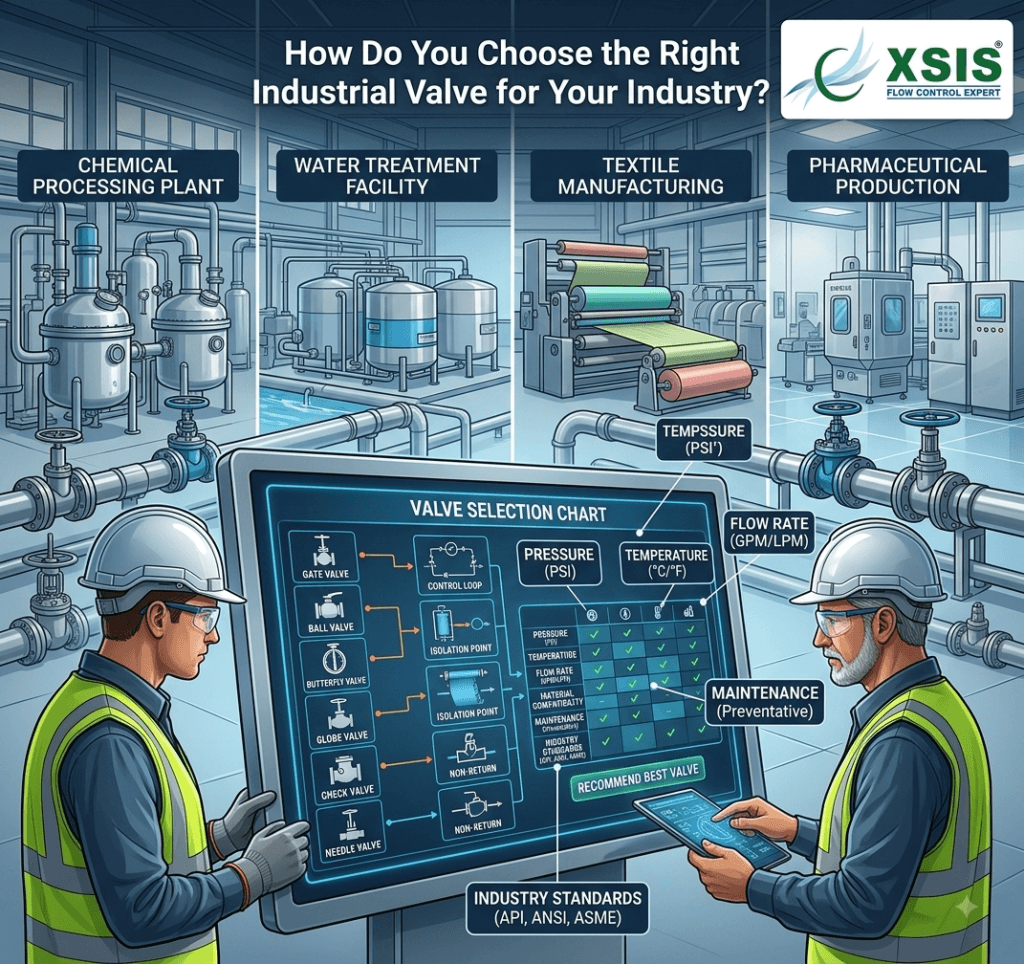
Choosing the right industrial valve requires a careful assessment of the operating conditions, fluid characteristics, and performance requirements of your system. Different industries have unique process demands, and selecting an unsuitable valve can lead to inefficiencies, increased maintenance costs, and equipment failures. Factors such as pressure, temperature, flow rate, and the type of fluid being handled must all be considered before making a decision.
Industries in Ahmedabad, including chemical processing, pharmaceuticals, textiles, water treatment, food manufacturing, and power generation, often use a variety of valve types to meet specific operational needs. Working with experienced industrial valve manufacturers and suppliers can help ensure that the selected valve meets industry standards, safety requirements, and long-term performance expectations.
Key Factors to Consider When Selecting an Industrial Valve
- Fluid Type and Compatibility: The valve material and design should be compatible with the fluid being handled. Corrosive chemicals, steam, gases, and water all require different valve solutions.
- Operating Pressure and Temperature: Every valve has specific pressure and temperature ratings. Selecting a valve that matches system conditions helps ensure safety and reliable performance.
- Flow Control Requirements: Determine whether the application requires isolation, throttling, or directional control. Different valve types are designed for different flow management functions.
- Valve Material Selection: Materials such as stainless steel, carbon steel, cast iron, brass, and PVC offer varying levels of durability and corrosion resistance. Choosing the right material extends valve lifespan.
- Maintenance and Serviceability: Valves that are easy to inspect, repair, and maintain can reduce downtime and operating costs. Maintenance requirements should be considered before installation.
- Compliance with Industry Standards: Ensure the valve meets relevant industry regulations, safety standards, and quality certifications. Compliance improves reliability and supports safe industrial operations.
How Can Proper Valve Maintenance Improve Industrial Performance?
Proper valve maintenance is essential for ensuring the efficiency, safety, and reliability of industrial operations. Over time, valves can experience wear and tear due to continuous use, pressure fluctuations, temperature changes, and exposure to corrosive fluids. Regular maintenance helps identify potential issues before they develop into major failures, reducing the risk of unplanned downtime and costly repairs.
Industries in Ahmedabad, including chemical plants, textile units, pharmaceutical facilities, water treatment plants, and power generation stations, rely on well-maintained valves to keep processes running smoothly. A proactive maintenance strategy not only extends valve lifespan but also improves system performance, energy efficiency, and workplace safety. Regular inspections and timely servicing help organizations achieve long-term operational success.
Best Practices for Industrial Valve Maintenance
- Conduct Regular Inspections: Routine inspections help identify leaks, corrosion, wear, and mechanical damage at an early stage. Early detection prevents minor issues from becoming major operational problems.
- Perform Performance Testing: Testing valves periodically ensures they open, close, and regulate flow correctly. This helps maintain system efficiency and operational reliability.
- Lubricate Moving Components: Proper lubrication reduces friction between moving parts and prevents premature wear. It also helps ensure smooth valve operation over time.
- Replace Worn Seals and Components: Damaged seals, gaskets, and internal components can lead to leakage and reduced performance. Timely replacement helps maintain effective valve functionality.
- Maintain Accurate Service Records: Keeping detailed maintenance records allows industries to track valve performance and schedule preventive maintenance activities. This supports better asset management and compliance.
- Implement Preventive Maintenance Programs: A structured preventive maintenance plan minimizes unexpected failures and downtime. Regular servicing improves equipment longevity and overall industrial productivity.
Conclusion
The Complete Guide to Industrial Valve Types for Ahmedabad Industries demonstrates how different valve types contribute to the safety, efficiency, and reliability of industrial operations. Whether it is gate valves for isolation, ball valves for quick shut-off, butterfly valves for large pipeline systems, or check valves for backflow prevention, each valve serves a specific purpose within industrial processes.
Understanding these functions helps businesses select the most suitable solutions for their operational requirements. As Ahmedabad continues to strengthen its position as a major manufacturing and industrial centre, choosing the right valve type and material becomes increasingly important. Factors such as fluid characteristics, operating conditions, maintenance requirements, and industry standards should always guide valve selection decisions.
By investing in high-quality industrial valves and implementing regular maintenance practices, industries can improve system performance, reduce downtime, enhance safety, and achieve long-term operational success.
Explore Our Recent Blog
- Valves for HVAC Systems in Ahmedabad
- Industrial Valves for the Dyeing and Textile Processing Industry in Ahmedabad
- ISO and API Certified Valve Manufacturers in Ahmedabad: Why It Matters
- How to Choose the Right Industrial Valve Manufacturer in Ahmedabad
- Top Industrial Valve Suppliers in Ahmedabad: What to Look For
Frequently Asked Questions
1. What are the main industrial valve types used in Ahmedabad industries?
The most commonly used industrial valve types include gate valves, ball valves, butterfly valves, globe valves, check valves, and needle valves. Each serves a specific purpose depending on flow control requirements and operating conditions. Industries often use multiple valve types within a single system.
2. Which valve is best for flow regulation?
Globe valves are generally considered the best choice for precise flow regulation. Their design allows operators to adjust flow rates accurately without compromising system performance. They are commonly used in steam, water, and process control applications.
3. Why are ball valves preferred in industrial applications?
Ball valves provide excellent sealing performance, quick operation, and minimal maintenance requirements. Their quarter-turn mechanism makes them easy to use and highly reliable. They are widely used across manufacturing, chemical processing, and utility systems.
4. How often should industrial valves be inspected?
Inspection frequency depends on operating conditions, industry regulations, and criticality of the application. Many facilities perform routine inspections quarterly or annually. High-risk systems may require more frequent monitoring and testing.
5. What materials are commonly used for industrial valves?
Common valve materials include stainless steel, carbon steel, cast iron, brass, alloy steel, and engineered plastics. The appropriate material depends on fluid compatibility, temperature, pressure, and environmental conditions. Selecting the right material improves durability and performance.
6. How do check valves protect industrial equipment?
Check valves prevent reverse flow that could damage pumps, compressors, and processing equipment. They operate automatically without manual intervention. This protection improves system reliability, safety, and equipment lifespan.