
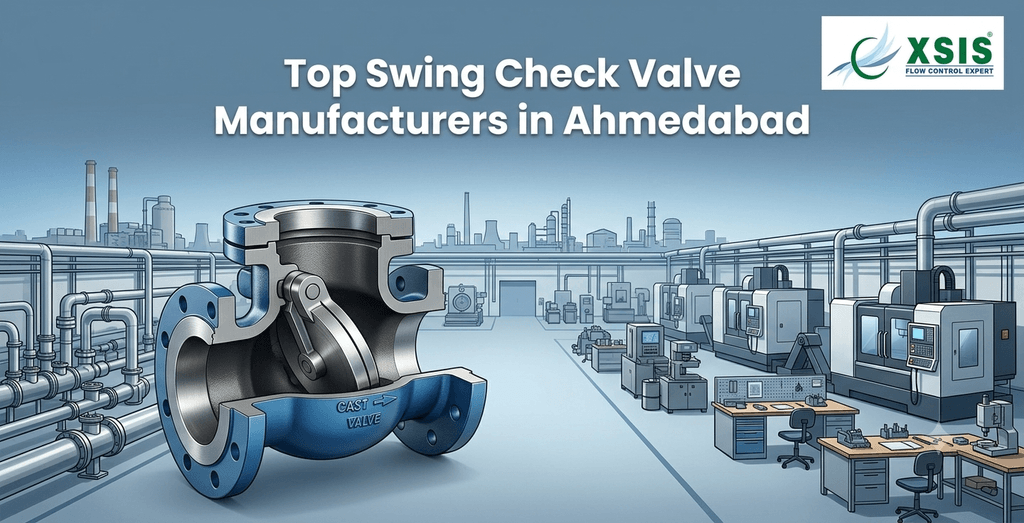
Ahmedabad is a major industrial centre for engineering, chemicals, pharmaceuticals, petrochemicals, water treatment, power generation, oil and gas, and process industries. These sectors require dependable flow-control equipment to manage pressure, protect machinery, and prevent reverse flow in pipelines. For businesses sourcing reliable industrial valves, identifying the Top Swing Check Valve Manufacturers in Ahmedabad can help them compare suitable products for different applications.
A swing check valve uses a hinged disc that opens when fluid moves in the intended direction and closes when the flow reverses. This automatic action helps protect pumps, pipelines, compressors, and other equipment from backflow. When evaluating swing check valve manufacturers, buyers should consider product specifications, materials, applicable standards, testing procedures, size and pressure ranges, application experience, and after-sales support.
The companies discussed below are a practical supplier shortlist based on publicly available manufacturer information, rather than an independently audited ranking. Several Ahmedabad manufacturers publish detailed specifications for swing check valves, while some offer broader check-valve and industrial-valve ranges. This guide can therefore help procurement teams, engineers, contractors, and plant managers compare available options before requesting quotations.
Which Are the Top Swing Check Valve Manufacturers in Ahmedabad?
When researching the Top Swing Check Valve Manufacturers in Ahmedabad, buyers should first look at manufacturers that publicly document their swing check valve capabilities, construction materials, standards, pressure classes, sizes, and industrial applications. Ahmedabad has several manufacturers and suppliers serving different sectors, so the appropriate choice depends on the actual operating requirements rather than the company name alone. Product documentation can help buyers understand whether a manufacturer can supply the required valve configuration.
XSIS Valves Pvt. Ltd. is an Ahmedabad-based industrial valve manufacturer and exporter offering check valves and non-return valves among its product range. Its published information states that the company serves industries including oil and gas, power, chemicals and fertilizers, water treatment, pharmaceuticals, LNG, marine, steel and mining. It also states that the company has operated since 2008 and follows ISO 9001:2015 quality practices.
Libra Valves India Pvt. Ltd. publishes a dedicated swing check valve range with bolted-cover and pressure-seal configurations. Its published specifications include sizes from 2 to 48 inches, pressure classes from 150 to 2500, API 6D/API 594/ASME B16.34/BS 1868 design standards, and API 598 testing.
Allied Valves India also publishes detailed swing check valve specifications, including cast iron, cast steel, stainless steel, WC6 and WC9 material options, sizes from 25 mm to 600 mm, and pressure classes including PN10, PN16, 150, 300 and 600. Its product information states that the valves are manufactured to BS 1868 and tested to BS 6755.
Other Ahmedabad-area manufacturers publishing swing check valve information include AK Valve Industries, Aqua Engineering, Shiv Valves Industries, Mettle Valves Mfg. Co., Beena Engineering, Jogani Valves, Intech Engineering, and Valson Valves. Their published product ranges vary in size, materials, standards, end connections, and intended applications.
What Should You Know About Swing Check Valve Manufacturers in Ahmedabad?
A swing check valve is a type of non-return valve designed to allow fluid flow in one direction and prevent reverse flow. It uses a hinged disc that moves away from the seat when forward pressure is sufficient and returns towards the seat when the flow reverses. This simple mechanism makes swing check valves in Ahmedabad suitable for many industrial pipeline systems. Manufacturers in Ahmedabad offer different designs based on pressure, temperature, materials, and application requirements.
When comparing swing check valve manufacturers in Ahmedabad, buyers should look beyond product availability and consider technical specifications, manufacturing capabilities, testing procedures, and applicable standards. The correct valve depends on factors such as pipeline size, process medium, operating pressure, temperature, and installation position. Reviewing these details helps procurement teams identify a suitable valve configuration for their specific industrial application.
Key Factors to Consider
- Valve Material: Choose body, seat, and trim materials according to the fluid, temperature, pressure, and corrosion conditions of the application.
- Pressure Rating: Check the valve’s pressure class and design pressure to ensure it can safely handle the operating conditions of the pipeline.
- Size Range: Confirm that the manufacturer can provide the required nominal valve size and dimensional specifications for your piping system.
- Applicable Standards: Verify relevant standards such as API, ASME, or BS requirements according to the project’s technical specifications.
- Testing and Inspection: Ask about pressure testing, leakage testing, material certificates, inspection reports, and other required quality documentation.
- Application Experience: Consider manufacturers with experience supplying swing check valves for industries similar to your application, such as chemical, water, power, or oil and gas.
How Do Swing Check Valves Work in Industrial Pipeline Systems?
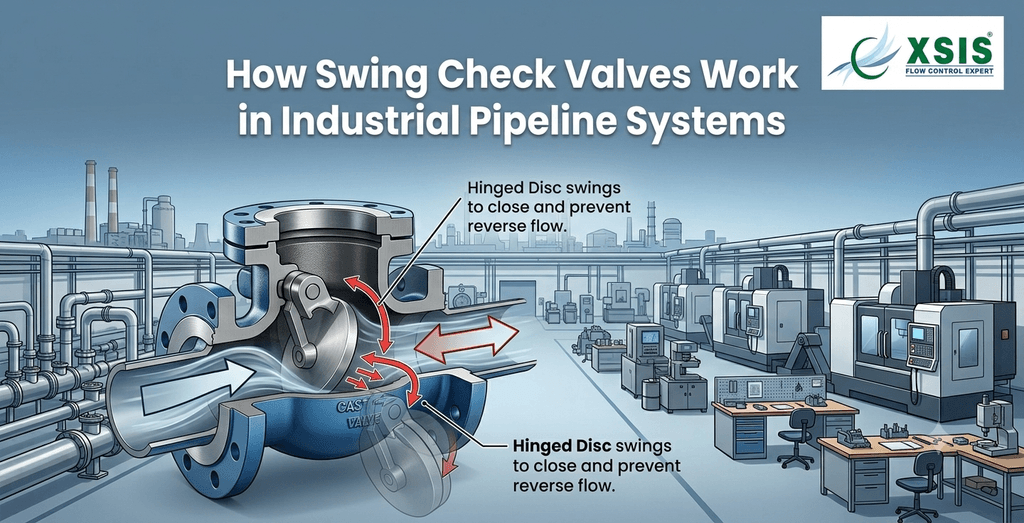
A swing check valve works automatically to allow fluid to move in one direction while restricting reverse flow in a pipeline. It contains a hinged disc that swings away from the valve seat when forward fluid pressure is sufficient. When the flow slows down or reverses, the disc moves back towards the seat and closes the passage. This operation helps reduce the risk of backflow without requiring an external actuator.
The working performance of a swing check valve depends on factors such as flow velocity, pressure conditions, valve size, disc design, and installation orientation. These valves are commonly used in pump discharge lines, water systems, cooling circuits, process pipelines, and other industrial applications. Proper sizing and installation are important for achieving reliable flow control and reducing problems such as excessive pressure drop or valve chatter.
Main Working Features of Swing Check Valves
- Automatic Flow Control: The valve opens and closes according to the direction and pressure of the fluid, without requiring manual operation.
- Backflow Prevention: The hinged disc closes when flow reverses, helping protect pumps, pipelines, and other equipment from unwanted reverse flow.
- Low Flow Resistance: When fully open, many swing check valve designs provide a relatively direct flow path that can help minimise pressure loss.
- Hinged Disc Mechanism: The disc swings around a hinge or pivot, allowing it to respond to changes in fluid flow and pressure conditions.
- Industrial Applications: Swing check valves are commonly used in water treatment, power, chemical, petrochemical, oil and gas, and process piping systems.
- Installation Considerations: Buyers should confirm the permitted flow direction, pipeline orientation, minimum flow requirements, and manufacturer’s installation instructions before installation.
Where Are Swing Check Valves Used Across Ahmedabad Industries?
Swing check valves are used across Ahmedabad’s industrial sectors, where preventing reverse fluid flow is important for safe and reliable pipeline operation. Their automatic closing mechanism makes them suitable for systems carrying water, chemicals, steam, oil, and other process fluids. Industries select different valve materials, pressure classes, sizes, and end connections according to their operating conditions. The right configuration should always be selected based on the specific application and pipeline requirements.
Ahmedabad has a strong presence of engineering, pharmaceutical, chemical, petrochemical, power, water-treatment, and manufacturing industries. In these facilities, swing check valves can be installed in pump discharge lines, process pipelines, cooling-water systems, and other flow-control applications. Swing check valve manufacturers in Ahmedabad may offer different designs and materials to meet the requirements of these varied industrial environments.
Common Industrial Applications
- Water Treatment: Swing check valves can help prevent reverse flow in water supply, treatment, and wastewater pipeline systems.
- Chemical Plants: Suitable material and seat combinations can be selected for pipelines handling different chemical and process fluids.
- Petrochemical Industry: These valves can be used in process and utility pipelines where reliable one-way flow is required.
- Power Plants: Swing check valves are used in suitable water, cooling, steam, and auxiliary pipeline applications based on pressure and temperature requirements.
- Oil and Gas: They can support one-way flow in selected oil, gas, and utility systems where the valve design meets project specifications.
- Pharmaceutical Facilities: Appropriate stainless-steel and hygienic configurations may be considered for applications requiring controlled and compatible flow components.
How Do You Choose the Right Swing Check Valve Manufacturer in Ahmedabad?
Choosing the right swing check valve manufacturer in Ahmedabad requires more than comparing product prices. Buyers should first understand the pipeline’s operating conditions, including fluid type, pressure, temperature, flow direction, valve size, and installation position. The manufacturer should be able to provide a valve configuration that matches these requirements and the project’s technical specifications. Reviewing product datasheets and technical documentation can help reduce the risk of selecting an unsuitable valve.
It is also important to evaluate the manufacturer’s quality practices, testing capabilities, applicable standards, production capacity, and industry experience. Buyers should check whether the manufacturer can provide material certificates, pressure-test reports, inspection documents, drawings, and other required documentation. Delivery schedules, warranty terms, technical support, customisation options, and spare-part availability can also affect the overall procurement decision. A complete technical and commercial comparison can help identify a suitable supplier for the intended application.
Key Factors to Check
- Technical Specifications: Verify the required size, pressure class, temperature range, materials, end connections, and design configuration.
- Manufacturing Experience: Check the manufacturer’s experience with swing check valves and applications similar to your industrial requirements.
- Quality Standards: Confirm the relevant design, manufacturing, inspection, and testing standards required for the project.
- Testing and Documentation: Ask for pressure-test reports, material certificates, inspection records, drawings, and other necessary quality documents.
- Customisation Capability: Determine whether the manufacturer can provide special materials, dimensions, trims, connections, or configurations when required.
- After-Sales Support: Consider technical assistance, delivery support, warranty terms, replacement parts, and ongoing service availability.
What Standards and Quality Checks Should Ahmedabad Valve Buyers Verify?
Before purchasing from swing check valve manufacturers in Ahmedabad, buyers should verify the design, manufacturing, dimensional, and testing standards applicable to their specific project. Commonly referenced standards for industrial swing check valves include API 6D, API 594, BS 1868, ASME B16.34, and API 598, while connection and face-to-face dimensions may involve standards such as ASME B16.5 and ASME B16.10. The applicable requirements should be confirmed against the project’s engineering specifications rather than assumed for every valve.
Quality checks should cover the valve’s materials, pressure performance, dimensions, sealing, and documentation. Buyers can request material test certificates, pressure-test reports, inspection records, dimensional reports, and traceability documents where required. For critical industrial applications, additional inspection or third-party verification may also be specified. These checks help confirm that the supplied swing check valve matches the approved technical and quality requirements.
Important Quality Checks
- Design Standard: Confirm that the valve design complies with the applicable standard specified for the project and service conditions.
- Material Verification: Check body, disc, seat, hinge, and trim materials against the approved material specification and certificates.
- Pressure Testing: Verify that the valve has undergone the required shell and seat-leakage tests according to the applicable testing standard.
- Dimensional Inspection: Check face-to-face dimensions, flange dimensions, bore, and other critical measurements against the approved drawings or relevant standards.
- Visual and Surface Inspection: Inspect the valve for casting defects, surface damage, corrosion, coating issues, and other visible manufacturing problems.
- Documentation and Traceability: Request test certificates, inspection reports, material certificates, drawings, and traceability records required for the project.
What Should You Ask Before Buying From Swing Check Valve Manufacturers in Ahmedabad?
Before buying from swing check valve manufacturers in Ahmedabad, buyers should provide complete information about the intended pipeline application. Important details include valve size, pressure class, process medium, operating and design temperature, body and trim materials, end connection, installation orientation, and required standards. Sharing these specifications helps the manufacturer recommend a suitable valve configuration rather than providing a generic product.
Buyers should also ask about testing, quality documentation, delivery timelines, warranty coverage, and technical support. For industrial projects, documents such as material certificates, pressure-test reports, inspection records, drawings, and compliance certificates may be required before approval. Comparing these technical and commercial details can help procurement teams evaluate suppliers more effectively and avoid issues during installation or operation.
Questions to Ask Manufacturers
- What valve size and pressure classes are available? Confirm that the manufacturer can supply the required size and pressure rating for your pipeline conditions.
- Which materials and trims are offered? Ask about body, disc, seat, hinge, and trim materials suitable for your process fluid and operating temperature.
- Which standards does the valve comply with? Verify applicable design, dimensional, manufacturing, and testing standards required by your project.
- What testing and inspection documents are provided? Ask whether the order includes pressure-test reports, material certificates, inspection records, and traceability documents.
- What is the expected delivery time? Confirm manufacturing lead time, dispatch schedule, and whether customised valve configurations require additional production time.
- What after-sales support is available? Ask about warranty terms, technical assistance, spare parts, replacement support, and service availability after installation.
Conclusion
The Top Swing Check Valve Manufacturers in Ahmedabad serve a broad range of industrial requirements, from water and wastewater systems to chemical, petrochemical, power, oil, gas, and process applications. Publicly available product information shows that manufacturers differ considerably in valve sizes, pressure classes, materials, standards, end connections and specialised configurations.
For procurement teams, the right approach is to compare the technical capabilities of swing check valve manufacturers in Ahmedabad against the actual application. Reviewing material compatibility, pressure and temperature ratings, design standards, testing requirements, documentation, delivery and technical support can help create a more reliable supplier shortlist.
A properly specified swing check valve can provide automatic backflow prevention and support dependable pipeline operation. Before placing an order, buyers should therefore provide complete service conditions and request the manufacturer’s technical datasheet, drawings, applicable certificates and test documentation for verification.
Explore Our Recent Blog
- Top Industrial Gate Valve Suppliers in Ahmedabad
- Top Industrial Globe Valve Suppliers in Ahmedabad
- Top Flanged Butterfly Valve Manufacturers in Ahmedabad
- Top Lug Type Butterfly Valve Manufacturers in Ahmedabad
- Top Wafer Check Valve Manufacturers in Ahmedabad
Frequently Asked Questions
1. What is a swing check valve used for?
A swing check valve is primarily used to permit flow in one direction and prevent reverse flow. It can help protect pumps, pipelines and process equipment from unwanted backflow. The hinged disc operates automatically according to the flow and pressure conditions.
2. How do I select swing check valve manufacturers in Ahmedabad?
Compare manufacturers according to technical range, materials, pressure classes, applicable standards and testing capabilities. Also check their experience with your particular industry and application. Documentation, delivery capability, technical support and customisation should also be considered.
3. Which industries use swing check valves in Ahmedabad?
Swing check valves are used in water treatment, wastewater, chemicals, petrochemicals, power, oil and gas, pharmaceuticals and process industries. They are also used in cooling-water, fire-protection and other industrial pipeline systems. The exact valve configuration depends on the process conditions.
4. What standards are commonly used for swing check valves?
Common standards published by manufacturers include BS 1868, API 6D, API 594, ASME B16.34 and API 598. Connection and dimensional requirements may also involve ASME B16.5 and ASME B16.10. The applicable standard should always be confirmed against the project’s technical specification.
5. What materials are available for industrial swing check valves?
Depending on the manufacturer and application, materials can include cast iron, carbon steel, stainless steel, alloy steel, duplex and specialised alloys. Seat and trim materials may also vary according to pressure, temperature and fluid compatibility. Material selection should be based on actual service conditions rather than price alone.
6. What information should I provide when requesting a swing check valve quotation?
Provide the valve size, pressure class, process medium, operating temperature, pressure, body material and required end connection. It is also useful to specify the applicable design and testing standards and installation orientation. Complete technical information helps manufacturers provide a more accurate and suitable quotation.