
Wafer check valves are important components in industrial piping systems because they allow fluid to move in one direction while helping prevent unwanted reverse flow. Their compact construction makes them suitable for pipelines where space, weight, installation flexibility, and dependable flow protection are important considerations. For industries operating in and around Ahmedabad, choosing from the top wafer check valve manufacturers in Ahmedabad can help procurement teams match valve construction with pressure, temperature, media, and pipeline requirements.
Ahmedabad has a strong industrial ecosystem supporting chemical processing, pharmaceuticals, water treatment, engineering, power, oil and gas, food processing, and infrastructure applications. Several local manufacturers publish specifications for wafer check valves, dual-plate check valves, disc check valves, and related non-return valve products. For example, Pantech Industries, Mettle Valves, WIN Enterprise, Hayat Valves, Lubi Valves, and other Ahmedabad-based manufacturers publish information about relevant check-valve configurations.
What Are Wafer Check Valves and How Do They Work?
A wafer check valve is an automatic flow-control device designed to permit fluid flow in the intended direction and restrict reverse movement. Unlike manually operated valves, a check valve generally does not require a handwheel or external actuator for normal operation. The pressure and movement of the flowing medium cause the internal disc or plate mechanism to open, while reduced flow or reverse pressure causes it to close.
The compact wafer construction allows the valve to be installed between compatible pipeline flanges. This can reduce the installation space required compared with some longer valve configurations. Depending on the design, wafer check valves may be available as single-plate, dual-plate, disc-type, or spring-assisted configurations. Ahmedabad manufacturers publish options using materials such as cast iron, carbon steel, stainless steel, and other alloys for different operating conditions.
What Should You Know About Wafer Check Valve Construction?
- Valve Body: The body provides the main pressure-containing structure and is selected according to the required pressure, temperature, fluid, and material compatibility.
- Disc or Plate: The internal disc controls directional flow and moves away from the seat when sufficient upstream pressure is available.
- Seat: The seat creates the sealing interface when the valve closes and may use materials such as EPDM, NBR, PTFE, or other suitable elastomers.
- Spring Mechanism: Some wafer check valve designs use springs to assist rapid closure and reduce the possibility of reverse-flow shock.
- Flange Connection: Wafer valves are designed to fit between suitable flanges, making flange dimensions and alignment important during installation.
- Testing: Manufacturers may specify standards such as API 598, while design standards can vary according to the valve type and intended application.
Top Wafer Check Valve Manufacturers in Ahmedabad
The following companies publish information about wafer check valves, wafer-type check valves, dual-plate check valves, or related industrial check-valve products. The list is presented for reference based on their published product information, with XSIS Valves listed first as requested.
1. XSIS Valves Pvt. Ltd.
XSIS Valves Pvt. Ltd. is an Ahmedabad-based industrial valve manufacturer and exporter established in 2008. Its published product range includes check valves, non-return valves, and dual-plate check valves, along with butterfly, gate, globe, strainer, and automatic valves. The company states that it is ISO 9001:2015 certified and serves industries such as oil and gas, power, chemical manufacturing, food processing, paper, water treatment, and wastewater management.
For buyers looking for wafer or related check-valve solutions in Ahmedabad, XSIS Valves can be considered as part of the technical evaluation. Buyers should confirm the exact wafer configuration, size, pressure rating, material, standards, and availability with the company according to their project requirements.
+91-8401181714 | +91-9909979891
2. Pantech Industries
Pantech Industries manufactures industrial valves from Ahmedabad and publishes a dedicated wafer check valve range. Its PTI and PTIC models are described as single-plate swing check valves with a short-pattern wafer body. The company states that these valves follow API 6D and ASME B16.34 design references, with API 598 inspection and testing.
Its published specifications include wafer-type connections, different seat materials, and body and disc materials such as WCB, CF8, CF8M, CF3, and CF3M. Pantech also describes applications including pump discharge duties and pipeline installations where compact construction is useful.
3. Mettle Valves Mfg. Co.
Mettle Valves Mfg. Co. is an Ahmedabad-based manufacturer and supplier that publishes a dedicated wafer check valve product. Its published specifications include body and disc material options, elastomer choices such as nitrile, EPDM, silicone and PTFE, and AISI 304/316 components.
Mettle’s published wafer check valve information references API 6D and ANSI B16.34 for design and manufacturing and API 598 for testing. The product information also specifies Class 150 pressure classification and provides dimensional information for different valve sizes.
4. WIN Enterprise
WIN Enterprise is an Ahmedabad-based industrial valve manufacturer and exporter that publishes several check-valve configurations. Its product range includes wafer-type check valves, stainless-steel wafer check valves, wafer-type dual-plate check valves, and stainless-steel disc check valves.
The company’s published information identifies applications across industries such as chemical processing, water treatment, refinery operations, and fabrication. Buyers can compare its available valve construction, materials, pressure ratings, and technical specifications against their particular pipeline requirements.
5. Hayat Valves
Hayat Valves publishes a wafer check valve designed for industrial piping applications. Its published product information states a size range extending from 1 to 42 inches and includes PN10 and PN16 pressure ratings. Material options listed by the company include cast iron, WCB, CF8, and CF8M.
Hayat Valves also publishes different seat-material options, including nitrile, EPDM, Viton, silicone, and PTFE. These options allow buyers to consider the compatibility of the valve with the process medium and operating conditions before selecting a specific configuration.
6. Lubi Valves
Lubi Valves publishes a wafer-type dual-plate check valve for industrial applications. Its published product information references PN10 and PN16 pressure ratings and API 594 and API 598 standards.
A dual-plate configuration can be considered where the project specification calls for this type of check-valve construction. Buyers should verify the required size, body and disc materials, seat material, pressure class, testing requirements, and applicable pipeline standards before placing an order.
7. Metflow Engineers
Metflow Engineers is an Ahmedabad-based check-valve manufacturer and supplier that publishes several configurations, including dual-plate, single-plate wafer, swing, and lift check valves. Its published product information lists materials such as cast iron, cast steel/WCB, and stainless steel CF8/CF8M.
Metflow identifies applications in water treatment, chemical processing, oil and gas, and steam utilities. This range can be relevant for buyers comparing different check-valve configurations for industrial process and utility piping systems.
How Do You Choose Among the Top Wafer Check Valve Manufacturers in Ahmedabad?
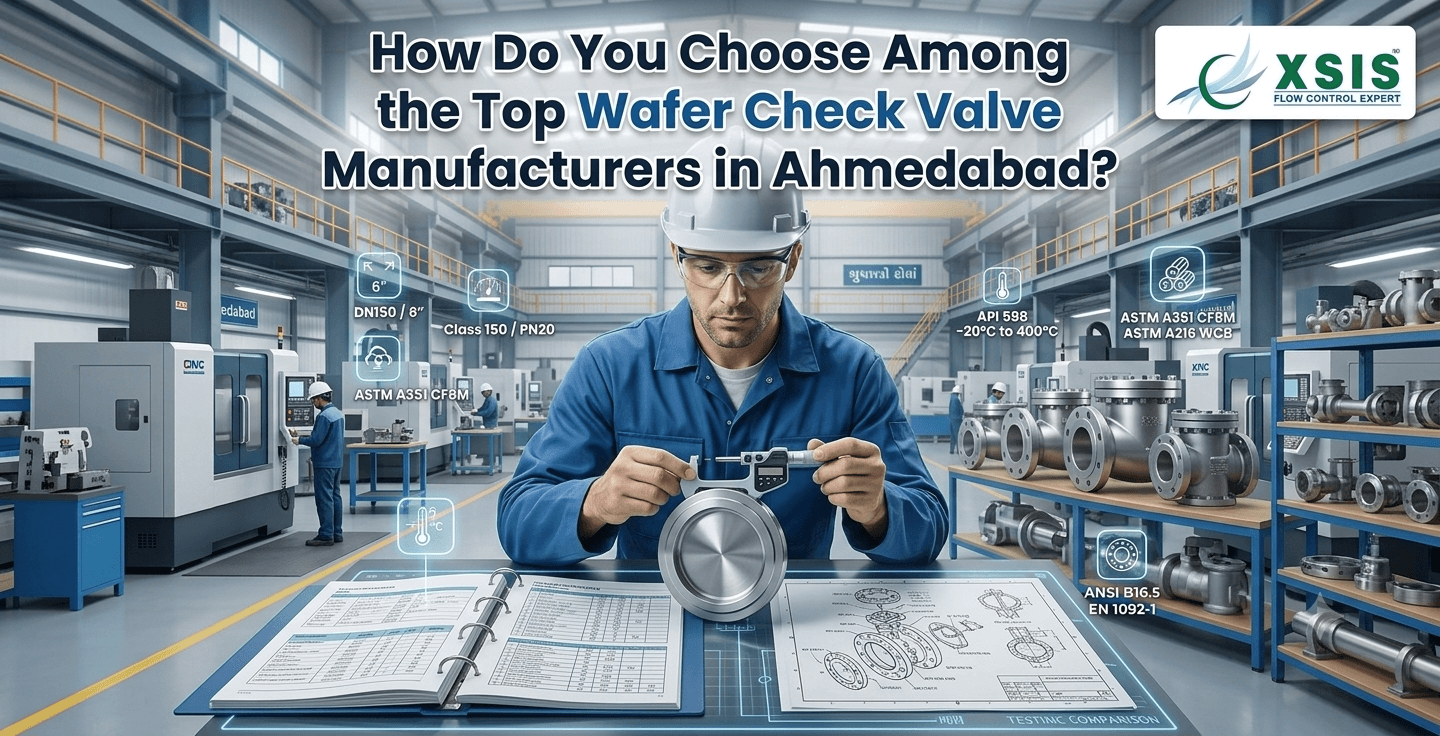
Choosing among the top wafer check valve manufacturers in Ahmedabad requires more than comparing prices. Procurement teams should first establish the operating requirements of the pipeline, including nominal valve size, pressure class, operating temperature, fluid characteristics, flow direction, installation position, flange standard, and required material. A valve that performs well in a water pipeline may not automatically be suitable for corrosive chemicals, high-temperature service, or demanding process applications.
It is also useful to review the manufacturer’s published technical documentation. Product drawings, material specifications, pressure ratings, testing standards, certificates, inspection procedures, and traceability documents can help engineers evaluate whether a proposed valve matches the project specification. Ahmedabad manufacturers publish significantly different combinations of materials, sizes, pressure classes, standards, and valve designs, so the technical comparison should be made against the actual application rather than against brand name alone.
What Technical Factors Should Buyers Compare?
- Valve Size: Select the nominal size according to the pipeline and required flow capacity rather than choosing solely from commonly stocked sizes.
- Pressure Rating: Check PN, Class, or other pressure classifications against both normal operating pressure and applicable design conditions.
- Temperature Range: Confirm the body, seat, gasket, and sealing materials can withstand the minimum and maximum process temperatures.
- Valve Material: Consider cast iron, carbon steel, stainless steel, or specialised alloys according to the fluid and corrosion environment.
- Connection Standard: Verify compatibility with the pipeline flanges, including applicable ANSI, DIN, IS, or other project requirements.
- Testing Requirements: Confirm the required inspection and pressure-testing documentation before approving the valve for procurement.
Why Are Wafer Check Valves Used in Ahmedabad Industries?
Wafer check valves are widely relevant to industrial piping because their compact construction can help save installation space while providing automatic protection against reverse flow. Their applications can include water treatment systems, process pipelines, pumping systems, chemical plants, HVAC installations, fire-protection systems, and other utility networks. The exact suitability depends on the valve construction and the operating conditions of the particular system.
The top wafer check valve manufacturers in Ahmedabad publish products aimed at different industrial requirements. WIN Enterprise, for example, identifies chemical, water treatment, refinery, and fabrication industries, while Metflow Engineers describes applications involving water treatment, chemical processing, oil and gas, and steam utilities. Hayat Valves publishes wafer valves with multiple body and seat material options for different operating conditions.
Where Can Wafer Check Valves Be Applied?
- Water Treatment: They can help control directional flow in treatment and distribution piping where backflow prevention is required.
- Chemical Processing: Appropriate material and seat selection can support applications involving chemically demanding process fluids.
- Oil and Gas: Check valves can help protect process sections and connected equipment from undesirable reverse flow.
- Power Systems: They may be used in auxiliary and process piping where automatic flow-direction protection is required.
- HVAC Systems: Compact wafer configurations can be useful in circulation and utility piping where installation space is limited.
- Fire Protection: Wafer-style non-return valves can be incorporated into suitable fire-water piping systems when their technical ratings meet project requirements.
What Materials Are Available From Wafer Check Valve Manufacturers in Ahmedabad?
Material selection is one of the most important considerations when purchasing wafer check valves. Ahmedabad manufacturers publish products in materials including cast iron, mild steel or carbon steel, stainless steel grades such as SS304 and SS316, and cast-steel grades such as WCB. The correct selection depends on the fluid, temperature, pressure, corrosion risk, mechanical requirements, and applicable project specification.
Sealing materials also require careful attention. Published Ahmedabad product information includes EPDM, NBR or nitrile, PTFE, Viton, silicone, and other seat or seal materials. For example, Hayat Valves lists Nitrile, EPDM, Viton, silicone, and PTFE options, while Mettle Valves publishes nitrile, EPDM, silicone, and PTFE options. These materials should not be selected generically; the manufacturer should confirm suitability for the actual medium and temperature.
How Do Material Choices Affect Valve Selection?
- Cast Iron: Often considered for suitable water and utility applications where the pressure and corrosion environment permit its use.
- Carbon Steel/WCB: Provides a broader industrial material option for applications requiring greater mechanical strength or specific process compatibility.
- Stainless Steel 304: Can be considered where improved corrosion resistance is required compared with standard carbon or cast-iron construction.
- Stainless Steel 316: Often selected for more demanding corrosive environments, subject to the actual process-fluid requirements.
- EPDM/NBR: Different elastomers provide different compatibility and temperature characteristics, so the medium must be checked before selection.
- PTFE and Special Materials: These can be relevant for specific chemical or temperature requirements when supported by the manufacturer’s design and application data.
How Do Wafer Check Valve Standards and Testing Affect Product Quality?
Standards and testing requirements help buyers establish a technical basis for evaluating industrial valves. The top wafer check valve manufacturers in Ahmedabad may publish different combinations of design and testing standards depending on the valve construction. For example, Mettle Valves lists API 6D and ANSI B16.34 as design and manufacturing standards and API 598 for testing, while Hayat Valves references BS 1868 and API 6D/API 598 for its wafer check valve.
Lubi Valves publishes API 594 for its wafer-type dual-plate check valve and API 598 for testing. KELOR Valves, operating from Ahmedabad, publishes API 594/BS EN 16668 design references and API 598/BS EN 12266 testing references for its single-plate wafer check valve. These examples show why buyers should compare the exact product documentation rather than assuming that every wafer check valve follows the same standard.
What Documents Should Buyers Request From Manufacturers?
- Technical Datasheet: Request the complete product datasheet showing size, pressure, temperature, materials, and connection information.
- Dimensional Drawing: Confirm face-to-face dimensions, flange compatibility, overall dimensions, and installation requirements.
- Material Documentation: Ask for material details or certificates where required by the project specification.
- Pressure-Test Report: Verify that required shell and seat testing has been completed according to the applicable standard.
- Quality Certificates: Request relevant quality or inspection documentation when the project requires formal supplier qualification.
- Traceability Records: For critical applications, confirm whether identification and manufacturing traceability can be provided with the supplied valve.
How Can Buyers Compare the Top Wafer Check Valve Manufacturers in Ahmedabad?
A practical comparison should consider technical suitability, manufacturing capability, quality systems, documentation, delivery requirements, after-sales support, and total procurement cost. The top wafer check valve manufacturers in Ahmedabad are not necessarily interchangeable because their published product ranges differ in size, material, pressure rating, construction, and standards. A buyer should therefore create a technical comparison sheet before requesting final quotations.
Price should be considered alongside product specifications rather than as the only selection criterion. A lower initial quotation may not represent the same material grade, testing requirement, certification package, dimensions, or delivery scope as another quotation. Comparing equivalent specifications helps procurement teams avoid selecting two products that appear similar but are technically different.
What Should a Valve Procurement Comparison Include?
- Product Configuration: Record whether the offered valve is single-plate, dual-plate, swing, disc, or another wafer configuration.
- Size and Rating: Compare identical nominal sizes and pressure ratings so quotations remain technically comparable.
- Materials: Check body, disc, shaft or pin, seat, gasket, and other wetted-component materials.
- Standards: Confirm that design, dimensional, inspection, and testing standards meet the project specification.
- Commercial Terms: Compare price, minimum order requirements, delivery period, warranty conditions, freight, and applicable taxes.
- Supplier Support: Consider technical assistance, drawings, documentation, replacement parts, and communication during procurement and installation.
What Should You Check Before Ordering From Wafer Check Valve Manufacturers?
Before placing an order, buyers should prepare a clear valve specification sheet containing the required size, pressure class, temperature range, medium, material, end connection, installation orientation, seat material, applicable standards, and testing requirements. This reduces the possibility of receiving a technically unsuitable product and makes quotations from different top wafer check valve manufacturers in Ahmedabad easier to compare.
Installation conditions should also be considered before finalising the purchase. Wafer check valves are installed between compatible flanges, so pipeline alignment, gasket selection, bolt arrangement, flow direction, and available clearance can affect installation. Manufacturer-specific instructions should be followed, particularly when the valve has a spring-assisted mechanism or a specified horizontal or vertical installation orientation. Published product specifications show that installation capabilities can differ between valve designs.
What Common Procurement Mistakes Should Be Avoided?
- Choosing Only by Price: A low quotation may involve different materials, standards, testing, or documentation than the required specification.
- Ignoring Fluid Compatibility: Body and seat materials must be compatible with the process medium and operating conditions.
- Skipping Pressure Checks: The selected valve must be suitable for the actual system pressure and applicable design conditions.
- Overlooking Dimensions: Face-to-face dimensions and flange compatibility should be confirmed before installation.
- Not Checking Testing: Required shell and seat testing should be specified clearly in the purchase order.
- Failing to Confirm Documentation: Drawings, datasheets, material certificates, test reports, and other documents should be requested where required.
Conclusion
The top wafer check valve manufacturers in Ahmedabad serve a wide range of industrial requirements through different valve constructions, materials, pressure classes, sizes, and technical standards. Published information from local manufacturers shows that buyers can find single-plate, dual-plate, disc-type, and other wafer-style check valve configurations for applications across water treatment, chemical processing, oil and gas, power, fabrication, and utility systems.
Selecting the right valve should always begin with the operating conditions rather than the supplier name or purchase price. Compare body and sealing materials, pressure and temperature ratings, dimensions, connection standards, testing requirements, documentation, and delivery conditions. For Ahmedabad industries, working with an established local manufacturer can also simplify technical communication, quotation management, inspection coordination, and ongoing valve requirements.
Explore Our Recent Blog
- Top Industrial Butterfly Valve Suppliers in Ahmedabad
- Top Industrial Gate Valve Suppliers in Ahmedabad
- Top Industrial Globe Valve Suppliers in Ahmedabad
- Top Flanged Butterfly Valve Manufacturers in Ahmedabad
- Top Lug Type Butterfly Valve Manufacturers in Ahmedabad
Frequently Asked Questions
1. What are the top wafer check valve manufacturers in Ahmedabad?
Several Ahmedabad-based manufacturers publish wafer or wafer-type check valve products, including Pantech Industries, Mettle Valves Mfg. Co., WIN Enterprise, Hayat Valves, Lubi Valves, and other industrial valve companies. XSIS Valves also publishes check valves, non-return valves, and dual-plate check valves as part of its industrial valve range. The appropriate manufacturer should be selected according to the exact technical and project requirements.
2. What is the main purpose of a wafer check valve?
A wafer check valve is primarily used to permit flow in one direction and restrict reverse flow automatically. It can help protect pumps, pipelines, equipment, and process sections from undesirable backflow. Its compact construction also makes it suitable for applications where installation space is limited.
3. What materials are commonly available for wafer check valves?
Published Ahmedabad product ranges include cast iron, mild steel or carbon steel, WCB, stainless steel 304, and stainless steel 316 options. Seat and seal materials can include EPDM, nitrile, PTFE, Viton, and silicone depending on the manufacturer and design. Material selection should be based on the actual fluid, temperature, pressure, and corrosion conditions.
4. Are wafer check valves suitable for water treatment plants?
Yes, suitable wafer check valve configurations can be used in water treatment and water-pipeline systems when their pressure, material, size, and installation requirements match the application. Several Ahmedabad manufacturers specifically identify water treatment among their target applications. Engineers should verify the valve’s technical specifications before installation.
5. What standards are used for wafer check valves?
The applicable standard depends on the specific valve design and manufacturer. Published examples include API 594, API 598, API 6D, ANSI B16.34, BS 1868, BS EN 16668, and BS EN 12266. Buyers should specify the required standard in the purchase specification and verify it through the manufacturer’s technical documentation.
6. How should I select a wafer check valve manufacturer in Ahmedabad?
Start by defining the valve size, pressure rating, temperature, fluid, material, connection, installation orientation, and applicable standards. Then compare manufacturers based on technical compliance, quality documentation, testing, manufacturing capability, delivery requirements, and after-sales support. Obtaining comparable quotations against the same technical specification makes the final procurement decision more reliable.