
Nobody thinks much about valves until one fails. In a water treatment plant, that failure doesn’t stay contained to the equipment room. It moves downstream, fast, and suddenly you’re dealing with interrupted supply, compromised water quality, and an emergency shutdown that nobody budgeted for.
Water treatment facilities are moving millions of litres every single day. And the thing is, the conditions aren’t uniform across the plant. Raw water coming in from a river or reservoir is a completely different service environment from a chlorination dosing line, which is completely different again from a treated water distribution main heading out to homes and hospitals. Valves for water treatment plants have to be selected zone by zone, application by application. A valve that performs perfectly in one part of the facility can corrode through or fail to seal in another.
This guide is for engineers and procurement teams working through those decisions. It covers which valve types belong where, what materials actually survive the conditions, the standards you need to know, and the selection mistakes that keep showing up on water projects.
Why Selecting the Wrong Valves for Water Treatment Plants Is Expensive?
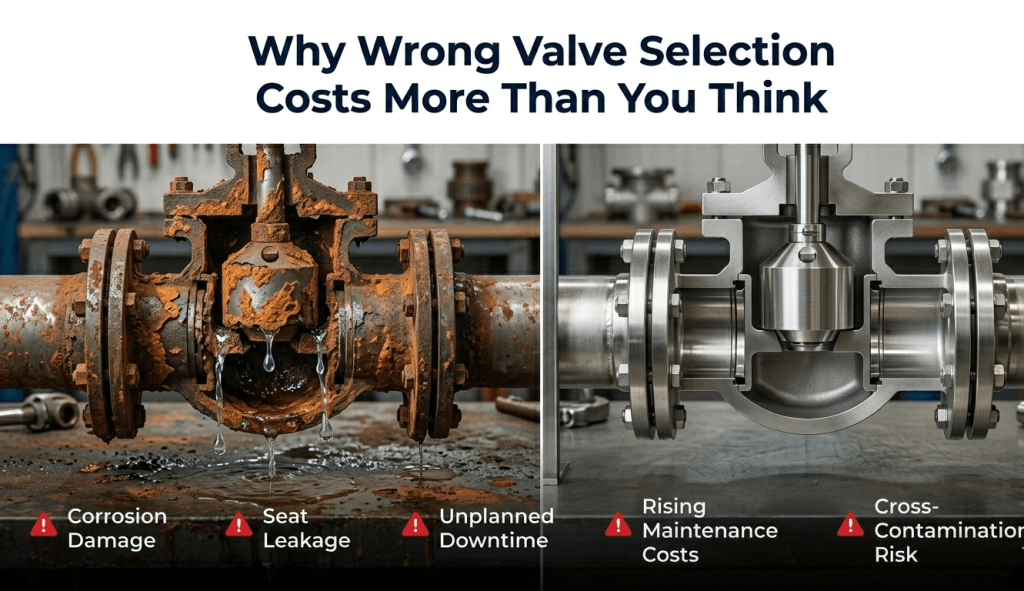
Here’s the thing about water treatment valve failures. They don’t announce themselves in advance. A valve with the wrong seat material in a chlorine dosing line will look fine during commissioning. Six months later it’s leaking. A gate valve that somebody has been running partially open on a filter outlet line, because it was convenient for flow adjustment, starts showing accelerated wear at the seat that wasn’t in anyone’s maintenance plan.
The consequences stack up in ways that aren’t always obvious on a purchase order:
- Corrosion moving through the valve body when material selection didn’t account for the actual treatment chemistry being used
- Seat and seal leakage when elastomers that weren’t rated for the service fluid start reacting after extended exposure
- Downtime that lands, reliably, during the worst possible periods – peak summer demand, flood events, high-consumption periods
- Maintenance costs climbing steadily from part replacements that should have been unnecessary
- The cross-contamination scenario that no utility wants to explain to a regulator or to the public
According to the World Health Organization, access to safe drinking water is a basic human right. The infrastructure that delivers it, including every valve in that system, carries that responsibility directly.
The cost difference between a correctly specified valve and a cheaper one that isn’t quite right for the service is real and visible on a purchase order. What isn’t visible on that same document is what a supply interruption during peak demand actually costs, or what a contamination incident costs, or what a failed inspection costs. Utilities that have been through those experiences tend to stop looking for savings on valve specifications.
Gate Valves and Butterfly Valves: The Workhorses of Water Treatment
Water treatment plants use several different valve types, and they aren’t interchangeable. Each one was designed for specific duties. Understanding which type belongs in which application is where the real specification work happens for valves for water treatment plants.
Gate Valves for Water Treatment Isolation Duties
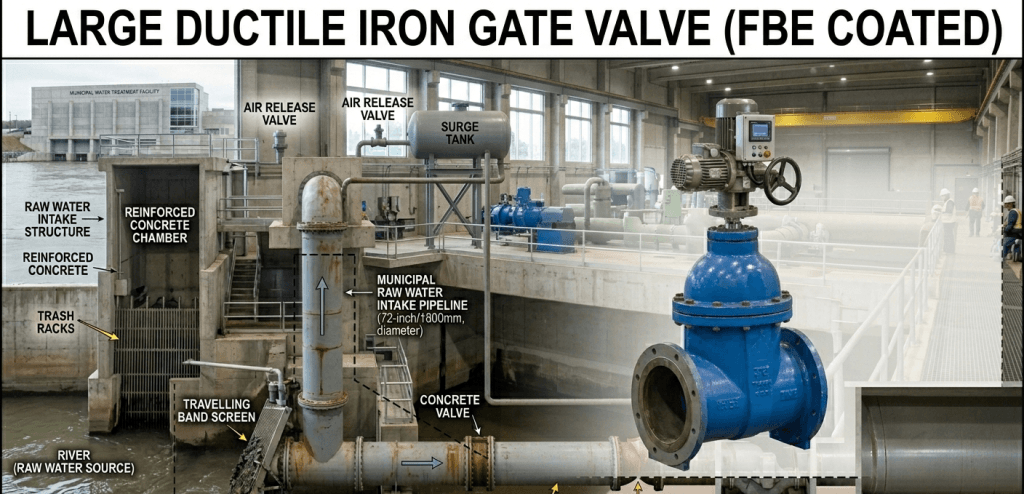
Go through most water treatment plants and gate valves are everywhere. They’ve been the standard isolation valve in water supply for a long time, and the design makes sense for that duty. When a gate valve opens, the disc lifts completely clear of the flow path. Full-bore passage, minimal pressure drop, nothing obstructing the flow. When it closes, the gate seats and holds.
Where they belong:
- Raw water intake lines where full, unobstructed flow matters and the valve is either open or closed
- Main distribution headers and trunk mains handling large volumes
- Filter inlet and outlet lines for isolation during maintenance
- Pump suction and discharge lines where reliable shut-off without flow restriction is needed
What they’re not suited for is throttling. This comes up enough that it’s worth being direct about. A gate valve operated partially open creates turbulence at the seat that accelerates wear in a way most maintenance schedules don’t anticipate. In water treatment service, gate valves should be fully open or fully closed. Running them anywhere in between is how you create premature seat damage that wasn’t in the budget.
Materials in water treatment service are typically ductile iron with epoxy-coated internals for raw and general water service, and SS304 for treated water and potable distribution lines where corrosion resistance matters more. The gate valve range covers the sizes, materials, and connection types used in water treatment service.
Butterfly Valves for Water Plant Flow Regulation
Butterfly valves are probably the most versatile option in a water treatment plant, and they show up in a lot of different applications for practical reasons. They’re compact. They’re lighter than an equivalent gate valve on larger diameters. Quarter-turn operation. And on large-diameter lines, the cost difference compared to gate valves is significant enough that project budgets notice.
The disc rotates 90 degrees to open or close, which means they can also be used for throttling where a gate valve can’t. In water treatment plants you’ll find them handling:
- Flow regulation across water distribution mains where some throttling control is needed
- Filter outlet lines for both isolation and flow adjustment
- Chemical feed line control where the line diameter justifies it
- Large-diameter channel and sluice applications where older mechanical gates are being replaced
Resilient-seated butterfly valves are the standard for potable water service, using EPDM or NBR elastomer seats. The elastomer certification is important here and gets overlooked more than it should. NSF/ANSI 61 certification on the seat material confirms it won’t leach harmful compounds into the water supply. For bigger diameter applications, double-offset or triple-offset designs give better sealing performance and the seat life holds up better under frequent cycling.
Ball Valves for Chemical Dosing Lines
Ball valves handle smaller-diameter lines throughout the plant where fast, reliable isolation matters. Quarter-turn, positive shut-off, simple mechanism. They don’t offer the same throttling range as a globe valve, but for on/off service on smaller lines they’re the practical choice.
In water treatment facilities they’re typically used on:
- Chemical dosing and metering lines where precise isolation on small-bore connections is needed
- Sampling points and drain connections
- Instrument isolation on pressure transmitters and flow meters
- Service water and utility supply connections
SS316 ball valves with PTFE seats are the standard specification for chemical dosing lines carrying chlorine compounds, coagulant solutions, or acids. Full-bore design keeps the internal diameter matched to the pipe, which minimises pressure drop and makes inspection and pigging straightforward. The XSIS Valves product range includes ball valves sized and rated for water treatment service.
Check Valves for Backflow Prevention in Water Systems
Check valves do one thing: they stop backflow. Flow moves in one direction, and when it reverses the valve closes on its own without any actuation. That automatic response is exactly what makes them essential in certain positions across a water treatment plant.
The applications where you need them:
- Pump discharge lines, so that when a pump trips or shuts down, water doesn’t flow back through it
- Chemical injection points, to prevent feed lines from siphoning contaminated water back into chemical storage tanks
- Filtration system outlet headers where reverse flow during backwash cycles would cause problems upstream
- Distribution networks where pressure zones need to be maintained and contamination from reverse flow needs to be prevented
Swing check valves handle large-diameter water lines well because the pressure drop they add is minimal. On smaller, faster-cycling lines where compact design and spring-assisted closure are both needed, lift check valves and dual-plate designs work better.
Globe Valves for Precise Flow Control in Water Treatment
Globe valves solve a problem that gate and butterfly valves can’t: precise flow regulation. A globe valve can be positioned accurately to control flow rate, which makes it the right choice anywhere an on/off device doesn’t give you enough control authority.
In water treatment plants they typically end up in:
- Chemical feed rate control on dosing pumps where the flow rate needs to be adjusted accurately and held there
- Pressure regulation in high-pressure zones within the distribution system
- Flow balancing in filter wash water systems where consistent flow rate across multiple filters matters
- Steam and hot water lines in sludge treatment sections
The limitation is pressure drop. Globe valves create more flow resistance than gate or butterfly valves even at full open, which means they’re best suited to lines where the flow regulation capability justifies that trade-off.
Automated Control Valves and SCADA Integration
Large water treatment plants can’t run effectively on manual valve operation. The number of process zones, the speed at which conditions change, and the precision required for dosing and level control all push toward automation. Control valves with pneumatic or electric actuators handle the majority of process automation duties.
Where automated valves are typically specified:
- Level control in raw water storage reservoirs and clear water tanks
- Pressure reducing and sustaining stations within distribution mains
- Automated filter backwash sequences that run on timed cycles
- Chlorination dosing control in disinfection systems where consistency directly affects water safety
XSIS Valves manufactures automation-ready valve solutions with electric and pneumatic actuators that integrate with SCADA and process control systems. Plant operators can manage flow, pressure, and dosing remotely with better accuracy and response time than manual operation allows.
Industrial Strainers for Water Treatment Protection
Strainers aren’t valves in the traditional sense but they’re part of the same specification exercise in water treatment plants. They sit upstream of control valves, dosing pumps, and flow meters to catch debris and particulate before it damages or blocks the equipment downstream. Y-strainers and basket strainers are both in common use, available in cast iron, ductile iron, and stainless steel. XSIS Valves supplies industrial strainers for water treatment, chemical processing, power, and oil and gas applications.
Ductile Iron and SS316: Material Selection for Water Treatment Valves
Material selection is where a lot of specification errors originate. The conditions across a water treatment plant are aggressive enough that material choices which work in general industrial service can fall short here:
- Ductile iron with fusion-bonded epoxy coating handles most of the large-diameter gate and butterfly valve duties in raw and potable water service. The epoxy coating provides corrosion protection from the water itself and from soil conditions in buried installations.
- Cast iron suits general utility water service in non-corrosive conditions and shows up in older plant designs. For new specifications, ductile iron is the stronger choice.
- SS304 and SS316 are used in potable water distribution lines, chemical dosing systems, and treated effluent lines. When chlorides or aggressive treatment chemicals are present, SS316 is the right grade.
- PFA-lined valves are for the aggressive end of chemical dosing service. Concentrated acids, caustic soda, chlorine solutions at high concentrations where stainless steel starts losing the battle.
- Bronze and brass come up on small-diameter service connections, instrument isolation, and sampling valves in non-chemical water service.
One requirement that cuts across all of these for potable water service: NSF/ANSI 61 compliance. This certification confirms that valve materials, coatings, and seat compounds won’t leach harmful substances into drinking water. Verify it before any specification for potable water contact is finalised.
NSF ANSI 61 and AWWA: Standards Governing Water Treatment Valve Procurement
Procurement for water treatment projects needs to align with applicable standards. These define material grades, pressure ratings, testing protocols, and performance requirements:
- NSF/ANSI 61 covers drinking water system component safety for materials in potable water contact
- AWWA C504 / C509 / C515 are American Water Works Association standards covering butterfly valves, gate valves, and resilient wedge gate valves in water supply systems
- ISO 9001:2015 is the quality management standard applicable to valve manufacturers
- API 598 covers valve testing and inspection protocols for pressure and seat leak verification
- IS 780 / IS 14846 are Indian Standards for sluice valves and butterfly valves in water supply, required for Indian municipal projects
- BS EN 1074 is the European standard for valve requirements in water supply systems
Key Selection Factors for Valves in Water Treatment Plants
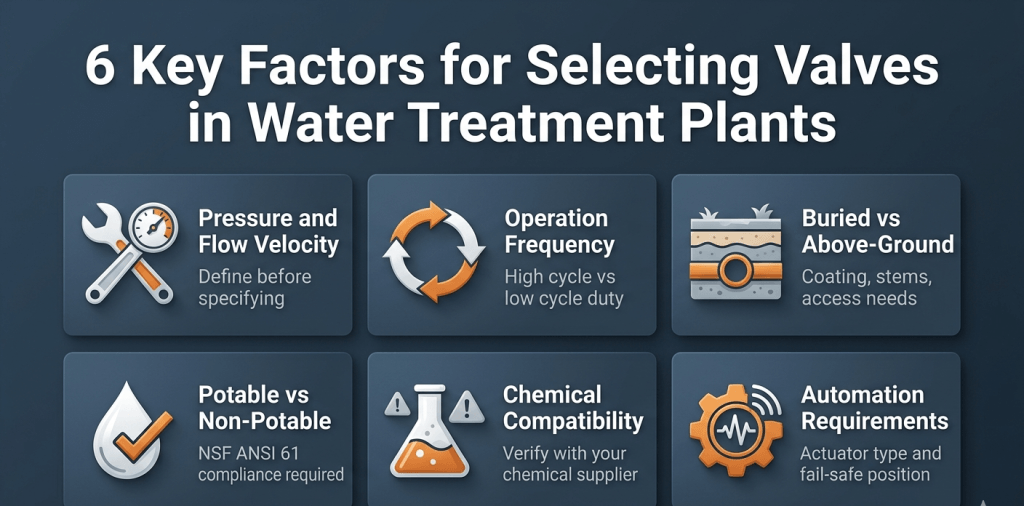
Valve type and material get most of the attention, but several practical factors drive real-world decisions in ways that selection guides don’t always cover:
- Pressure rating and flow velocity need to be documented before anything gets specified. These determine pressure class and body wall thickness. Assumptions made here become commissioning problems.
- How often does this valve actually operate? A backwash valve on a filtration system cycles constantly and needs actuators and seat materials rated for high cycle life. A trunk main isolation valve that opens once a year is a completely different specification.
- Buried or above-ground? Buried valves need external corrosion protection, cathodic protection compatibility, and extended stems for surface operation. Above-ground valves need to account for ambient temperature range and maintenance access.
- Potable versus non-potable service. NSF/ANSI 61 or equivalent applies to any valve touching drinking water. Raw water lines and wastewater zones have different requirements entirely.
- Chemical compatibility needs to be verified against the specific chemicals you’re using, not just broad material categories. Do that with your chemical supplier before the specification is locked.
- Automation requirements need to be in the specification at procurement. Actuator type, fail-safe position, and control signal type are not details to add later.
Conclusion
Valves for water treatment plants aren’t a commodity purchase. Every zone in a water treatment facility has different process conditions, chemical exposure, operating frequencies, and consequences when something fails. The specification has to reflect that zone by zone.
XSIS Valves has over 17 years of industrial valve manufacturing experience across water treatment projects of different scales. Whether you need ductile iron gate valves for large trunk mains, SS316 ball valves for chemical dosing lines, or automated butterfly valves for filter control, XSIS Valves team works through the requirements for your plant.
Frequently Asked Questions
Gate valves and butterfly valves together handle most of the work. Gate valves are standard for isolation on large-diameter raw and potable water lines. Butterfly valves take over where flow regulation is needed and where the combination of space, cost, and diameter makes them the more practical choice.
For most water service applications, ductile iron with fusion-bonded epoxy coating is the standard valve body material. SS316 is used on chemical dosing lines and treated water systems where chloride exposure is a factor. PFA-lined valves are reserved for the most aggressive chemical dosing service where stainless steel doesn’t hold up.
NSF/ANSI 61 certifies that valve materials, coatings, and seat compounds don’t leach harmful substances into drinking water. Any valve in contact with potable water needs this certification. Without it there’s no formal assurance the valve isn’t introducing contamination into the supply.
Yes, resilient-seated butterfly valves work for both duties in water treatment service. When precise flow control is the main requirement, particularly in dosing and pressure regulation applications, globe valves or dedicated control valves give better performance and repeatability.
Wrong material selection is the most common cause. After that it’s running gate valves partially open for throttling they weren’t designed for, inadequate corrosion protection on buried installations, and using valves without NSF/ANSI 61 certified seats on potable water lines. All specification failures, not maintenance failures, which means all avoidable.
Yes. Municipal water supply projects in India are typically specified to IS 780 for sluice valves and IS 14846 for butterfly valves. AWWA and ISO standards are also widely accepted on Indian EPC and utility projects, particularly on larger schemes or internationally funded infrastructure programmes.