
Ask any seasoned pharma plant engineer what component causes the most arguments during procurement reviews. Nine times out of ten, the answer isn’t what you’d expect. Not the reactors. Not the filtration skids. It’s the valves.
And honestly, once you understand what’s actually flowing through those lines, it makes sense. Purified water. Water for injection. Clean steam. Active pharmaceutical ingredients. These aren’t process fluids in the normal sense. They’re either going into medicine directly, or they’re in contact with systems that produce one. Industrial valves for pharmaceutical manufacturing sit right in the middle of that responsibility, and the margin for error is genuinely small.
This isn’t a theoretical guide. This guid will help you to understand better Industrial valves for pharmaceutical manufacturing. It covers the valve types that work, the material and compliance requirements that matter, and the specification mistakes that keep showing up on projects that should have gone more smoothly.
Why Do Standard Valves Keep Getting Rejected in Pharma Plants?

Here’s something that surprises a lot of engineers making the switch from general industry. A valve they’ve spec’d without issue for a decade gets flagged in the first pharma procurement review they sit in. Not because of price. Not because of the brand. Because of things that weren’t on their radar before.
Standard industrial valves weren’t built for this environment. The gaps aren’t subtle:
- Fluid pockets that don’t drain. The internal geometry of a standard valve often leaves areas where the product just sits. Between CIP runs, that standing fluid isn’t neutral. It’s a contamination environment that builds over time, quietly, until a microbial count test flags it.
- Surface finish that looks fine but isn’t. Touch the inside of a standard valve body and it feels smooth enough. At the microscopic level it has surface variation that cleaning chemistry can’t reliably penetrate. That’s where residue hides, and where bacteria establish between cycles.
- No paperwork trail. FDA and EMA auditors aren’t just checking whether your process runs. They’re tracing components. Material test reports, surface finish certifications, FDA 21 CFR compliance statements. A standard valve typically ships with none of it. A component with no documentation trail is effectively unqualified, regardless of how it performs in the line.
- Seat and seal materials with no formal declarations. Chemically compatible isn’t the same as compliant. In a regulated facility the difference matters.
Look, the price gap between standard and pharmaceutical-grade valves is real. Nobody’s pretending otherwise. But a single batch rejection, or a 483 observation during an FDA inspection, costs more than years of savings from cheaper valve choices. The plants that have gone through that experience don’t go back.
Three Standards That Shape Every Pharma Valve Spec
When procurement teams ask which regulations apply to industrial valves for pharmaceutical manufacturing, the answer usually involves three overlapping frameworks. Understanding what each one actually demands saves a lot of back-and-forth with suppliers.
- ASME BPE: is the technical baseline. Ra 0.8 µm on product-contact surfaces as a minimum. WFI and sterile lines usually need Ra 0.4 µm or better. SS316L is mandated for product-contact components. Weld quality is specified. Full drainability with zero dead legs is required, not recommended. For any facility exporting to the US or under FDA oversight, this standard is the floor, not an upgrade.
- GMP guidelines: from FDA, EMA, and India’s CDSCO focus on outcomes. Valves must be non-reactive with process fluids, cleanable without disassembly, and sterilisable where the application calls for it. WHO’s GMP guidance specifically calls out cross-contamination prevention as a core requirement, and that connects directly to how product-contact valves are selected, installed, and kept in service.
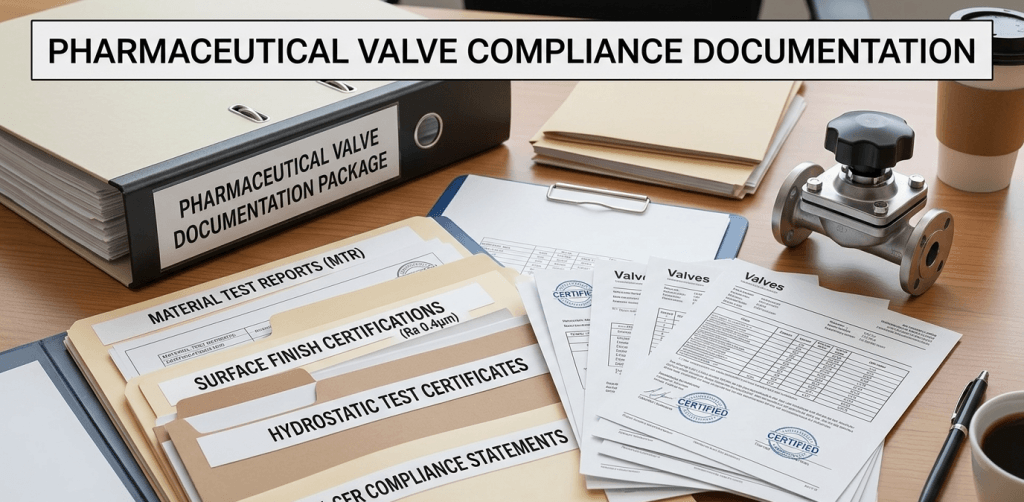
- Pre-shipment documentation: is the part that trips up even experienced procurement teams. It gets treated as an afterthought and becomes urgent when an auditor shows up. The complete package should include material test reports, hydrostatic test certificates, dimensional inspection records, surface finish certifications with actual Ra measurements, and FDA 21 CFR compliance statements. Ask for it before anything ships. Tracking it down during a validation or an audit is a problem that’s completely avoidable.
Valve Types: What Goes Where and Why?
Getting valve type selection right is where most of the real specification work happens. The options aren’t interchangeable. Wrong valve type on a product-contact line means expensive rework after qualification, which is the worst possible time to be pulling piping apart.
Ball Valves
Ball valves are the workhorse for isolation and shut-off across most of a pharmaceutical plant. Purified water loops, solvent transfer lines, general utility systems. This is their territory.
- SS316L construction, full-bore design, PTFE or FDA-compliant soft seats
- Tri-clamp connections for field disassembly that doesn’t disrupt surrounding pipe runs
- Full-bore geometry isn’t just a flow rating thing. It’s what allows CIP to actually work
- Reduced-bore designs on WFI lines are a known problem. They create stagnant zones that routine cleaning can’t flush. Cleaning validation teams find them eventually.
The XSIS Valves industrial product range including ball valves built to hygienic design requirements is available on their website.
Butterfly Valves
Butterfly valves make sense on larger-diameter lines where space is tight and minimising pressure drop matters.
- Clean steam headers, CIP mains, and process gas lines are the natural fit
- Crevice-free internal geometry and SS316L disc material are both required
- FDA-compliant elastomer seats aren’t optional. They’re the baseline for pharma service
- The compact footprint is a genuine practical advantage in dense pipe runs
Globe Valves
Globe valves solve a different problem than most valve types. They’re not primarily isolation devices. They’re control devices.
- Used where precise throttling matters: dosing systems, blending, reactor jacket temperature control, steam regulation
- Polished internal flow paths and FDA-compliant stem packings are required specs
- The configuration needs to prevent fluid entrapment at every operating position, not just fully open
Diaphragm Valves
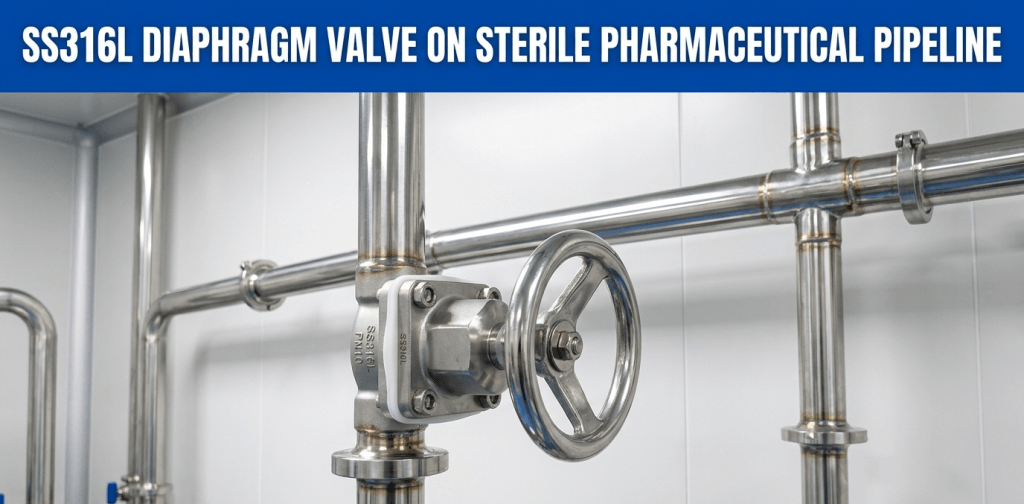
For sterile and aseptic service, diaphragm valves are the standard. They’ve held that position for a long time because the design principle genuinely solves the contamination problem. The diaphragm physically separates the product stream from the entire mechanical side. Stem, actuator, all hardware. None of it touches the fluid.
- Standard on sterile filling lines, bioreactor systems, and aseptic processing
- EPDM and PTFE are both in use. Each needs FDA 21 CFR compliance documentation
- Chemical compatibility with the process fluid is one question. Survival under your SIP cleaning regime is a separate question entirely
- Some materials hold up fine against the product but start degrading after repeated peracetic acid SIP cycles. That’s a discovery you want to make before finalising the spec, not after the first failure
XSIS Valves supplies diaphragm valves and other hygienic types for pharmaceutical applications. Their pharma and industrial valve solutions are built to the compliance standards regulated environments require.
Check Valves and Automated Control Valves
Check valves in pharmaceutical systems deal with backflow prevention in loops that often run at low differential pressures. Spring-assisted closure is what delivers reliable sealing in those conditions.
- Full drainability and hygienic end connections are both needed to stay integrated with the validated system
- Automated control valves handle temperature, pressure, and flow loops across the plant
- Pneumatic or electric actuation works fine with DCS and SCADA integration
- One thing worth remembering: automation doesn’t change what the valve body needs to be built from. Every hygienic design and material requirement still applies, regardless of how the valve is actuated
SS316L: The Reasons Behind the Standard
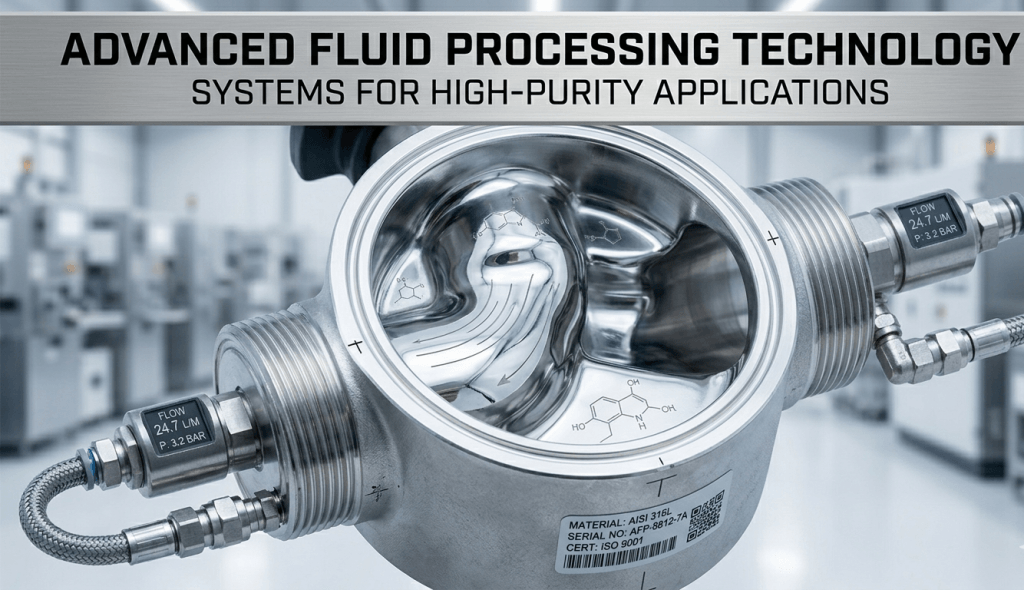
SS316L is in every pharma valve specification. Most engineers know it’s the right material. Fewer know exactly why, which matters when supplier conversations come up.
- It handles welding better than alternatives. Pharma piping systems get welded during installation and often reworked over their service life. Low carbon content in SS316L prevents sensitisation at heat-affected zones, a corrosion vulnerability that higher-carbon grades develop when repeatedly heated during welding.
- It survives cleaning chemistry. NaOH, peracetic acid, and similar agents run through these systems on every single batch. The molybdenum in SS316L gives it meaningfully better chloride corrosion resistance than standard 316 under that kind of continuous exposure.
- It electropolishes reliably. Mechanical polishing gets you part of the way to Ra 0.4 µm. Electropolishing gets you the rest. SS316L responds well to that process, which is how the surface finish cleaning validation depends on getting consistently achieved in production.
- Seat and seal materials carry through. Ball valve seats run PTFE for inertness and temperature stability. Diaphragm and butterfly seats use EPDM or silicone with appropriate compliance declarations.
- For aggressive chemical service, API synthesis lines involving concentrated acids sometimes need PFA-lined valves. These give stronger chemical resistance while keeping a stainless steel structural body. ASME BPE standards are explicit that surface finish and material traceability are non-negotiable for bioprocessing equipment.
Before You Place the Order: A Working Checklist
Most valve specification errors don’t surface at procurement. They show up during commissioning, cleaning validation runs, or in the middle of an audit. A few questions asked before ordering prevent most of them:
- What’s the service classification for each line?
Product-contact lines need full pharmaceutical-grade specification. Utility lines don’t need the same standard. Blanket application of maximum spec everywhere adds cost without any corresponding safety benefit.
- Are operating conditions properly documented?
Temperature range, pressure, flow rate, fluid viscosity. These determine valve type and pressure class. Assumptions made at this stage become commissioning problems later.
- What are the CIP and SIP requirements at each valve position?
A valve that’s compatible with the process fluid can still fail under the cleaning regime. Cleaning temperature, chemical agents, cycle frequency, and SIP conditions all belong in the specification before procurement, not after.
- Are Ra values stated explicitly?
Vague surface finish requirements result in receiving whatever the supplier defaults to. WFI and sterile lines typically need Ra 0.4 to 0.8 µm. Write the number into the purchase order.
- Is the full documentation package confirmed before shipment?
MTRs, hydrostatic test certs, surface finish certifications, FDA 21 CFR compliance statements. These should ship with the valves. Getting them after the fact, when a validation is running or an inspector is on site, is an avoidable headache.
Conclusion
Industrial valves for pharmaceutical manufacturing don’t require complicated engineering. What they require is deliberate specification across valve type, material, surface finish, cleaning compatibility, and documentation, all treated as connected decisions rather than separate line items. Getting any one of them wrong affects whether the others hold up when it matters.
If you’re working through a new project or reviewing existing valve choices ahead of a qualification, the XSIS Valves team can help you work through the requirements for your specific application.
Frequently Asked Questions
SS316L is the material you’ll find in practically every pharmaceutical valve specification. Its low carbon content, molybdenum addition, and compatibility with electropolishing make it genuinely suited to the process fluids and cleaning regimes that GMP environments run on a continuous basis.
The diaphragm creates a physical barrier between the process fluid and the entire mechanical side of the valve. Stem, actuator, all hardware stays separated from the product. That separation is what makes diaphragm valves compatible with aseptic processing and CIP and SIP protocols in a way other valve types simply aren’t.
It determines whether cleaning cycles can do their job. Rough internal surfaces at the microscopic level give bacteria and residual product somewhere to hide that cleaning chemistry doesn’t consistently penetrate. The Ra value controls this directly, and cleaning validation depends on it being correct.
No. Material grade, surface finish, internal geometry, and documentation all fall short of what GMP compliance requires. A standard valve on a product-contact line creates contamination risk and will not hold up under regulatory review.
Material test reports for all product-contact components, hydrostatic test certificates, dimensional inspection records, surface finish certifications showing Ra measurements, and FDA 21 CFR material compliance statements. All of it is required for GMP audits and process validation. None of it is optional.
A dead leg is any section of pipework that doesn’t get swept during normal operation or CIP cycles, which means fluid stagnates in that section between cleaning runs. In a pharmaceutical system, that stagnant fluid is a contamination risk. ASME BPE requires valve geometry and system layout that eliminates dead legs. It’s a hard requirement, not a guideline.