
Choosing the right industrial valve supplier is an important decision for industries where pressure control, flow regulation, safety, and process reliability directly affect operations. ISO & API Certified Valve Makers in Ahmedabad: Why It Matters is therefore more than a question of certification logos; it is about understanding how recognized quality systems and product standards can support dependable valve manufacturing, inspection, documentation, and delivery.
Ahmedabad has a strong industrial ecosystem serving chemical processing, pharmaceuticals, textiles, engineering, petrochemicals, oil and gas, water treatment, and other process industries. For these applications, buyers often look beyond price and compare industrial valve manufacturers, manufacturing capabilities, material quality, pressure ratings, testing procedures, and quality documentation.
ISO certification can indicate a structured quality-management system, while relevant API standards can define requirements for particular valve products. ISO 9001 is specifically designed around quality-management systems, while ISO 5208 addresses pressure testing of metallic industrial valves.
What Does ISO and API Certification Mean for Valve Manufacturers in Ahmedabad?
For buyers, the first question is often what certification actually means in practical terms. ISO certification generally relates to an organization’s management system and its ability to establish controlled, repeatable processes for quality. ISO 9001, for example, covers requirements for establishing, implementing, maintaining, and continually improving a quality-management system. This can help manufacturers manage processes, customer requirements, documentation, corrective actions, and continual improvement more systematically.
API standards, on the other hand, can be product-specific. The American Petroleum Institute lists separate standards for different valve categories, including steel gate valves, metal ball valves, check valves, and butterfly valves. For example, API 600 covers steel gate valves, while API 608 covers metal ball valves and API 609 covers butterfly valves. Consequently, buyers should ask whether the supplier’s particular product and manufacturing facility are covered by the relevant API requirements.
What Buyers Should Understand
- Quality Management: ISO 9001 certification demonstrates that a manufacturer operates a recognized quality-management framework. It does not, by itself, certify every individual valve design or performance characteristic.
- Product Standards: API standards can apply to specific valve types and applications. Buyers should identify the exact API specification applicable to the valve required for their project.
- Manufacturing Controls: A structured QMS can support consistent purchasing, production, inspection, testing, documentation, and corrective-action procedures throughout the manufacturing process.
- Certification Scope: Always check the certificate scope, issuing certification body, validity, manufacturing location, and applicable standard before treating certification as evidence for procurement decisions.
- Technical Compliance: Certification should complement technical verification. Valve size, pressure class, materials, end connections, trim, temperature, and service conditions still need to match the project specification.
- Supplier Credibility: A transparent manufacturer that readily provides relevant certificates and technical documentation can make vendor evaluation easier and reduce uncertainty during procurement.
Why Should Industries Choose ISO & API Certified Valve Makers in Ahmedabad?
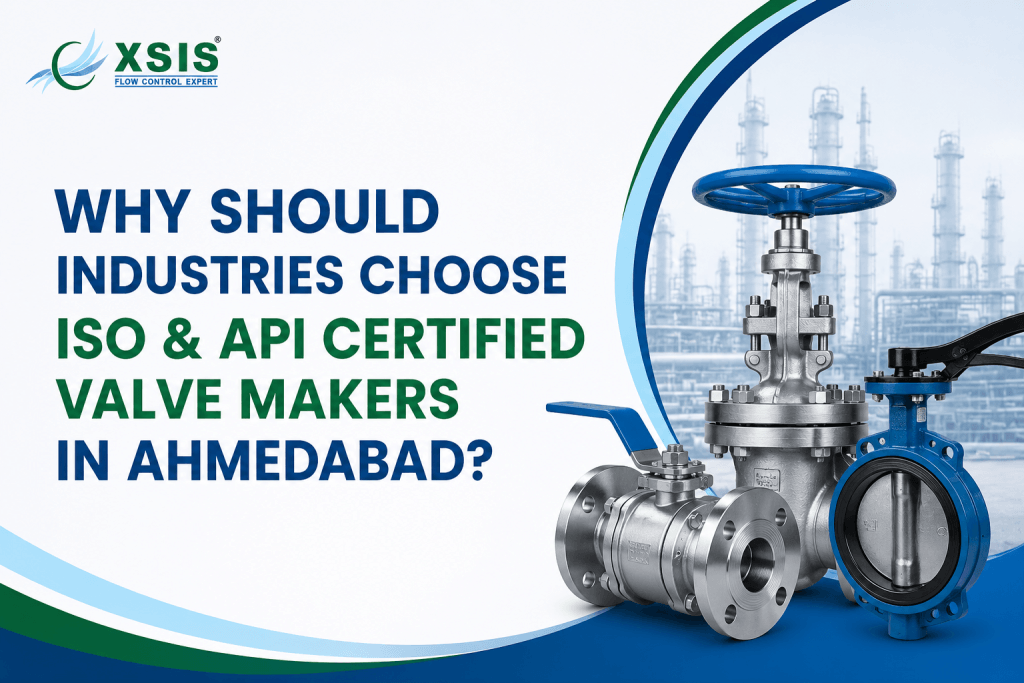
Industrial valves often operate in demanding environments involving high pressure, elevated temperatures, corrosive fluids, steam, hydrocarbons, chemicals, or continuous process cycles. A valve failure can result in leakage, production interruptions, maintenance costs, environmental concerns, or safety risks. Selecting ISO & API Certified Valve Makers in Ahmedabad: Why It Matters becomes especially relevant when valves are being specified for critical process lines rather than simple low-risk applications.
Certification does not guarantee that a valve will never fail, but it provides an important framework for evaluating the manufacturer’s processes and stated conformity. ISO 9001 focuses on consistent quality-management practices, while applicable API product standards establish requirements for particular valve categories. In addition, ISO 5208 provides a recognized framework for pressure testing metallic industrial valves, including assessment of pressure-boundary integrity and closure tightness.
Key Reasons Certification Matters
- Process Consistency: Controlled manufacturing processes can help reduce variation between production batches. Consistency is particularly important when valves are purchased repeatedly for large industrial projects.
- Quality Assurance: Documented quality procedures support inspection, testing, non-conformance management, and corrective actions. This gives buyers greater visibility into how quality is controlled.
- Project Compliance: EPC contractors and industrial buyers may specify particular standards in procurement documents. Working with suppliers familiar with those requirements can simplify technical evaluation.
- Reduced Operational Risk: Properly specified, manufactured, and tested valves can contribute to reliable flow isolation and control. Certification is one part of a broader risk-management approach.
- Better Documentation: Professional suppliers should be capable of providing relevant certificates, inspection reports, material documentation, and test records when required by the purchase specification.
- Long-Term Value: Selecting a technically capable manufacturer can reduce the likelihood of premature replacement, repeated procurement, and avoidable maintenance expenses.
How Do ISO and API Standards Improve Industrial Valve Quality?
Industrial valve quality depends on much more than the appearance of a finished product. It involves material selection, design, machining, assembly, inspection, pressure testing, sealing performance, traceability, and documentation. API and ISO requirements can contribute to these areas in different ways, depending on the certification and product standard involved.
ISO 5208 is particularly relevant when discussing valve testing because it specifies examinations and tests intended to establish pressure-boundary integrity and verify closure tightness and structural adequacy of the closure mechanism. ISO states that the standard is intended to be used alongside the relevant product standard where applicable. API standards likewise address specific valve categories, meaning the applicable product specification should be identified before purchasing.
Quality Areas to Evaluate
- Material Control: Valve bodies, stems, seats, discs, balls, and other components must be selected according to service conditions. Material certificates and traceability can help verify conformity.
- Dimensional Accuracy: Accurate machining and controlled dimensions are important for proper assembly and compatibility with connected piping systems.
- Pressure Testing: Testing helps evaluate pressure-containing capability and closure performance. The exact test requirements should follow the applicable product and project specification.
- Sealing Performance: Seat and stem sealing are critical to controlling unwanted leakage. Buyers should confirm the required leakage class or test criteria where specified.
- Inspection Procedures: Inspection may include dimensional checks, visual examination, material verification, and other examinations specified by the purchase order or applicable standard.
- Traceability: Proper identification of materials, components, heat numbers, test results, and final products makes quality verification easier throughout the valve lifecycle.
Which Types of Industrial Valves Can Certified Ahmedabad Manufacturers Supply?
Ahmedabad’s industrial market requires different valve designs for different process applications. A manufacturer may produce or supply gate valves, globe valves, ball valves, butterfly valves, check valves, plug valves, control valves, and specialised industrial valves. The appropriate choice depends on whether the valve is required for isolation, throttling, backflow prevention, flow control, or another specific function.
API’s valve-related standards illustrate why buyers need to identify the exact valve category before evaluating compliance. API lists API 594 for check valves, API 600 for steel gate valves, API 602 for smaller gate, globe, and check valves, API 608 for metal ball valves, and API 609 for butterfly valves. This means a buyer should not simply request an “API-certified valve”; the required valve type and applicable specification should be clearly stated.
Common Valve Categories
- Gate Valves: Primarily used for on/off isolation rather than continuous throttling. They are widely used in pipelines where full-flow passage and reliable isolation are required.
- Globe Valves: Designed for flow regulation and throttling applications. Their construction can provide useful control over process flow where isolation alone is insufficient.
- Ball Valves: Use a rotating ball to control flow and are commonly selected where quick operation and tight shut-off are important.
- Butterfly Valves: Compact and relatively lightweight compared with some other valve designs. They are often considered for larger pipe sizes and applications requiring efficient flow isolation.
- Check Valves: Designed to help prevent reverse flow. Selection depends on factors such as line conditions, flow direction, pressure, and installation requirements.
- Specialised Valves: Process industries may require customised materials, trims, actuators, pressure classes, or corrosion-resistant construction depending on operating conditions.
How Can Buyers Verify an ISO or API Certified Valve Manufacturer?
A certificate displayed on a website or brochure should be treated as the beginning of verification rather than the end. Buyers should examine the certification scope and determine whether it applies to the relevant organisation, manufacturing location, quality-management system, or product standard. ISO itself advises organisations to refer to the complete standard reference when making certification claims.
For API-related procurement, buyers should also verify whether the manufacturer is licensed for the relevant API product standard where an API Monogram licence is required or specified. API maintains programme information and identifies the standards included within its Monogram programme. A procurement team should therefore compare certificates with the technical specification instead of relying solely on marketing language.
A Practical Verification Checklist
- Check Certificate Scope: Confirm the organisation name, facility location, scope of certification, standard reference, and validity dates before approval.
- Verify Product Coverage: Determine whether the specific valve type is covered by the claimed product standard. ISO certification alone does not mean every valve is API-certified.
- Request Test Reports: Ask for applicable hydrostatic, pneumatic, shell, seat, or other required test documentation according to the purchase specification.
- Review Material Documents: For critical applications, request material certificates and traceability records for pressure-retaining and other specified components.
- Assess Technical Capability: Examine manufacturing equipment, inspection facilities, engineering resources, testing capacity, and experience with the required valve category.
- Compare Documentation: A reliable supplier should be able to provide coherent technical documents, drawings, datasheets, certificates, inspection reports, and product identification records.
Are ISO & API Certified Valve Makers in Ahmedabad Better for Oil, Gas and Chemical Industries?
Oil, gas, petrochemical, chemical, and process industries can involve demanding operating conditions where valve selection must account for pressure, temperature, fluid characteristics, corrosion, emissions, and required shutdown performance. For these sectors, standards-based procurement can provide a more structured method for assessing valve manufacturers and products.
API’s published standards cover several valve categories used in petroleum and natural-gas-related applications, including pipeline and piping valves, steel gate valves, smaller gate/globe/check valves, metal ball valves, and butterfly valves. However, buyers should avoid assuming that an API reference automatically makes a valve suitable for every oil, gas, or chemical application. Service conditions and project specifications must determine the final selection.
Why These Industries Need Careful Selection
- High-Pressure Service: Pressure-containing components require appropriate design, materials, manufacturing controls, and testing for the specified service conditions.
- Corrosive Media: Chemicals and process fluids can attack unsuitable materials. Valve body, trim, seat, gasket, and seal materials should therefore be selected carefully.
- Temperature Requirements: High or low temperatures can affect material strength and sealing performance. The valve specification should match the actual operating range.
- Leakage Control: Process leakage can affect safety, environmental performance, product quality, and operating costs. Required sealing performance should be defined before procurement.
- Shutdown Reliability: Isolation valves may be required during maintenance or emergency situations. Reliable operation depends on correct valve design, installation, maintenance, and testing.
- Industry Documentation: EPC and industrial projects frequently require detailed documentation. A manufacturer experienced with standards-based procurement can make technical review and project documentation more efficient.
What Should You Check Before Buying Valves from Ahmedabad Manufacturers?
Price is naturally an important purchasing factor, but it should not be the only selection criterion for industrial valves. A low initial price can become expensive if the valve has poor sealing, unsuitable materials, inadequate testing, limited documentation, or a short service life. A better procurement approach evaluates technical compliance, quality systems, lifecycle value, delivery capability, and after-sales support together.
The buyer should begin with a clear valve datasheet or purchase specification. Important details can include valve type, nominal size, pressure class, end connection, body and trim material, seat material, operating temperature, medium, actuator requirements, testing requirements, applicable standards, inspection requirements, and documentation. API purchasing guidance for products such as API 600 and API 608 demonstrates the importance of clearly specifying technical details in purchase documentation.
Important Purchasing Factors
- Application: Clearly define whether the valve will provide isolation, throttling, backflow prevention, or another function before selecting the design.
- Pressure and Temperature: Match the pressure class and material selection to the actual operating and design conditions rather than selecting solely by nominal size.
- Materials: Confirm body, trim, seat, gasket, and seal materials according to fluid compatibility, temperature, pressure, and corrosion conditions.
- Testing: Establish the required inspection and pressure-testing procedures before placing the order. Applicable standards and project specifications should govern acceptance criteria.
- Documentation: Confirm which drawings, datasheets, certificates, inspection reports, test reports, and material records will be supplied with the valves.
- After-Sales Support: Consider spare parts, technical assistance, maintenance support, warranty terms, and response times when evaluating total supplier value.
How Do Certified Valve Makers Help Ahmedabad Industries Reduce Long-Term Costs?
The purchase price of a valve represents only one part of its total cost. Installation, inspection, maintenance, replacement, process downtime, spare parts, leakage, and emergency repairs can have a much larger financial impact over the valve’s service life. Choosing a manufacturer with controlled quality processes and appropriate product-standard experience can support a lifecycle-oriented procurement strategy.
This is why ISO & API Certified Valve Makers in Ahmedabad: Why It Matters should be considered from a total-cost perspective. Certification does not automatically make one manufacturer better than another, but it gives buyers useful evidence about quality systems or product-standard participation when properly verified. Combined with technical competence, testing, traceability, and after-sales service, these factors can contribute to more predictable industrial valve performance.
Ways Certification Can Support Cost Efficiency
- Fewer Quality Issues: Better-controlled processes can help identify and prevent non-conformities before products reach the customer, potentially reducing costly rework and replacement.
- Lower Downtime Risk: Reliable valves can support continuous operation and reduce interruptions associated with premature failures or leakage.
- Better Maintenance Planning: Traceable documentation and known specifications make it easier to identify correct replacement parts and maintenance requirements.
- Reduced Procurement Risk: Standardized documentation helps engineering and purchasing teams compare suppliers more effectively and identify gaps before ordering.
- Longer Service Value: Correct material selection, appropriate design, and suitable testing can contribute to dependable service over the intended operating life.
- Improved Vendor Relationships: Suppliers that maintain clear quality systems and documentation can support repeat orders, audits, inspections, and long-term industrial procurement programs.
Conclusion
Selecting the right industrial valve manufacturer requires a balance of technical performance, quality management, standards compliance, testing, documentation, and lifecycle value. ISO & API Certified Valve Makers in Ahmedabad: Why It Matters Because Recognized Quality Systems and Applicable Product Standards Can Give Industrial Buyers a More Structured Basis for Evaluating Suppliers and Reducing Procurement Uncertainty.
For Ahmedabad industries, the best approach is not simply to search for a manufacturer displaying ISO or API logos. Instead, verify the exact certificate scope, relevant API specification, valve design, material selection, pressure rating, testing requirements, inspection documentation, and manufacturing capabilities. When these factors are evaluated together, businesses can make more informed valve purchasing decisions and select suppliers better aligned with demanding industrial applications.
Explore Our Recent Blog
- Industrial Valves for the Textile Industry in Ahmedabad
- Valves for Chemical Processing Plants in Ahmedabad
- Industrial Valves for Power Plants Near Ahmedabad
- Valves for HVAC Systems in Ahmedabad
- Industrial Valves for the Dyeing and Textile Processing Industry in Ahmedabad
Frequently Asked Questions
1. What does ISO certification mean for a valve manufacturer?
ISO certification generally indicates that the organization has a quality-management system assessed against the requirements of a particular ISO standard. ISO 9001 focuses on quality-management processes rather than certifying every individual valve. Buyers should therefore review the exact certificate scope and standard reference before making procurement decisions.
2. What does API certification mean for industrial valves?
API requirements can relate to specific valve products and industries, depending on the applicable API standard or program. API lists standards covering products such as pipeline valves, steel gate valves, ball valves, check valves, and butterfly valves. Buyers should identify the exact API specification applicable to their valve instead of relying on a general “API certified” statement.
3. Are ISO-certified valves automatically API-certified?
No. ISO quality-management certification and API product-standard compliance are different matters. A manufacturer may have an ISO-certified quality-management system without holding an API license for a particular valve product, so buyers should verify both requirements separately when the project specification calls for them.
4. Why is valve pressure testing important?
Pressure testing helps assess the integrity of pressure-containing components and the tightness of valve closure. ISO 5208:2015 specifies examinations and tests for metallic industrial valves and addresses pressure-boundary integrity, closure tightness, and structural adequacy of the closure mechanism. The applicable product standard and project requirements should determine the final testing regime.
5. Which API standards are relevant to industrial valves?
The appropriate API standard depends on the valve type and application. The API currently lists standards including API 594 for check valves, API 600 for steel gate valves, API 602 for smaller gates, globes, and check valves, API 608 for metal ball valves, and API 609 for butterfly valves. API 6D also covers pipeline and piping valves.
6. What should I ask an Ahmedabad valve manufacturer before placing an order?
Ask for the applicable ISO and API certificates, certificate scope, product datasheet, technical drawings, material information, pressure and seat-test documentation, inspection requirements, and traceability records. You should also confirm valve size, pressure class, end connections, materials, operating temperature, fluid service, actuator requirements, delivery schedule, warranty, and after-sales support.