
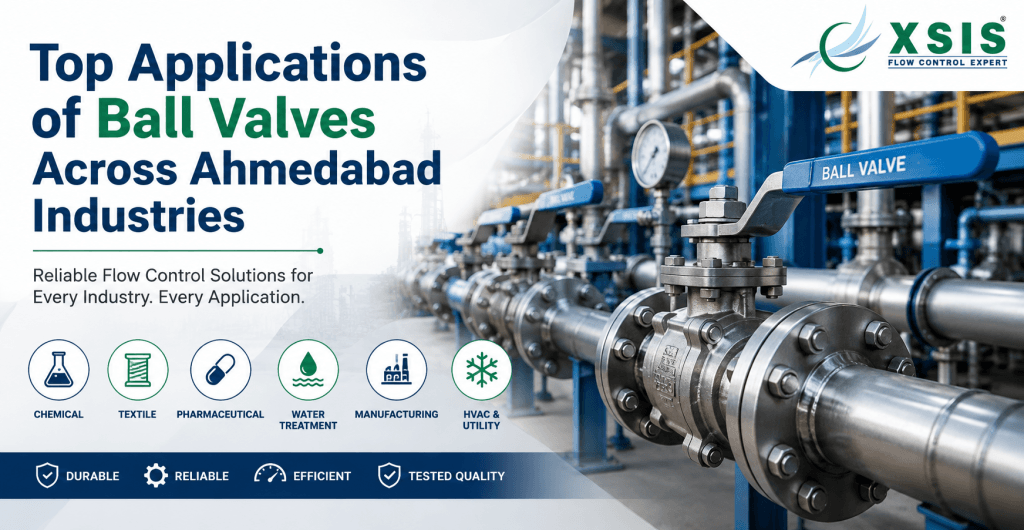
Ahmedabad is a major industrial centre where manufacturing, chemicals, textiles, pharmaceuticals, food processing, water treatment, engineering, and infrastructure projects require dependable flow-control systems. In these demanding environments, ball valves are widely considered for applications that require reliable shut-off, quick operation, compact installation, and controlled handling of liquids, gases, and compatible process media.
Their straightforward design makes them suitable for many industrial piping arrangements. Understanding the Top Applications of Ball Valves Across Ahmedabad Industries helps engineers, plant managers, procurement teams, and maintenance professionals choose the right valve for specific operating conditions.
Ball valves can be manufactured in materials such as stainless steel, carbon steel, and other alloys, with different seat and seal materials selected according to temperature, pressure, and media compatibility. The correct specification is therefore essential for safe and efficient operation.
What Are the Top Applications of Ball Valves Across Ahmedabad Industries?
Ball valves use a spherical closure element with a passage through its centre. When the bore aligns with the pipeline, the valve allows fluid to pass; when the ball rotates to block the passage, flow is stopped. This quarter-turn operating principle provides fast isolation and makes ball valves in Ahmedabad particularly useful where pipelines need frequent or emergency shut-off.
Across Ahmedabad’s industrial ecosystem, ball valves can be found in utility lines, process piping, water systems, compressed-air networks, chemical handling systems, fuel services, and manufacturing equipment. Their compact construction and relatively simple operating mechanism can reduce installation complexity while providing dependable isolation. However, selection should always consider pressure class, temperature, fluid properties, valve size, end connection, and material compatibility.
Why Are Ball Valves Suitable for Industrial Piping?
Ball valves are especially useful where tight shut-off and rapid operation are important. A properly selected valve can provide efficient isolation with comparatively low pressure loss when fully open, making the design attractive for many process and utility applications. Manual handles are common for smaller installations, while larger or automated systems may use pneumatic or electric actuators.
Their versatility also allows manufacturers and suppliers to provide different configurations for specialised requirements. Full-port designs may be selected where maintaining flow capacity is important, while reduced-port versions can suit applications where compactness and cost considerations are more significant. The appropriate configuration should always be matched with the process design rather than selected only on price.
Which Ahmedabad Industries Commonly Use Ball Valves?
Ball valves are relevant to numerous Ahmedabad industries because industrial plants routinely need dependable isolation of process and utility lines. Textile manufacturing facilities, chemical plants, pharmaceutical units, food-processing facilities, water-treatment systems, HVAC installations, and general engineering plants all have piping systems where quarter-turn isolation can be useful. The actual suitability depends on the fluid, pressure, temperature, and operating cycle.
The Top Applications of Ball Valves Across Ahmedabad Industries therefore extend beyond one particular manufacturing sector. A valve used for clean water may have very different material and sealing requirements from one handling corrosive chemicals or high-temperature process fluids. Industrial buyers should evaluate the complete operating environment before finalising a valve specification.
Key Industrial Sectors Using Ball Valves
- Chemical Manufacturing: Ball valves can be used for isolation in compatible chemical process lines where corrosion resistance and sealing performance are important.
- Textile Manufacturing: They can support water, air, steam-related utility, and process-service lines used throughout textile production facilities.
- Pharmaceutical Plants: Suitable hygienic or compatible designs can be considered for selected utility and process applications where cleanliness is essential.
- Food Processing: Stainless-steel configurations may be selected for compatible applications involving water, process fluids, and cleaning systems.
- Water Treatment: Ball valves can provide convenient isolation in water distribution, filtration, dosing, and utility piping arrangements.
- HVAC and Engineering: They can be used for isolation in chilled-water, compressed-air, utility, and mechanical-service systems when appropriately specified.
How Are Ball Valves Used in Ahmedabad’s Chemical and Pharmaceutical Industries?
Chemical and pharmaceutical plants often handle process fluids under controlled temperature, pressure, and cleanliness requirements. Ball valves can provide quick isolation for selected process and utility lines, helping operators shut off sections of piping during maintenance, equipment servicing, or process changes. In chemical applications, however, valve-body and seat materials must be carefully selected according to the chemical composition and concentration of the media.
Pharmaceutical facilities can have even stricter requirements because contamination control and cleanability can influence equipment selection. Stainless-steel valve bodies and suitable sealing materials may be considered for compatible services, while specialised hygienic designs may be required for particular process applications. The valve should be selected according to the plant’s hygienic design requirements rather than assuming that every standard ball valve is appropriate.
Important Considerations for Process Industries
- Chemical Compatibility: Valve body, ball, stem, seat, and seal materials should resist the process medium under actual operating conditions.
- Temperature Rating: The selected valve should have an appropriate temperature rating for continuous and intermittent process conditions.
- Pressure Rating: Working pressure and potential pressure fluctuations must be considered when selecting the valve class and configuration.
- Sealing Performance: Reliable shut-off is important where process leakage could cause product loss, contamination, or safety concerns.
- Cleanability: Pharmaceutical and sensitive processing applications may require designs that support effective cleaning and sanitation procedures.
- Documentation: Industrial buyers may require material certificates, testing records, traceability, and other quality documentation for critical installations.
Why Are Ball Valves Important in Ahmedabad Textile and Manufacturing Plants?
Ahmedabad has a strong manufacturing base, and textile plants depend on extensive networks of water, compressed air, utilities, process fluids, and other services. Ball valves can be installed at equipment connections, branch lines, utility headers, and maintenance isolation points where rapid shut-off is beneficial. Their quarter-turn operation can also make routine operation straightforward for plant personnel.
In manufacturing facilities, reducing unnecessary downtime is a major operational priority. Strategically installed isolation valves can allow technicians to isolate a particular section without necessarily shutting down an entire system, provided the piping layout has been designed accordingly. This can make maintenance planning easier and support more efficient plant operation.
Common Manufacturing Applications
- Compressed-Air Lines: Ball valves can provide quick isolation for pneumatic equipment and branch connections where compatible valve designs are used.
- Water Supply Lines: They can be installed in industrial water distribution systems to isolate equipment, process areas, or maintenance sections.
- Utility Piping: Manufacturing facilities may use them on selected utility services requiring dependable on-off control.
- Equipment Isolation: Individual machines or process units can have dedicated isolation points to simplify servicing and troubleshooting.
- Process Lines: Suitable ball valves may be used where compatible liquids or gases require straightforward isolation.
- Maintenance Systems: Properly positioned valves can help maintenance teams isolate sections of a pipeline before inspection or repair.
How Do Ball Valves Support Water Treatment and Utility Systems?
Water-treatment plants require valves throughout intake, filtration, treatment, storage, distribution, and utility networks. Ball valves can be useful for selected isolation duties where rapid operation and dependable shut-off are required. They may be used around pumps, instruments, equipment branches, dosing systems, and utility connections, depending on the system design and water chemistry.
The choice of ball valve for water applications still requires careful consideration. Potable-water, industrial-water, wastewater, and chemically treated water can create different service conditions. Valve materials, elastomers, pressure ratings, and applicable compliance requirements should therefore be checked before installation.
Applications in Water and Utility Services
- Water Distribution: Ball valves can isolate individual branches, equipment connections, or sections of industrial water pipelines.
- Filtration Systems: They may be installed around filtration equipment to simplify isolation during cleaning or replacement.
- Pump Connections: Properly selected valves can support equipment isolation during maintenance and servicing.
- Chemical Dosing: Compatible valves can be used in dosing arrangements where the valve materials tolerate the chemicals being handled.
- Utility Networks: Ball valves can be used in industrial plants for auxiliary water and service lines. They provide convenient isolation for selected sections during operation..
- Wastewater Systems: Suitable corrosion-resistant configurations may be considered for compatible wastewater applications.
What Makes Ball Valves Useful for HVAC and Building Services in Ahmedabad?
Ahmedabad’s commercial buildings, industrial facilities, warehouses, hospitals, and large infrastructure projects often require HVAC systems that distribute chilled water or other utility fluids through extensive piping networks. Ball valves can provide convenient isolation at equipment and branch connections. Their compact design can also be beneficial where plant-room space is limited.
For HVAC applications, the valve must match the system’s pressure, temperature, flow, and fluid requirements. Ball valves are generally most appropriate for on-off isolation rather than applications that require precise continuous throttling. Using a valve for a duty outside its intended operating function can reduce performance and shorten service life.
HVAC and Building-Service Uses
- Chilled-Water Lines: Suitable ball valves can isolate selected branches or equipment connections in chilled-water systems.
- Air-Handling Equipment: Valves may support isolation around compatible HVAC equipment and associated utility connections.
- Pump Assemblies: They can provide convenient shut-off points for maintenance and equipment servicing.
- Cooling Systems: Ball valves can be considered for selected water-service connections within cooling infrastructure.
- Building Utilities: They can support isolation in utility piping where rapid manual or automated operation is beneficial.
- Maintenance Zones: Dedicated isolation points can help technicians work on individual sections without disturbing the entire network.
How Should Ahmedabad Industries Select the Right Ball Valve?
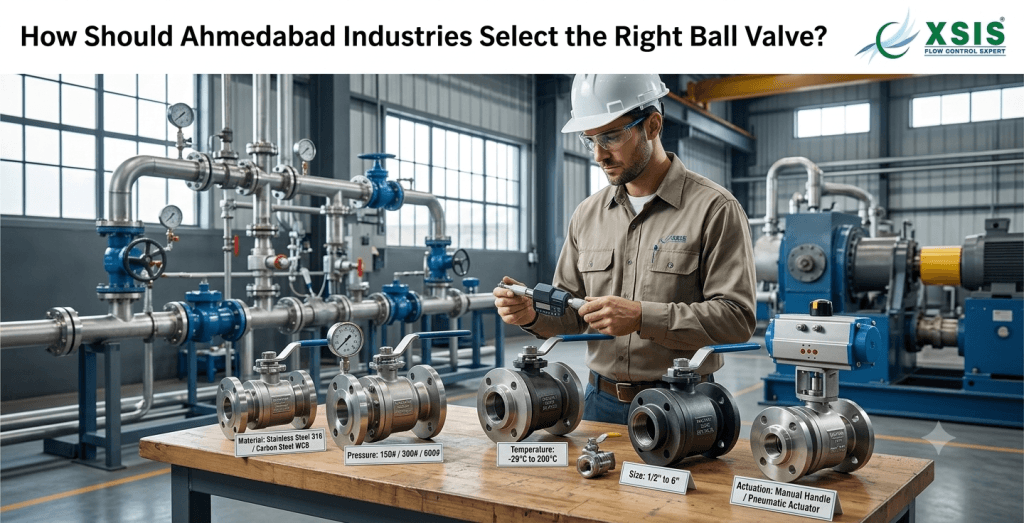
Choosing a ball valve should begin with the process rather than the valve catalogue. Engineers should identify the fluid, pressure, temperature, flow requirements, operating frequency, pipe size, connection type, and required shut-off performance. They should then determine the appropriate body, ball, seat, stem, and seal materials based on the actual service conditions.
Supplier capability is another important consideration. Industrial buyers should look for manufacturers or suppliers that can provide consistent quality, dimensional accuracy, pressure testing, appropriate documentation, and technical support. A quality-focused supplier can help reduce the risk of selecting a valve that appears suitable on paper but performs poorly under actual plant conditions. The uploaded reference also emphasises quality-tested valves and engineering inspection as relevant visual context for industrial valve manufacturing.
Six Factors to Check Before Purchasing
- Valve Material: Select stainless steel, carbon steel, alloy, or another suitable material according to fluid compatibility and operating conditions.
- Pressure and Temperature: Confirm that the valve’s pressure and temperature ratings safely cover the application’s normal and foreseeable conditions.
- Port Design: Full-port or reduced-port construction should be selected according to flow requirements, pressure drop considerations, and system design.
- End Connection: Threaded, flanged, welded, or other connections should match the existing pipeline and installation requirements.
- Actuation: Manual, pneumatic, or electric actuation should be selected according to valve size, accessibility, automation requirements, and operating frequency.
- Quality and Testing: Check whether the supplier provides appropriate inspection, pressure testing, material traceability, and relevant documentation.
How Can Ball Valve Maintenance Improve Industrial Reliability?
Even a high-quality ball valve requires appropriate installation, operation, inspection, and maintenance. Routine checks can identify external leakage, difficult operation, damaged handles, actuator problems, or connection issues before they develop into larger operational problems. Maintenance frequency should reflect the valve’s service conditions, operating cycle, media, and criticality.
Industries should also avoid operating ball valves outside their intended function. Frequent throttling, excessive force on manual handles, incorrect actuator settings, incompatible chemicals, or unsuitable temperature conditions can damage seats and sealing components. Planned maintenance combined with correct valve selection can help extend service life and reduce unexpected shutdowns.
Practical Ball Valve Maintenance Practices
- Inspect for Leakage: Regularly check valve bodies, stems, connections, and seals for signs of external leakage or deterioration.
- Check Operation: Confirm that manual handles or actuators move correctly without unusual resistance or vibration.
- Monitor Process Conditions: Keep pressure and temperature within the valve’s specified operating range.
- Inspect Seals: Examine sealing components when servicing critical valves, especially where process conditions are demanding.
- Follow Installation Practices: Ensure valves are correctly aligned, supported, and installed without imposing excessive pipeline stress.
- Maintain Records: Keep inspection, repair, testing, and replacement records to support planned maintenance and asset management.
What Are the Benefits of Using Ball Valves in Ahmedabad Industries?
Ball valves can offer several practical advantages for industrial facilities when correctly specified. Their quarter-turn mechanism allows rapid operation, while their compact construction can simplify installation in many piping arrangements. They can also be supplied in various sizes, pressure classes, materials, connection types, and actuation options, allowing engineers to adapt the valve to different service requirements.
However, the benefits depend on proper selection and application. A ball valve should not automatically be considered the best choice for every industrial process. For applications requiring precise flow regulation, specialised control valves may be more suitable, while certain abrasive, slurry, extremely high-temperature, or specialised hygienic services may require alternative valve technologies.
Major Advantages of Industrial Ball Valves
- Fast Shut-Off: Quarter-turn operation allows rapid isolation when a pipeline needs to be opened or closed efficiently.
- Compact Construction: Their relatively compact design can be advantageous in crowded machinery rooms and industrial piping layouts.
- Reliable Isolation: Properly selected ball valves can provide dependable shut-off for many compatible liquid and gas applications.
- Low Flow Resistance: When fully open, suitable full-port designs can provide a relatively unobstructed flow path.
- Automation Options: Pneumatic and electric actuators can support automated process control and remote operation.
- Wide Application Range: Different materials, sizes, seats, and configurations allow ball valves to serve numerous industrial and utility applications.
Conclusion
The Top Applications of Ball Valves Across Ahmedabad Industries demonstrate why these valves remain important components in modern industrial piping systems. From chemical and pharmaceutical facilities to textile plants, water-treatment systems, HVAC installations, food-processing units, and general manufacturing, ball valves can provide convenient and reliable isolation when their specifications match the service conditions.
For Ahmedabad industries, selecting the correct industrial ball valves should involve more than comparing prices. Engineers and procurement teams should evaluate valve material, pressure rating, temperature range, media compatibility, port design, connection type, actuation, testing, and supplier support. With proper specification, installation, and maintenance, ball valves can contribute to safer operation, efficient maintenance, and dependable process performance.
Explore Our Recent Blog
- Complete Guide to Industrial Valve Types for Ahmedabad Industries
- Best Industrial Valves for Water Treatment Plants in Ahmedabad
- Stainless Steel vs. Cast Iron Valves for Ahmedabad Industries
- Industrial Valve Problems and Maintenance Tips for Ahmedabad Factories
- Right Valve Material for Industrial Applications in Ahmedabad
Frequently Asked Questions
1. What are the main applications of ball valves in Ahmedabad industries?
Ball valves are commonly considered for industrial water systems, compressed-air networks, chemical process lines, textile utilities, pharmaceutical applications, HVAC systems, and general manufacturing. Their quick quarter-turn operation makes them useful for isolation duties. The correct application depends on pressure, temperature, fluid compatibility, and valve construction.
2. Why are ball valves preferred for industrial isolation?
Ball valves can provide quick operation and dependable shut-off when correctly selected for the service. Their quarter-turn mechanism is simple to operate and can be paired with pneumatic or electric actuators for automation. They are particularly useful where a pipeline needs efficient on-off control rather than continuous flow regulation.
3. Which ball valve materials are suitable for Ahmedabad industries?
Stainless steel and carbon steel are common choices, but the appropriate material depends on the fluid and operating environment. Corrosive chemicals may require specialised alloys or corrosion-resistant components, while clean applications may require particular stainless-steel or hygienic configurations. Material selection should always be based on actual process conditions.
4. Are ball valves suitable for chemical industries?
Yes, ball valves can be suitable for selected chemical applications when their body, ball, seats, seals, and other wetted components are compatible with the chemical medium. Pressure and temperature ratings must also be verified. For aggressive or specialised chemicals, engineers should obtain technical confirmation before selecting the valve.
5. Can ball valves be used in textile manufacturing plants?
Yes, ball valves can be used for various compatible utility and process services in textile plants. Common considerations include water, compressed air, and other plant utility lines requiring convenient isolation. The valve specification should match the particular fluid, temperature, pressure, and operating frequency.
6. How can industries choose reliable ball valve suppliers in Ahmedabad?
Industrial buyers should evaluate product quality, material traceability, testing procedures, technical support, dimensional consistency, certifications where applicable, and after-sales service. A supplier should also be able to recommend an appropriate configuration based on the application’s operating conditions. Comparing suppliers on technical capability rather than price alone can help industries make more reliable purchasing decisions.