

Globe valves are widely used in industrial piping systems where accurate flow regulation, reliable shut-off, and controlled fluid movement are important. Globe Valves in Ahmedabad: Working Principle and Common Uses is a relevant topic for industries that depend on dependable valve solutions for steam, water, chemicals, oil, gas, and other process fluids. Their construction allows operators to regulate flow more precisely than many basic isolation valves.
Understanding the globe valve working principle, construction, materials, pressure ratings, and industrial applications helps engineers and plant operators make informed purchasing decisions. The right selection can improve process control, reduce unnecessary maintenance, and support safer pipeline operation. For buyers evaluating industrial valves in Ahmedabad, application requirements should always be considered alongside valve size, pressure, temperature, fluid characteristics, and end connections.
What Is a Globe Valve, and How Does It Work?
A globe valve is a linear-motion valve designed to start, stop, and regulate fluid flow through a pipeline. Its internal construction generally includes a valve body, bonnet, stem, disc, and seat. Unlike a simple isolation valve that is normally operated fully open or fully closed, a globe valve in Ahmedabad can be positioned at different openings to control the amount of fluid passing through the system.
The globe valve working principle is based on the movement of a disc toward or away from a stationary seat. When the handwheel or actuator moves the stem, the disc changes its position relative to the seat. Raising the disc opens the flow passage, while lowering it toward the seat restricts or stops flow. This controlled movement makes globe valves suitable for throttling applications where operators need to adjust flow gradually.
How Does the Internal Mechanism Control Flow?
- Disc Movement: The disc moves linearly in response to stem movement, allowing the opening to be adjusted precisely. This makes the valve useful where controlled flow is required rather than simple on/off operation.
- Valve Seat: The disc works against a stationary seat to regulate or stop fluid movement. Proper seat and disc design helps provide reliable shut-off and supports long-term service.
- Stem Operation: The stem transfers movement from the handwheel, gearbox, or actuator to the disc. Depending on the installation, globe valves may be manually operated or integrated with automated control systems.
- Flow Passage: Fluid changes direction inside a conventional globe valve, creating resistance that contributes to pressure loss. This characteristic is important when engineers calculate system pressure requirements.
- Throttling Action: Partially opening the valve creates a controlled restriction in the pipeline. Operators can therefore use a globe valve to adjust flow according to process requirements.
- Closing Performance: When the disc reaches the seat, the flow passage is closed. Correct sizing, material selection, and seat design are important for achieving dependable shut-off performance.
Why Are Globe Valves Used in Ahmedabad Industries?
Ahmedabad’s industrial landscape creates demand for valves capable of handling different fluids, pressures, temperatures, and process conditions. Manufacturing facilities may require valves for utility lines, process pipelines, steam services, cooling systems, chemical handling, and other applications. Globe valves are particularly useful where the process requires repeated adjustment of fluid flow.
The suitability of a globe valve depends on the specific application rather than simply the industry name. For example, a textile facility may use valves in steam and utility systems, while a chemical plant may require carefully selected materials for corrosive or aggressive media. Pharmaceutical and food-processing facilities can also have strict requirements concerning cleanliness, material compatibility, and operating conditions.
Which Industries Commonly Use Globe Valves?
- Chemical Industry: Globe valves can be used for controlling process fluids, utility services, and selected chemical lines. Material compatibility must be evaluated carefully when corrosive or reactive media are involved.
- Pharmaceutical Manufacturing: Process and utility systems may require precise fluid regulation. Valve materials, surface finish, cleanliness, and operating conditions should be matched with the relevant process requirements.
- Textile Industry: Steam, hot water, compressed-air-related services, and other utilities can require controlled flow. Globe valves can provide useful regulation where gradual adjustment is needed.
- Power and Steam Systems: Globe valves are commonly associated with applications requiring flow control in steam and utility services. Temperature and pressure ratings are particularly important for these installations.
- Water Treatment: Selected process and utility lines may use globe valves when flow regulation is required. Valve construction and material should be chosen according to the water chemistry and operating conditions.
- General Engineering: Engineering and manufacturing plants may use globe valves across utility and process systems. Their versatility makes them a practical option when both throttling and shut-off are required.
What Are the Common Applications of Globe Valves?
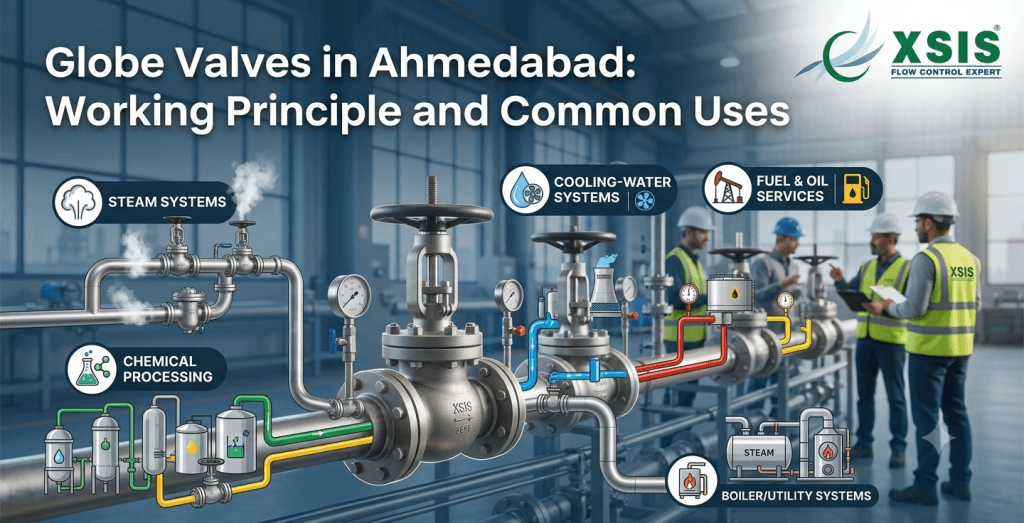
The most important advantage of globe valves is their ability to regulate flow rather than merely isolate a pipeline. They are therefore often considered for systems where operators need to control fluid volume, maintain process conditions, or adjust downstream flow. Common applications include steam lines, cooling-water services, fuel systems, process piping, and various industrial utilities.
When evaluating Globe Valves in Ahmedabad: Working Principle and Common Uses, it is important to distinguish between suitable and unsuitable applications. Globe valves can provide effective control, but their internal flow path can create a greater pressure drop than some other valve designs. For applications where minimum pressure loss is the main priority, another valve type may be more appropriate.
Where Are Globe Valves Commonly Installed?
- Steam Lines: Globe valves can regulate steam flow in industrial utility and process systems. Correct pressure-temperature ratings and suitable packing and seat materials are essential for dependable operation.
- Cooling-Water Systems: Where controlled water flow is required, globe valves can be installed at selected points. Engineers should consider pressure loss, flow requirements, and water quality before selection.
- Fuel and Oil Services: Certain fuel and oil applications can benefit from controlled flow adjustment. Valve materials, sealing arrangements, temperature limits, and fluid compatibility must be verified.
- Chemical Process Lines: Globe valves may be used for controlled movement of compatible process fluids. The valve body, trim, packing, and sealing materials should be selected according to chemical characteristics.
- Boiler and Utility Systems: Controlled flow is important in many boiler-related and auxiliary services. Globe valves can provide adjustment and isolation where their pressure and temperature ratings are appropriate.
- Process Control Systems: Globe valves can be integrated with actuators for automated regulation. This makes them useful where flow needs to respond to changing process conditions.
How Do Globe Valves Compare With Other Industrial Valves?
Selecting a valve requires understanding the difference between flow-control characteristics and simple isolation. Globe valves are generally valued for throttling, whereas gate valves are commonly selected for full-flow isolation. Butterfly valves can provide compact and lightweight flow control in many applications, while ball valves are often preferred where quick operation and tight shut-off are priorities.
The choice should not be based on valve type alone. Engineers need to consider fluid type, operating pressure, temperature, flow rate, frequency of operation, available installation space, maintenance requirements, and the consequences of leakage or failure. Comparing these factors helps Ahmedabad industries identify the most appropriate industrial valve supplier and valve configuration for each application.
What Makes Globe Valves Different?
- Globe vs Gate Valves: Globe valves are generally better suited to throttling and flow adjustment. Gate valves are commonly used for isolation and typically offer a relatively unrestricted passage when fully open.
- Globe vs Ball Valves: Ball valves are known for quick quarter-turn operation and effective shut-off. Globe valves provide more controlled linear movement for applications where gradual flow adjustment is important.
- Globe vs Butterfly Valves: Butterfly valves are compact and often suitable for larger pipelines. Globe valves may be preferred when more precise throttling is required and pressure drop is acceptable.
- Flow Regulation: Globe valve construction supports gradual adjustment of the flow passage. This makes the design useful for process systems where operators need to control flow rather than simply stop it.
- Pressure Drop: The internal flow path of a globe valve can produce more pressure loss than some isolation valve designs. Engineers should account for this during pipeline and pump-system calculations.
- Application Flexibility: Globe valves can be manufactured in different sizes, pressure classes, materials, and trim configurations. This allows them to serve a broad range of industrial requirements when properly specified.
How Do You Select the Right Globe Valve for an Industrial Application?
Selecting the right globe valve begins with understanding the actual operating conditions. Engineers should identify the fluid, normal and maximum pressure, operating temperature, required flow rate, line size, flow-control requirements, and expected operating frequency. These details help determine the appropriate valve body, trim, seat arrangement, pressure class, and actuation method.
Material selection is equally important because the valve must remain compatible with the medium and environment. Carbon steel, stainless steel, alloy materials, and other construction options may be appropriate for different services. Buyers should also evaluate globe valve specifications, testing requirements, end connections, certifications where applicable, and the supplier’s ability to provide consistent quality.
Which Factors Should Buyers Check Before Purchase?
- Fluid Characteristics: Identify whether the medium is water, steam, oil, gas, slurry, or a chemical solution. Viscosity, corrosiveness, solids content, and chemical compatibility can influence valve selection.
- Pressure and Temperature: Check normal, minimum, and maximum operating conditions. The selected valve should have suitable pressure and temperature ratings for the intended service.
- Valve Size: The valve should be correctly sized for the required flow conditions rather than simply matching the pipeline diameter. Incorrect sizing can affect control performance and operating efficiency.
- Body and Trim Material: Material selection should account for corrosion, erosion, temperature, and fluid compatibility. Stainless steel or specialised alloys may be considered for demanding services where appropriate.
- Actuation Requirements: Determine whether manual operation is sufficient or whether pneumatic, electric, or hydraulic actuation is required. Automated systems may need additional control and feedback arrangements.
- Supplier Quality: Buyers should assess manufacturing consistency, inspection procedures, testing, documentation, after-sales support, and technical assistance.
What Are the Advantages and Limitations of Globe Valves?
Globe valves offer several advantages for industrial flow-control applications. Their construction provides good throttling capability, and operators can make gradual adjustments rather than relying only on fully open or fully closed positions. They can also be manufactured for a wide range of pressures, temperatures, materials, and industrial services.
However, no valve design is ideal for every application. Globe valves can introduce a comparatively high pressure drop because fluid changes direction through the body. They may also require more operating effort than some quarter-turn valve designs, particularly in larger sizes or high-pressure applications. Understanding both benefits and limitations is essential before specifying Globe Valves in Ahmedabad: Working Principle and Common Uses for a plant.
What Benefits Do Globe Valves Provide?
- Precise Flow Regulation: The linear movement of the disc allows operators to adjust the opening progressively. This supports applications where maintaining a desired flow rate is important.
- Reliable Shut-Off: A properly selected globe valve can provide dependable closure when the disc and seat are correctly matched. Regular inspection helps maintain sealing performance.
- Wide Application Range: Globe valves are available in multiple materials, sizes, pressure classes, and configurations. This makes them suitable for many industrial and utility services.
- Suitable for Automation: Globe valves can be fitted with suitable actuators and control accessories. This allows them to become part of automated process-control systems.
- Industrial Durability: Properly manufactured valves can withstand demanding operating environments. Performance depends heavily on correct material, design, installation, and maintenance.
- Controlled Operation: Globe valves provide gradual movement rather than rapid quarter-turn action. This can be useful when sudden changes in flow need to be avoided.
How Should Globe Valves Be Maintained for Long-Term Performance?
Regular maintenance helps ensure that globe valves continue to operate safely and efficiently. Inspection should cover the body, bonnet, stem, packing, handwheel or actuator, connections, and visible signs of leakage or corrosion. Valves used in demanding environments may require more frequent inspection depending on operating conditions and manufacturer recommendations.
Maintenance should also consider the valve’s actual service conditions. Excessive force should not be applied to manual handwheels, and unusual operating resistance should be investigated rather than ignored. Where valves are installed in high-temperature, high-pressure, or hazardous services, maintenance activities should follow appropriate plant safety procedures and isolation practices.
Which Maintenance Practices Help Prevent Valve Problems?
- Inspect for Leakage: Check around the stem, bonnet, body joints, and connections for visible leakage. Early detection can prevent minor sealing problems from developing into larger operational issues.
- Check Stem Condition: The stem should move smoothly without unusual resistance or visible damage. Corrosion, contamination, or mechanical damage can interfere with normal valve operation.
- Monitor Packing: Packing helps control leakage around the moving stem. It should be inspected and adjusted or replaced when necessary according to the valve design and maintenance procedure.
- Inspect the Seat and Disc: Poor shut-off can indicate wear, damage, contamination, or improper operation. Inspection should be performed during planned maintenance or when performance problems are identified.
- Maintain Actuators: Automated globe valves require inspection of actuators, control signals, and associated accessories. Proper calibration helps ensure that the valve reaches the required position accurately.
- Keep Maintenance Records: Recording inspections, repairs, replacements, and operating issues helps identify recurring problems. Maintenance history can also support better future valve-selection decisions.
How Can Ahmedabad Industries Choose a Reliable Globe Valve Supplier?
Choosing a reliable supplier is an important part of maintaining dependable industrial piping systems. Ahmedabad buyers should look beyond price and evaluate manufacturing capability, technical specifications, material traceability, testing practices, delivery reliability, and after-sales support. The supplier should be able to understand the application rather than simply provide a valve based on nominal size.
For industrial procurement, documentation and consistency are particularly important. Buyers may need dimensional information, pressure ratings, material details, inspection records, testing documentation, and other technical information depending on the application. A supplier with strong technical knowledge can help customers compare globe valve suppliers in Ahmedabad and select a solution that matches their process requirements.
What Should You Ask a Globe Valve Supplier?
1. Can You Provide Complete Specifications? Ask for valve size, pressure class, temperature range, materials, end connections, and applicable design information. Complete specifications make technical comparison easier.
2. Are the Valves Tested? Confirm what inspection and testing procedures are performed before dispatch. Appropriate testing helps verify that the valve meets the specified performance requirements.
3. Can You Support Material Selection? A technically capable supplier should be able to discuss body, trim, seat, and packing options. This is particularly important for corrosive, high-temperature, or high-pressure applications.
4. Do You Provide Custom Configurations? Some applications may require special materials, actuators, dimensions, or connection arrangements. Buyers should determine whether the supplier can meet these requirements.
5. What Documentation Is Available? Depending on the project, documentation may include material certificates, test reports, drawings, and inspection records. Confirm documentation requirements before placing the purchase order.
6. Is After-Sales Support Available? Technical support can be valuable during installation, commissioning, troubleshooting, and maintenance. A supplier offering responsive service can reduce avoidable operational delays.
Conclusion
Globe Valves in Ahmedabad: Working Principle and Common Uses is an important subject for industries seeking dependable flow regulation and shut-off solutions. Globe valves operate through controlled linear movement of a disc against a seat, allowing them to provide gradual flow adjustment across many industrial applications. Their ability to throttle flow makes them particularly useful in systems where precise control is required.
Ahmedabad’s diverse industrial base creates applications for globe valves across chemical processing, pharmaceuticals, textiles, engineering, utilities, water treatment, and manufacturing. However, selecting the right valve requires more than choosing a standard size. Engineers and procurement teams should evaluate fluid characteristics, pressure, temperature, materials, flow requirements, actuation, maintenance, testing, and supplier capability before making a final decision.
Explore Our Recent Blog
- Stainless Steel vs. Cast Iron Valves for Ahmedabad Industries
- Industrial Valve Problems and Maintenance Tips for Ahmedabad Factories
- Right Valve Material for Industrial Applications in Ahmedabad
- Top Applications of Ball Valves Across Ahmedabad Industries
- Gate Valves in Ahmedabad: Features, Benefits, and Industrial Applications
Frequently Asked Questions
1. What is the main purpose of a globe valve?
The main purpose of a globe valve is to regulate, start, and stop fluid flow in a pipeline. Its construction allows the disc to move gradually toward or away from the seat, making it particularly useful for throttling applications. Globe valves are commonly considered where controlled flow is more important than minimising pressure loss.
2. How does a globe valve control fluid flow?
A globe valve controls flow by moving a disc relative to a stationary seat. Raising the disc increases the flow opening, while lowering it restricts the passage and eventually stops the flow. The controlled linear movement makes the valve suitable for adjusting process flow rates.
3. Where are globe valves commonly used in Ahmedabad?
Globe valves can be used in Ahmedabad’s chemical, pharmaceutical, textile, engineering, manufacturing, water-treatment, and utility industries. Common services include steam, cooling water, process fluids, fuel systems, and selected industrial utilities. The actual suitability depends on pressure, temperature, fluid characteristics, and required control performance.
4. Are globe valves suitable for throttling applications?
Yes, globe valves are generally well suited to throttling because their disc can be positioned at intermediate openings. This enables operators or automated control systems to adjust flow progressively. However, engineers should account for the pressure drop associated with the valve’s internal flow path.
5. What factors should be considered when selecting a globe valve?
Important factors include fluid type, flow rate, pressure, temperature, line size, body and trim materials, pressure class, end connections, and actuation requirements. Buyers should also consider maintenance requirements, testing, documentation, and supplier support. Correct sizing and material compatibility are essential for reliable performance.
6. How can the service life of a globe valve be extended?
Regular inspection, correct operation, appropriate maintenance, and timely replacement of worn components can help extend service life. Leakage, corrosion, unusual stem resistance, and poor shut-off should be investigated promptly. Following the manufacturer’s maintenance recommendations and maintaining suitable operating conditions can further support dependable valve performance.