

Check valves are essential flow-control components used in industrial pipelines to prevent fluid from flowing in the wrong direction. They allow liquids, gases, steam, and other process media to move in the intended direction while automatically stopping reverse flow. This makes them particularly valuable in systems where backflow could damage pumps, contaminate processes, create pressure problems, or reduce operational efficiency.
For industries in Ahmedabad, selecting the right check valve requires consideration of pressure, temperature, media characteristics, pipe size, installation position, and operating conditions. Check Valves in Ahmedabad: Types, Benefits, and Installation Guide is therefore an important topic for manufacturers, plant engineers, maintenance teams, and procurement professionals looking to improve pipeline reliability.
What Are Check Valves and How Do They Work?
Check valves are automatic flow-control devices designed to permit fluid flow in one direction and prevent it from returning in the opposite direction. Unlike manually operated valves, they generally do not require a handwheel, lever, or external actuator to control normal operation. Their internal mechanism responds to changes in flow and pressure, allowing the valve to open when flow moves correctly and close when reverse flow begins.
The operating principle is relatively simple, but the correct design is important for reliable performance. When upstream pressure becomes sufficient to overcome the valve’s closing force, the internal disc, ball, piston, or other closure element moves away from the seat. When forward flow stops or reverses, the closure element returns toward the seat and restricts reverse movement. The exact response depends on the check valve design, installation orientation, pressure conditions, and process medium.
- One-Way Flow: Check valves are primarily designed to maintain flow in a single direction. This makes them useful in pipelines where reverse movement of the medium must be controlled automatically without continuous operator intervention.
- Automatic Operation: Most check valves operate through differential pressure and therefore do not require manual opening or closing during normal service. This can simplify pipeline operation and reduce the need for additional control equipment.
- Backflow Prevention: Preventing reverse flow helps protect pumps, compressors, filters, heat exchangers, and other equipment connected to the pipeline. It can also reduce the risk of unwanted mixing between different process streams.
- Pressure Response: The valve opens when the upstream pressure is sufficient to move its closing mechanism. When the pressure difference changes, the mechanism moves toward the closed position to restrict reverse flow.
- Multiple Designs: Swing, lift, wafer, dual-plate, ball, and piston check valves are among the designs available for different operating requirements. Each design has different characteristics related to pressure drop, installation, maintenance, and flow response.
- Industrial Applications: Check valves can be used in water systems, chemical processing, compressed-air systems, steam applications, pumping stations, and many other industrial pipelines.
What Are the Different Types of Check Valves Used in Ahmedabad Industries?
Different industrial processes require different check valves in Ahmedabad because pressure, temperature, flow characteristics, pipe configuration, and media can vary considerably. Choosing a valve only by pipe diameter can result in unsuitable performance because internal construction and closing characteristics are equally important. Engineers should evaluate the complete operating environment before finalising a valve.
Common check valve types include swing check valves, lift check valves, wafer check valves, dual-plate check valves, ball check valves, and piston check valves. Ahmedabad industries may use these designs across water treatment, chemical processing, textile manufacturing, pharmaceutical production, utilities, and general engineering applications.
- Swing Check Valves: A swing check valve uses a disc that moves around a hinge or shaft to permit forward flow. It is commonly considered for applications where relatively unobstructed flow and moderate pressure-drop characteristics are desirable.
- Lift Check Valves: Lift check valves use a closure element that moves vertically from its seat. They can provide effective backflow prevention and are often selected where pressure and flow conditions are suitable for their design.
- Wafer Check Valves: Wafer-style check valves have a compact construction and can fit between pipeline flanges. Their space-saving design can be useful where installation space is limited or where a lightweight valve arrangement is preferred.
- Dual-Plate Check Valves: Dual-plate check valves contain two spring-assisted plates that respond to flow changes. Their compact construction can make them suitable for various industrial pipeline configurations.
- Ball Check Valves: Ball check valves use a spherical closure element that moves according to the direction and pressure of flow. They can be useful in applications involving liquids and certain process conditions where their design is appropriate.
- Piston Check Valves: Piston check valves use a piston-like closure mechanism to control flow direction. They may be considered for systems requiring controlled closure characteristics and compatibility with specific pressure and process conditions.
How Do Check Valves Benefit Industrial Pipelines?
The main advantage of a check valve is its ability to automatically restrict reverse flow. This simple function can have an important effect on the reliability of an entire piping system. When properly selected and installed, check valves can help protect equipment, improve process stability, reduce operational risks, and support efficient fluid transportation.
The benefits can vary according to valve construction and application. A valve designed for a clean-water pipeline may not provide the same results in a high-temperature chemical process. Therefore, the benefits of check valves in Ahmedabad industries are maximised when the valve’s material, pressure rating, size, connection type, and internal mechanism match the actual operating environment.
- Backflow Protection: Check valves help prevent process media from moving backward through pipelines. This can protect upstream equipment and reduce the possibility of unwanted reverse circulation.
- Pump Protection: Reverse flow can cause operational problems for pumps, particularly when systems are shut down or pressure conditions change. A properly selected check valve can help isolate the pump from reverse movement of the fluid.
- Equipment Safety: Heat exchangers, compressors, filters, storage systems, and other equipment may require protection from reverse pressure or fluid movement. Check valves can form an important part of this protection strategy.
- Reduced Contamination Risk: In interconnected process systems, backflow may allow one fluid stream to enter another. Check valves can help maintain directional separation where process design requires it.
- Automatic Flow Control: Because check valves respond automatically to pressure and flow conditions, they can operate without continuous manual intervention. This can simplify certain pipeline arrangements and improve operational convenience.
- System Reliability: Correctly selected check valves can support dependable pipeline operation by maintaining the intended direction of flow. Their contribution becomes especially valuable in systems containing pumps or parallel lines.
How Do You Select the Right Check Valve for an Industrial Application?
Selecting the correct valve involves much more than matching the valve size with the pipeline diameter. Engineers should understand the process medium, normal and maximum pressure, operating temperature, expected flow rate, installation orientation, allowable pressure drop, and potential reverse-flow conditions. These parameters help determine which check valve construction is appropriate.
For check valve selection, industries should also consider material compatibility and connection standards. For example, a valve used for clean water may have substantially different material requirements from one handling corrosive chemicals or high-temperature process fluids. Reviewing the complete valve specification with an experienced supplier or qualified engineer can reduce the risk of incorrect selection.
- Identify the Process Medium: Determine whether the valve will handle water, air, steam, oil, chemicals, slurry, or another medium. Media properties influence the required body, seat, and internal component materials.
- Check Pressure Requirements: Review normal operating pressure as well as maximum and minimum pressure conditions. The selected valve should have an appropriate pressure rating for the intended service.
- Evaluate Temperature: Operating temperature affects material performance, sealing behaviour, and valve durability. Temperature limits should be checked for the complete valve assembly rather than the body material alone.
- Confirm Pipe Size: The nominal pipeline size should be matched with the appropriate valve size and connection arrangement. Incorrect sizing can create unnecessary pressure losses or unsuitable flow behaviour.
- Consider Installation Position: Some check valve designs work best in specific orientations. Horizontal, vertical-upward, or other installation arrangements should be confirmed before choosing the valve.
- Assess Closing Behaviour: Rapid closure can help prevent reverse flow but may contribute to water hammer or pressure surges in some systems.
How Should Check Valves Be Installed Correctly?
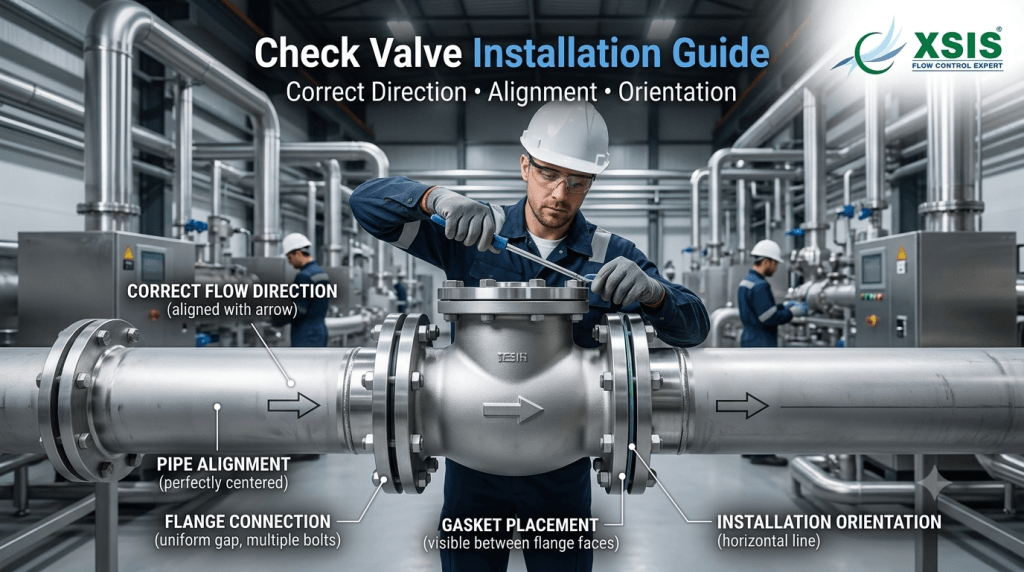
Correct check valve installation is essential because even a high-quality valve can perform poorly when installed incorrectly. Before installation, the pipeline should be inspected for debris, welding residue, scale, and other foreign materials that could interfere with the valve’s internal closure mechanism. The valve’s flow direction should also be checked carefully against the arrow or directional marking on its body.
The surrounding pipeline should provide suitable support and alignment so that the valve is not exposed to unnecessary mechanical stress. Flanges, gaskets, bolts, and pipe connections should be appropriate for the system specification. After installation, the system should be tested under controlled conditions to confirm that the valve opens correctly during forward flow and closes effectively when flow stops or reverses.
- Verify Flow Direction: Check the arrow marked on the valve body before fitting it into the pipeline. Installing the valve in the wrong direction can prevent normal flow and may lead to operational problems.
- Clean the Pipeline: Remove dirt, metal particles, welding slag, and other debris before installation. Foreign material can damage seating surfaces or prevent the closure element from moving properly.
- Align the Valve: Ensure that the valve is correctly aligned with the pipeline. Excessive pipe strain or misalignment can place unnecessary stress on the valve body and connected components.
- Use Suitable Connections: Select appropriate flanges, gaskets, fasteners, and connection methods according to the pipeline specification. Connections should be tightened correctly without creating mechanical distortion.
- Follow Orientation Requirements: Confirm whether the selected valve requires horizontal or vertical installation. Some designs depend on gravity, spring action, or specific flow orientation for reliable closing.
- Perform Commissioning Checks: After installation, gradually introduce the operating medium and inspect the system for leakage, unusual vibration, pressure abnormalities, or unexpected flow behaviour.
What Causes Check Valve Failure and How Can It Be Prevented?
Check valve failure can result from incorrect selection, unsuitable installation, contamination, excessive pressure, corrosion, wear, or poor maintenance. A valve that repeatedly slams shut, develops leakage, or fails to open fully may indicate an underlying system or valve problem. Simply replacing the valve without identifying the root cause may result in repeated failures and unnecessary maintenance costs.
Preventive maintenance should therefore focus on both the valve and the conditions under which it operates. Industries using check valves in Ahmedabad should establish inspection procedures appropriate for their process conditions. Critical valves may require more frequent monitoring, particularly when they operate continuously or handle aggressive, high-temperature, abrasive, or contaminated media.
- Improper Sizing: A valve that is too large or too small for the application may experience unsuitable flow behaviour. Proper sizing based on actual process conditions helps support stable operation.
- Incorrect Installation: Wrong flow direction, unsuitable orientation, poor alignment, or inadequate support can affect valve performance. Installation should follow the manufacturer’s technical requirements.
- Foreign Material: Dirt, scale, welding particles, and process deposits can interfere with the seating mechanism. Pipeline cleanliness and suitable filtration can help reduce this risk where applicable.
- Corrosion and Wear: Aggressive media and repeated operating cycles can deteriorate internal components. Selecting compatible materials and monitoring valve condition can extend service life.
- Pressure Surges: Sudden changes in flow can cause pressure spikes and rapid valve closure. Suitable valve selection and appropriate system design can help reduce damaging hydraulic effects.
- Insufficient Inspection: A valve may gradually develop leakage or restricted movement without immediately causing a complete failure. Routine inspection and timely maintenance can identify developing problems before they affect production.
How Can Industries Maintain Check Valves for Longer Service Life?
Maintenance requirements depend on the valve design, operating environment, process medium, and criticality of the pipeline. Some check valves may require periodic inspection and cleaning, while others may be installed in systems where maintenance access is more difficult. Establishing an inspection schedule based on actual service conditions is more effective than applying the same maintenance frequency to every valve.
Maintenance teams should monitor signs such as external leakage, unusual noise, vibration, pressure fluctuations, reverse flow, and unexpected changes in system performance. When a valve is removed for inspection, its seat, disc, spring, hinge, ball, piston, and other relevant components should be examined according to its construction. Replacement parts should be compatible with the original valve specification.
- Conduct Routine Inspections: Regular visual and operational inspections can identify leakage, corrosion, vibration, or other early warning signs. Inspection frequency should reflect the valve’s importance and operating conditions.
- Check for Leakage: Unexpected leakage may indicate seat damage, foreign material, wear, or incorrect operating conditions. Identifying the cause early can prevent more extensive equipment or process problems.
- Inspect Internal Components: During planned maintenance, internal parts should be checked for wear, deposits, corrosion, or mechanical damage. Components that no longer meet service requirements should be repaired or replaced.
- Keep Records: Maintenance records can help teams identify recurring problems and determine appropriate inspection intervals. Documentation should include valve location, service conditions, inspection findings, and corrective actions.
- Use Compatible Spare Parts: Replacement components should match the valve model and service requirements. Using unsuitable materials or components can affect sealing performance and overall reliability.
- Review Operating Conditions: Repeated failures may indicate that the original valve selection no longer matches actual process conditions. Maintenance teams should review pressure, temperature, flow, media, and installation factors when problems persist.
How Can Ahmedabad Industries Choose Reliable Check Valve Suppliers?
Choosing a reliable check valve supplier in Ahmedabad is an important part of achieving consistent valve performance. Suppliers should be able to provide clear technical specifications covering materials, pressure ratings, sizes, connection types, temperature limitations, and applicable standards. Industries should also evaluate whether the supplier understands the specific requirements of their process rather than simply supplying a valve based on nominal pipe size.
A dependable supplier can help customers compare different industrial check valves and identify the most suitable construction for their application. Buyers should request technical documentation and verify that the proposed valve is appropriate for the actual service conditions. For critical installations, technical support, inspection facilities, product traceability, and after-sales assistance can also be important considerations.
- Review Technical Specifications: Compare valve materials, pressure ratings, size ranges, connection standards, and operating limitations before purchasing.
- Consider Industry Experience: A supplier with experience in industrial valve applications may better understand the requirements of different process environments.
- Verify Product Quality: Ask about inspection and quality-control procedures used for the valves. Consistent manufacturing and testing practices can contribute to dependable performance.
- Evaluate Material Compatibility: The supplier should be able to explain why the selected body and internal materials are appropriate for the process medium.
- Check Documentation: Product datasheets, drawings, test documentation, and installation information can support proper procurement and commissioning.
- Assess Technical Support: Reliable technical assistance can be valuable during selection, installation, troubleshooting, and maintenance. Suppliers that understand application requirements can help industries avoid preventable valve-related problems.
Conclusion
Understanding Check Valves in Ahmedabad: Types, Benefits, and Installation Guide can help industrial businesses make better decisions when designing, upgrading, or maintaining pipeline systems. Check valves provide an important automatic backflow-prevention function and can help protect pumps, equipment, process streams, and overall system reliability when correctly selected.
The right valve depends on more than size alone. Process medium, pressure, temperature, flow characteristics, installation orientation, materials, closing behaviour, and maintenance requirements should all be evaluated before procurement. With appropriate selection, professional installation, regular inspection, and dependable technical support, industrial check valves can provide reliable directional flow control across many Ahmedabad applications.
Explore Our Recent Blog
- Industrial Valve Problems and Maintenance Tips for Ahmedabad Factories
- Right Valve Material for Industrial Applications in Ahmedabad
- Top Applications of Ball Valves Across Ahmedabad Industries
- Gate Valves in Ahmedabad: Features, Benefits, and Industrial Applications
- Globe Valves in Ahmedabad: Working Principle and Common Uses
Frequently Asked Questions
1. What are check valves mainly used for in industrial pipelines?
Check valves are primarily used to prevent reverse flow while allowing fluid to move in the intended direction. They can help protect pumps, compressors, pipelines, and other connected equipment from backflow-related problems. The appropriate check valve type depends on the process medium, pressure, temperature, flow conditions, and installation requirements.
2. Which type of check valve is best for industrial applications?
There is no single check valve that is best for every industrial application. Swing, lift, wafer, dual-plate, ball, and piston designs each have different operating characteristics and installation requirements. The correct choice should be based on pressure, temperature, media, flow rate, pipe size, orientation, and required closing behaviour.
3. How do I select check valves in Ahmedabad for my industry?
Start by identifying the process medium, operating pressure, temperature, flow rate, pipe size, and installation orientation. Then compare suitable valve designs, materials, pressure ratings, connection types, and closing characteristics. Working with an experienced check valve manufacturer or supplier in Ahmedabad can also help ensure that the selected valve matches the actual application.
4. Can check valves be installed vertically?
Some check valves can be installed vertically, but the suitability depends on the valve’s construction and the direction of flow. Gravity-operated designs may have specific orientation requirements, while spring-assisted designs can provide greater installation flexibility. Always confirm the manufacturer’s installation instructions before fitting a valve in a vertical pipeline.
5. Why does a check valve leak after installation?
Leakage can occur because of damaged seating surfaces, foreign particles, incorrect installation, worn internal components, unsuitable pressure conditions, or material incompatibility. Installing the valve in the wrong direction can also prevent proper operation. Inspection should identify the underlying cause rather than treating leakage only as a replacement issue.
6. How often should industrial check valves be maintained?
There is no universal maintenance interval because service conditions differ between industries and applications. Valves handling aggressive media, high temperatures, contaminated fluids, or critical processes may require closer monitoring than valves used in less demanding services. Industries should establish inspection schedules based on operating conditions, manufacturer recommendations, valve criticality, and previous maintenance history.