

Pneumatic vs Electric Valves for Ahmedabad Industries is of crucial interest for commercial enterprise facilities that rely on reliable drift-manage structures to govern liquids, gases, steam, chemical compounds, and one-of-a-kind system media well and successfully. Actuated valves are especially critical in applications where manual operation is slow, difficult, or unsuitable for automated industrial processes.
Among the most widely used alternatives, pneumatic and electric-powered actuated valves offer a range of benefits, depending on the application, operating environment, control requirements, and available utilities. Choosing among pneumatic and electric-powered actuation calls for more than comparing purchase prices.
Plant operators have to keep in mind reaction time, electricity intake, safety requirements, installation conditions, automation requirements, and long-term operating costs. Understanding those variations can assist industries in picking out the most suitable valve automation solution for their applications.
What Is the Difference Between Pneumatic and Electric Actuated Valves?
Pneumatic and electric-powered actuated valves differ specifically in how they generate the pressure needed to operate a valve. Pneumatic actuators use compressed air to open, close, or operate valves, while electric actuators use an electric motor and mechanical equipment. Both are notably utilized in business automation and drift-control packages. The preference depends on elements including operating speed, manipulation requirements, available utilities, and device conditions.
Pneumatic actuators are frequently desired for instant biking and programs requiring fail-stable operation, mainly wherein compressed air is without a problem to be had. Electric actuators can be appropriate for specific positioning, remote operation, and plant life without an established compressed-air system. Understanding their versions permits industries to pick out the proper actuator for precise operating and automation requirements.
Key Differences Between Pneumatic and Electric Actuated Valves
- Power Source: Pneumatic actuators use compressed air, at the same time as electric-powered actuators depend on electricity. The available plant utilities can affect the most practical option.
- Operating Speed: Pneumatic actuators normally provide fast valve motion, making them appropriate for common braking. Electric actuators can provide controlled motion wherein pace is a superb deal and lots less important.
- Control Precision: Electric actuators can offer precise positioning and control for automatic systems. Pneumatic actuators are generally used for dependable open-close or fast switching applications.
- Fail-Safe Operation: Pneumatic actuators can, without problem, be configured with spring-return mechanisms for described failure positions. Electric structures may also require more additives or backup arrangements for comparable capability.
- Maintenance Needs: Pneumatic structures require maintenance of air compressors, filters, regulators, tubing, and leaks. Electric actuators in particular require inspection of actuators, gears, wiring, switches, and control components.
- Industrial Applications: Pneumatic valves are not unusual in chemical, production, and manufacturing industries requiring rapid operation.
Which Actuated Valve Is Better for Ahmedabad Industries?
For Pneumatic vs. electric valves for Ahmedabad Industries, there may be no single solution that applies to each industrial corporation’s facility. Pneumatic actuators can be quite appropriate for programs requiring speedy valve operation, common cycling, and reliable fail-safe motion. Electric actuators can be more appropriate where precise positioning, programmable control, or simpler software program infrastructure is critical.
Ahmedabad has a diverse commercial company base that includes chemical compounds, prescription drugs, textiles, engineering, food processing, water treatment, and production. Each area gives particular operational requirements. A chemical-processing plant can also prioritise protection and corrosion resistance, whilst a materials facility may additionally focus on reliable automation and efficient application management. A water-remediation plant can also require reliable management of water and chemical dosing strains.
The selection should therefore begin with a thorough assessment rather than immediately deciding on the most common actuator. Engineers have to take a look at the operating pressure, temperature, media developments, valve torque, cycle frequency, required reaction time, available utilities, setup surroundings, and management philosophy.
How Do Pneumatic and Electric Valves Compare in Speed and Control?
Pneumatic and electric-powered valves vary significantly in operating speed and control. Pneumatic actuators are typically mentioned for their speedy reaction, making them suitable for programs that require brief starting, stopping, or continuous cycling. Electric actuators usually carry out extra step-by-step control, but they can provide accurate movement and positioning for automated industrial approaches.
The required response, which is to be constantly evaluated alongside the level of manipulation. Fast pneumatic operation can be valuable for emergency isolation and rapid switching, while electric-powered actuation may be ideal for packages requiring controlled motion, position control, or modulating operation. The proper choice is predicated upon the valve kind, process requirements, actuator layout, and automation system.
Key Speed and Control Differences
- Fast Operation: Pneumatic actuators can deliver fast valve motion, making them appropriate for quick isolation and frequent cycling. Their reaction time may be especially useful in demanding industrial applications.
- Controlled Movement: Electric actuators can provide smooth and controlled valve motion for packages wherein sudden adjustments are unwanted. This can help enhance process stability and operational control.
- Positioning Accuracy: Electric actuators can assist precise intermediate positioning and feature control. This makes them suitable for automated systems requiring precise flow control.
- Response Requirements: Pneumatic actuation is often determined at the same time as rapid response, which is a primary operational requirement. Electric actuation can be preferred, as controlled motion is more essential than maximum speed.
- Modulating Applications: Electric actuators may be configured for modulating applications in which the valve needs to operate at precise positions.
- Process Protection: Extremely fast valve motion is not always desirable because it can cause stress surges or water hammer. Selecting the right operating velocity permits protecting pipelines and connected equipment.
Which Is More Energy Efficient: Pneumatic or Electric Actuation?
Energy use performance is a vital consideration at the same time as comparing industrial valve automation. Pneumatic systems require compressed air, and producing compressed air can require significant power input. Losses may additionally increase through air leaks, inefficient compressors, pressure drops, and poorly maintained pneumatic devices. Therefore, the power requirement of a pneumatic valve needs to be taken into consideration as part of the overall compressed-air system.
Electric actuators typically consume energy at the same time because the motor is running, despite the fact that actual intake depends on the actuator type, operating cycle, valve load, and manipulation technique. For valves that operate only occasionally, the electrical power requirement can be considerably reduced. However, the actuator ought to be efficaciously sized to avoid immoderate motor load and unnecessary power use.
For Ahmedabad industries looking for higher operational performance, the evaluation ought to consider the whole tool in place of the actuator alone. Plants with a gift, properly maintained compressed-air network can also additionally find out pneumatic actuation is practical, at the same time as facilities without device air may also discover electric-powered actuation is lower in fee.
How Do Maintenance Requirements Differ Between Pneumatic and Electric Valves?
Pneumatic and electric-powered valves have different maintenance requirements because their actuation mechanisms use different power sources and components. Pneumatic valves require regular maintenance of compressed-air components, filters, regulators, tubing, fittings, and air leaks, as well as the actuator itself. Electric valves normally have fewer software program application-element components; however, they require inspection of motors, gears, wiring, limit switches, and feedback devices.
Regular preventive maintenance is important for every type of actuated valve to keep dependable operation and decrease unexpected downtime. Maintenance schedules should consider inspection frequency, operating conditions, temperature, humidity, dirt, vibration, and exposure to chemical substances. Proper servicing can extend actuator life and help maintain consistent valve performance.
Key Maintenance Considerations
- Compressed-Air System: Pneumatic valves rely upon clean and effectively pressurised air for reliable operation. Filters, regulators, tubing, and fittings should be inspected often for contamination, wear issues, and leaks.
- Electrical Components: Electric actuators require inspection of wiring, terminals, motors, switches, and control connections. Loose or damaged electric-powered connections may have an impact on the actuator’s overall performance and reliability.
- Lubrication and Moving Parts: Pneumatic and electric-powered actuators may also include transferring additives that require suitable inspection and lubrication. Maintenance should follow the actuator producer’s guidelines.
- Leak Detection: Pneumatic systems ought to be checked for air leakage in spherical hoses, fittings, seals, and connections. Detecting leaks early can improve device performance and save you from common actuator performance issues.
- Environmental Conditions: Dust, moisture, chemicals, heat, and vibration may have an effect on valve and actuator components. Selecting suitable enclosure protection and carrying out regular inspections can lessen environmental harm.
- Preventive Maintenance: Scheduled inspections can discover worn seals, weird noise, corrosion, loose connections, and leaking issues before failure occurs.
Are Pneumatic or Electric Valves Safer for Industrial Applications?
Safety depends on the software program application, actuator configuration, valve layout, device media, and management system. Pneumatic actuators can offer fail-safe capability using spring-return configurations, allowing a valve to move to a predetermined safe position when air or control power is lost. This function may be valuable in emergency shutdown and critical approach programs.
Electric actuators, moreover, can be integrated into safety-oriented systems using suitable controls, backup energy arrangements, fail-safe designs, and emergency shutdown strategies. However, the preferred configuration relies upon the way and the consequences of actuator or electrical failure. An actuator should never be determined in reality due to the fact that it’s often labelled pneumatic- or electrically powered.
Industries dealing with flammable, toxic, corrosive, or unstable media need an intensive engineering assessment. Electrical gadgets can also require suitable explosion-proof protection, at the same time as pneumatic machines may also need reliable device-air and appropriate additives. For essential installations, engineers must have a look at failure modes, emergency requirements, environmental exposure, and applicable business necessities before finalising the actuator.
How Should Industries Select the Right Valve Actuator?
Selecting the right actuator starts with identifying the valve kind and torque or thrust requirement. Ball valves and butterfly valves typically use area-turn actuation, at the same time as other valve designs can also require linear movement. The actuator ought to have sufficient on-the-foot capability under the actual working conditions, which incorporates stress, temperature, media hazards, and any capability growth in valve working torque.
The frequency of operation is another essential difficulty. A valve that cycles loads or masses of times may also require a tremendous actuator technique from one that operates sometimes. Engineers ought to determine whether the valve requires simple open-close operation, throttling, intermediate positioning, remote control, monitoring, or integration with a distributed control system or PLC.
The following selection elements must be assessed.
- Valve Type and Size: Confirm the valve format, period, strain elegance, and required operating torque before deciding on the actuator. Correct sizing helps you avoid premature actuator failure and unreliable valve operation.
- Operating Environment: Consider temperature, humidity, dust, chemical compounds, vibration, and outdoor exposure. The actuator enclosure and construction should be suitable for the surrounding environment.
- Available Utilities: Check whether dependable compressed air or electric power is already available. Existing plant infrastructure can significantly impact installation complexity and lifecycle charge.
- Required Operating Speed: Determine how quickly the valve wants to circulate between positions. Pneumatic actuation may be extremely good for instant cycling, while electric-powered actuators may be determined, as controlled motion is more critical.
- Control and Automation: Identify whether or not the valve wants to connect with PLCs, SCADA systems, sensors, or other automation equipment. Position comments and modulating manipulation may additionally impact the actuator choice.
- Maintenance and Lifecycle Cost: Compare setup, strength, spare elements, servicing, and predicted operating existence. A decreased initial price does not always imply a lower total cost of ownership.
What Are the Best Applications for Pneumatic and Electric Valves in Ahmedabad?
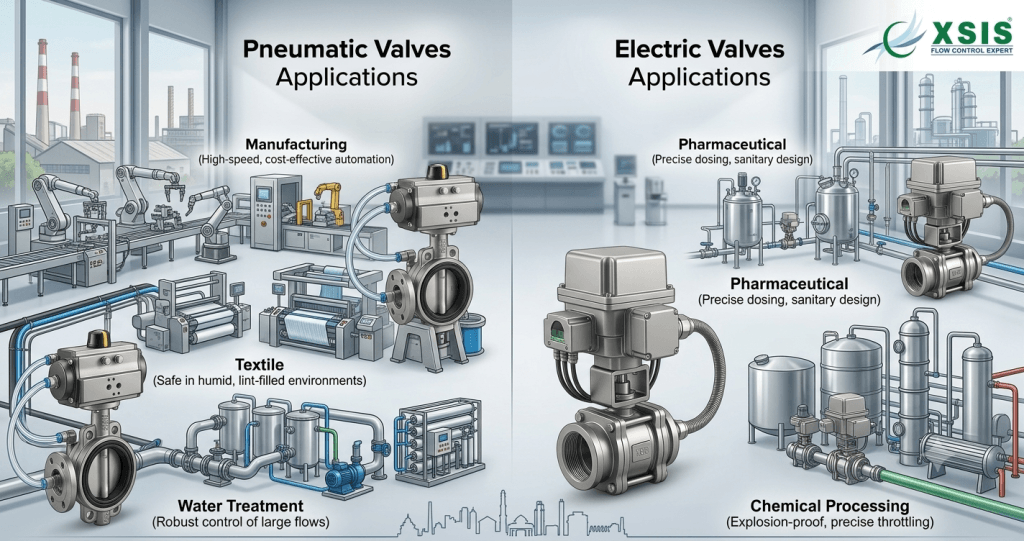
Pneumatic and electric-powered actuated valves are used throughout many industries in Ahmedabad for controlling the flow of beverages, gases, steam, chemical substances, and other media. Pneumatic valves are especially useful where rapid operation, common use, and fail-safe capability are required, mainly because a reliable compressed-air supply is already available. Electric valves can be splendid wherein specific positioning, long-distance operation, and integration with computerized management systems are critical.
The high-quality preference is based entirely on the method requirements, valve type, operating conditions, required utilities, and automation goals of each facility. Chemical, pharmaceutical, material, food-processing, production, water-treatment, and HVAC industries may also require distinct actuation solutions. Evaluating strain, temperature, media tendencies, operating frequency, manipulation requirements, and protection conditions allows Ahmedabad industries to select the most appropriate valve type.
Common Industrial Applications
- Chemical Processing: Pneumatic valves can be a useful resource for fast isolation and non-routine process cycles in chemical plants. Electric actuators may be appropriate where controlled positioning and automated monitoring are required.
- Pharmaceutical Manufacturing: Actuated valves help control the flow of fluids and utilities in pharmaceutical facilities. Proper material choice, hygiene requirements, and specific process control must be considered when selecting a manual actuator.
- Textile Industries: Automated valves can modify water, steam, air, and other utilities applied in fabric production. Pneumatic actuation can be a useful resource in common applications, while electric-powered systems can provide controlled operation.
- Water Treatment: Electric actuated valves are beneficial for a long way off operation and automatic go along with the glide control in water-treatment systems. Pneumatic options can also be powerful where compressed air is available.
- Food Processing: Actuated valves can assist in automating the motion of water, steam, air, and process fluids. The valve and actuator should be selected in step with hygiene, temperature, and method necessities.
- Manufacturing and HVAC: Both can be used for automated management of process traces, cooling systems, heating systems, and software program application networks.
Conclusion
The evaluation between pneumatic and electric-powered actuation includes several factors, which encompass operating speed, energy requirements, maintenance, control precision, safety, infrastructure, and life-cycle cost. Pneumatic actuators may be a strong choice for instant operation and applications in which compressed air is readily available. Electric actuators may be appealing for precise control, widespread automation, and plant life without an established compressed-air network.
Ultimately, Pneumatic vs Electric Valves for Ahmedabad Industries need to be dealt with as an engineering choice in order to ensure a smooth product evaluation. Working with a skilled commercial enterprise valve provider can help agencies examine valve compatibility, actuator sizing, automation requirements, and long-term protection goals. A properly selected valve and actuator combination can contribute to more stable processes, better control, decreased downtime, and more reliable industrial operations.
Explore Our Recent Blog
- Right Valve Material for Industrial Applications in Ahmedabad
- Top Applications of Ball Valves Across Ahmedabad Industries
- Gate Valves in Ahmedabad: Features, Benefits, and Industrial Applications
- Globe Valves in Ahmedabad: Working Principle and Common Uses
- Check Valves in Ahmedabad: Types, Benefits, and Installation Guide
Frequently Asked Questions
1. Which is better, pneumatic or electric actuated valves?
Neither actuator is universally better because the right preference depends on the software program. Pneumatic actuators are regularly preferred for fast operation and common applications, while electric-powered actuators may be useful for particular control and applications without compressed air. Industries should have a look at machine requirements, utilities, safety, protection, and lifecycle prices before choosing one.
2. Are pneumatic valves suitable for chemical industries in Ahmedabad?
Pneumatically actuated valves may be suitable for chemical packages when the valve, actuator, seals, and manipulative additives are successfully determined for the media and surroundings. They can offer speedy operation and can be configured for fail-safe packages. The final design should not forget stress, temperature, corrosion, hazardous-area requirements, and the traits of the chemical being treated.
3. Do electric actuated valves consume more energy than pneumatic valves?
Energy consumption depends on the entire device and operating pattern. Pneumatic structures consume energy via compressed-air technology, distribution, and leakage, whilst electric-powered actuators, broadly speaking, use electrical energy throughout operation. A lifecycle power evaluation is therefore more useful than comparing actuator electricity scores on my own.
4. Which actuator requires less maintenance?
Electric actuators may require much less complicated software application requirements because they no longer need compressors, air strains, filters, or regulators. However, they still require inspection of electrical connections, gears, valves, switches, and related components. Pneumatic systems can also offer dependable service even as compressed-air systems and associated components are well maintained.
5. Can pneumatic and electric actuators be used with ball and butterfly valves?
Yes, both pneumatic and electric-powered actuators are commonly available for on/off valve applications together with ball and butterfly valves. The actuator ought to be effectively matched to the valve’s running torque and approach conditions. Selection needs to moreover account for biking frequency, manage requirements, mount configuration, and required failure function.
6. How can Ahmedabad industries choose the right industrial valve supplier?
Industries want to examine providers based on product quality, technical information, actuator compatibility, material alternatives, documentation, after-sales support, and availability of spare components. The issuer wants to understand the actual technical situation instead of recommending a valve based mostly on period or price. Comparing technical specifications and lifecycle requirements can help groups make a more reliable purchasing choice.