

High-pressure industrial systems require valves that can safely control, isolate, and regulate fluids under demanding operating conditions. In sectors such as chemicals, pharmaceuticals, oil and gas, power generation, engineering, textiles, and process manufacturing, a valve failure can lead to leakage, production losses, equipment damage, and serious safety concerns. For this reason, selecting the right valve for pressure-intensive applications is an important part of industrial system design.
High-Pressure Industrial Valves in Ahmedabad are used in applications where pipelines and process equipment operate under elevated pressure and require dependable flow control. These valves are available in different designs, materials, pressure classes, sizes, and actuation options to suit specific industrial requirements. Choosing the correct configuration depends on factors such as operating pressure, temperature, fluid characteristics, flow requirements, installation conditions, and frequency of operation.
What Are High-Pressure Industrial Valves and How Do They Work?
High-pressure industrial valves in Ahmedabad are mechanical devices used to control, isolate, regulate, or direct fluids in pressurised industrial systems. Depending on their design, they can stop flow completely, regulate fluid movement, or divert media between pipelines. These valves are engineered to withstand demanding pressure and temperature conditions while maintaining reliable sealing and mechanical strength. They are widely used in chemical, pharmaceutical, power, textile, water-treatment, and manufacturing industries.
A typical high-pressure valve consists of components such as a valve body, bonnet, stem, trim, seat, and sealing elements. The internal design determines how efficiently the valve controls the flowing medium. Valves can be operated manually through handwheels or levers, or automatically using pneumatic, electric, or hydraulic actuators. The selected operating method depends on the application, frequency of operation, and level of process automation required.
For High-Pressure Industrial Valves in Ahmedabad, selection should consider more than pressure rating alone. Engineers should evaluate operating temperature, fluid compatibility, valve size, end connections, pressure class, flow requirements, and sealing materials. Proper sizing and specification ensure dependable flow control, reduce leakage risks, improve operational safety, and support longer valve service life across demanding industrial applications.
Which Types of High-Pressure Valves Are Used in Ahmedabad Industries?
Several valve designs are available for high-pressure industrial applications, and each offers different operating characteristics. Gate valves are commonly considered when full isolation is required, while globe valves can be used when flow regulation is needed. Ball valves can provide quick quarter-turn shut-off, whereas check valves are designed to prevent reverse flow within a pipeline.
The most suitable design depends on what the valve needs to accomplish within the process. A valve used primarily for isolation may require different characteristics from a valve used continuously for throttling. Engineers should therefore consider the required flow path, pressure drop, operating frequency, maintenance accessibility, and potential exposure to abrasive, corrosive, or high-temperature media before selecting a valve type.
Commonly considered options include
- High-Pressure Gate Valves: Gate valves are primarily used for isolation rather than continuous throttling. Their full-bore flow path can minimise resistance when the valve is fully open, making them suitable for selected high-pressure pipeline applications.
- High-Pressure Globe Valves: Globe valves are useful where controlled flow regulation is required. Their internal construction allows the flow passage to be adjusted progressively.
- High-Pressure Ball Valves: Ball valves use a rotating ball with a bore to control flow. They can provide quick shut-off and tight sealing, making them suitable for many process and utility applications when correctly rated.
- High-Pressure Check Valves: Check valves allow flow in one direction while helping prevent reverse flow. They are often used near pumps, compressors, and process equipment where backflow could damage machinery or disturb the process.
- High-Pressure Butterfly Valves: Butterfly valves use a rotating disc to control flow and can provide a compact solution for selected larger-diameter pipelines.
- High-Pressure Needle Valves: Needle valves can provide fine flow adjustment through a small orifice and are commonly considered for instrumentation and control applications.
Where Are High-Pressure Industrial Valves Used in Ahmedabad?
Ahmedabad and surrounding industrial areas contain facilities involved in chemical processing, pharmaceuticals, textiles, engineering, food processing, utilities, water treatment, and other manufacturing activities. Many of these facilities depend on pressurised pipelines to transport water, steam, gases, chemicals, oils, and process fluids. High-pressure valves provide controlled isolation and flow management at critical points throughout these systems.
In chemical and pharmaceutical facilities, valve materials and sealing components must be compatible with the process medium. In power and utility applications, pressure and temperature may become major selection factors. Engineering and manufacturing facilities may require robust valves for hydraulic, pneumatic, or process systems, while water-related facilities may need dependable valves for pressurised distribution and treatment lines.
Important application areas include
- Chemical Processing: Chemical plants may use high-pressure valves for transferring, isolating, and controlling process fluids. Material compatibility, corrosion resistance, pressure rating, and reliable sealing are important considerations for these installations.
- Pharmaceutical Manufacturing: Pharmaceutical facilities require controlled and dependable process systems. Valve selection may involve considerations such as hygienic design, material quality with process fluids.
- Power and Utility Systems: Pressurised water, steam, and other utility services may require industrial valves designed for demanding operating conditions. Temperature and pressure ratings are particularly important when selecting valves for these systems.
- Textile Manufacturing: Textile plants use valves across utility, water, steam, dyeing, finishing, and process systems. The appropriate valve depends on the fluid, pressure, temperature, flow requirements, and operating frequency.
- Water Treatment: High-pressure pipelines in water-treatment systems require reliable isolation and flow-control equipment. Valve selection should account for pressure, water chemistry, pipe size, operating cycle, and maintenance requirements.
- Engineering and Manufacturing: Industrial machinery and production facilities may use high-pressure valves in hydraulic, pneumatic, cooling, and process applications.
How Do You Select the Right High-Pressure Industrial Valve?
Selecting a high-pressure valve requires a systematic assessment of process conditions rather than simply choosing a valve with the highest available pressure rating. The valve should be able to safely handle the actual operating pressure and temperature, including any relevant variations or transient conditions. The media being transported must also be considered because chemicals, steam, gases, water, and abrasive fluids can place different demands on valve components.
Valve size and flow requirements are equally important. Oversizing or undersizing a valve can affect system performance, pressure drop, control capability, and operating efficiency. Engineers should also evaluate the valve’s end connections, installation orientation, actuator requirements, maintenance access, and expected number of operating cycles before finalising the specification.
Key selection factors should be reviewed
- Operating Pressure: Determine the normal, minimum, maximum, and potential transient pressure conditions. The selected valve must have an appropriate pressure rating for the actual application.
- Operating Temperature: Temperature can affect valve body materials, seats, gaskets, packing, and seals. Select components capable of maintaining their required performance across the complete operating temperature range.
- Fluid Compatibility: Identify whether the medium is water, steam, gas, oil, chemical, slurry, or another process fluid. Valve materials and sealing components should be compatible with the medium to reduce corrosion and premature deterioration.
- Valve Size and Flow: Select the valve according to pipeline size and required flow characteristics. Proper sizing helps maintain acceptable pressure loss and ensures that the valve performs as intended under operating conditions.
- Pressure Class and Standards: Verify the relevant pressure class, dimensional requirements, testing expectations, and applicable industry standards.
- Actuation and Control: Decide whether the valve will be manually operated or automated. Pneumatic and electric actuators can support remote operation and process automation where frequent or controlled valve movement is required.
Which Valve Materials Are Suitable for High-Pressure Applications?
Material selection is a critical part of high-pressure valve engineering because the valve body and internal components must withstand mechanical pressure while remaining compatible with the process medium. Common industrial valve materials include carbon steel, stainless steel, alloy steel, and other specialised materials. The appropriate choice depends on pressure, temperature, corrosion conditions, fluid characteristics, and applicable technical requirements.
Stainless steel is often considered where corrosion resistance and material durability are important, while carbon steel can be suitable for many industrial services when process conditions permit. Alloy materials may be considered for particularly demanding pressure or temperature environments. The choice of seat, packing, gasket, and other internal components is equally important because these parts directly influence sealing and operating performance.
Material considerations include
- Carbon Steel: Carbon steel can provide strong mechanical performance for many industrial applications. Its suitability depends on the process medium, corrosion environment, temperature, pressure rating, and required protective measures.
- Stainless Steel: Stainless steel is commonly selected where corrosion resistance is important. Different stainless-steel grades provide different levels of resistance, so the specific process environment should be evaluated before selection.
- Alloy Steel: Alloy steel may be considered for demanding pressure and temperature conditions. Its mechanical properties can make it appropriate for specialised industrial applications requiring enhanced performance.
- Valve Seats: Seat materials influence sealing performance, temperature resistance, and compatibility with the process medium. The seat should be selected according to pressure, temperature, fluid characteristics, and expected operating conditions.
- Gaskets and Packing: Gaskets and packing help prevent leakage around valve joints and stems. Their material must remain stable under the application’s pressure, temperature, and chemical conditions.
- Corrosion Resistance: Material selection should account for external as well as internal corrosion. Humidity, chemicals, atmospheric exposure, and process-fluid characteristics can all influence long-term valve performance.
How Do High-Pressure Valves Improve Industrial Safety?
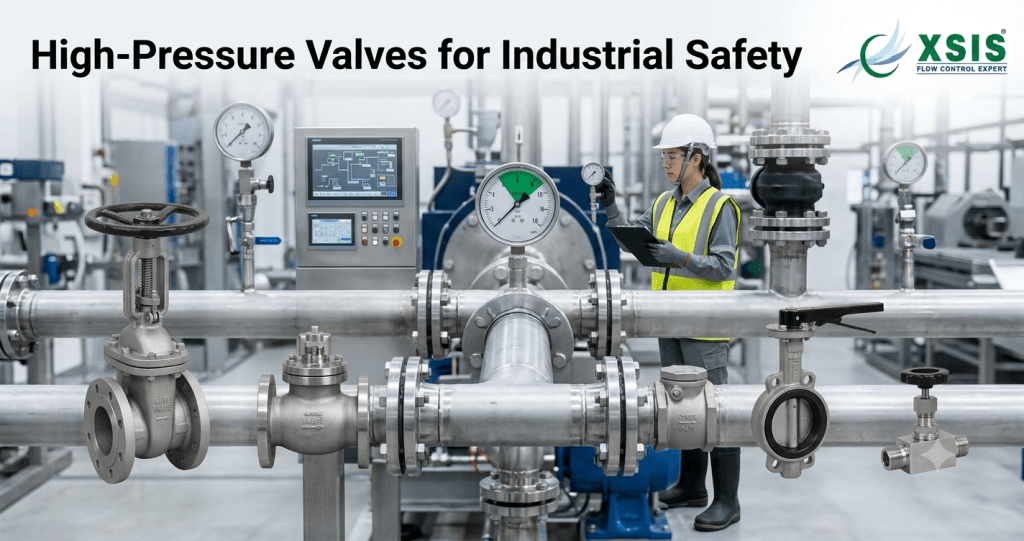
High-pressure systems can contain significant stored energy, making dependable isolation and flow control essential for industrial safety. A properly selected valve can help isolate sections of a pipeline during maintenance, equipment inspection, emergency situations, or process shutdown. Reliable sealing also helps reduce the possibility of unintended fluid release.
Safety performance depends on the complete valve assembly and operating system. Valve design, pressure rating, material compatibility, actuator configuration, installation, inspection, and maintenance all contribute to dependable operation. For automated systems, position feedback and appropriate control logic can further support process monitoring and emergency response.
Safety considerations should be prioritised
- Reliable Pressure Containment: The valve body and pressure-containing components must be appropriate for the application’s operating conditions. Correct pressure-temperature selection reduces the risk of mechanical failure.
- Effective Isolation: Isolation valves should provide dependable shut-off when sections of a system need to be separated. Proper seat and sealing selection is important for maintaining isolation performance.
- Leakage Prevention: Internal and external leakage can create safety and environmental concerns. Appropriate sealing materials, correct installation, and regular inspection help maintain valve integrity.
- Emergency Shutdown: Critical systems may require valves that can move to a predetermined safe position during an emergency. The actuator and control arrangement should be selected according to the process safety requirements.
- Pressure Relief Considerations: High-pressure systems may require dedicated pressure-relief protection in addition to isolation valves.
- Inspection and Testing: Periodic inspection can identify wear, corrosion, seal deterioration, and operating problems. Appropriate testing and maintenance help ensure that valves remain ready to perform when required.
What Maintenance Practices Extend High-Pressure Valve Life?
Regular maintenance is essential for keeping high-pressure industrial valves dependable over their service life. Even a high-quality valve can develop problems if it is exposed to unsuitable operating conditions, excessive cycling, corrosion, poor installation, or inadequate inspection. Maintenance teams should monitor valves for visible leakage, abnormal operating force, vibration, corrosion, and changes in operating performance.
A preventive maintenance programme should be based on the valve’s application and criticality. Frequently operated valves may require more regular inspection than rarely operated isolation valves, while valves handling corrosive or hazardous media may need additional monitoring. Maintenance records can also help identify recurring problems and determine when components require replacement.
Maintenance practices can improve reliability
- Routine Visual Inspection: Inspect valve bodies, joints, stems, actuators, and connections for visible damage or leakage. Early identification of abnormalities can prevent small issues from becoming major failures.
- Leakage Monitoring: Check for internal and external leakage according to the application’s safety and maintenance procedures. Persistent leakage should be investigated rather than ignored.
- Stem and Actuator Checks: Verify that manually or automatically operated valves move correctly. Unusual resistance, noise, vibration, or incomplete movement can indicate mechanical or actuator-related problems.
- Corrosion Inspection: Examine exposed surfaces and components for corrosion, particularly in humid or chemically aggressive environments.
- Seal and Packing Maintenance: Inspect packing, gaskets, and other sealing components according to the manufacturer’s recommendations and service conditions.
- Maintenance Documentation: Record inspections, repairs, component replacements, and operating issues. Maintenance history can help engineers identify trends and plan preventive servicing more effectively.
How Can Ahmedabad Industries Choose a Reliable High-Pressure Valve Supplier?
Choosing the right supplier is an important step when sourcing High-Pressure Industrial Valves in Ahmedabad because technical support can be just as important as product availability. A reliable supplier should be able to understand the application, recommend an appropriate valve configuration, and provide relevant technical information. Product selection should be based on pressure, temperature, media, size, material, and operating requirements rather than price alone.
Industries should also consider after-sales support, spare-part availability, documentation, testing capabilities, and experience with industrial applications. A supplier that can provide clear specifications and assist with valve sizing can make procurement and installation more straightforward. For critical applications, buyers should also verify relevant quality documentation and testing requirements before placing an order.
Supplier-selection factors
- Technical Expertise: Choose a supplier capable of understanding process conditions and recommending suitable valve types. Technical knowledge is especially important for demanding high-pressure applications.
- Product Range: A supplier offering multiple valve types, materials, sizes, pressure classes, and actuation options can make it easier to find an appropriate configuration for different plant requirements.
- Quality Documentation: Ask for relevant technical specifications, material information, pressure ratings, testing documentation, and other project-specific records where required.
- Application Support: Suppliers should be able to discuss valve sizing, material compatibility, actuation, installation, and operating requirements. Application-specific guidance can reduce the risk of selecting an unsuitable valve.
- Spare Parts and Service: Consider the availability of replacement seals, packing, actuators, and other service components. Accessible support can reduce maintenance delays and minimise production downtime.
- Industry Experience: Experience with chemical, pharmaceutical, textile, water-treatment, engineering, or other relevant industries can be valuable.
Conclusion
Selecting High-Pressure Industrial Valves in Ahmedabad requires careful consideration of the complete industrial process rather than focusing on a single specification. Factors such as operating pressure, temperature, media compatibility, valve type, size, pressure class, material, actuation, installation conditions, and maintenance requirements should be evaluated together. Proper selection helps ensure reliable flow control, minimise leakage, and reduce the risk of premature valve failure.
A reliable high-pressure valve should provide effective pressure containment, dependable sealing, and long-term performance. Working with an experienced industrial valve supplier can help businesses select suitable valve types, materials, pressure ratings, and actuation systems. Proper installation and preventive maintenance further support safer operation, improved reliability, and reduced industrial downtime.
Explore Our Recent Blog
- Right Valve Material for Industrial Applications in Ahmedabad
- Top Applications of Ball Valves Across Ahmedabad Industries
- Gate Valves in Ahmedabad: Features, Benefits, and Industrial Applications
- Globe Valves in Ahmedabad: Working Principle and Common Uses
- Check Valves in Ahmedabad: Types, Benefits, and Installation Guide
Frequently Asked Questions
1. What are high-pressure industrial valves used for?
High-pressure industrial valves are used to control, isolate, regulate, or direct fluids in pressurised industrial systems. They can be used with water, steam, gases, chemicals, oils, and other process media depending on their design and material compatibility. Their applications include chemical processing, manufacturing, power, water treatment, and industrial utilities.
2. Which valve is best for high-pressure applications?
There is no single valve type that is best for every high-pressure application. Gate, globe, ball, check, butterfly, and needle valves can each be suitable for specific duties depending on isolation, regulation, flow, pressure, temperature, and media requirements. Engineers should select the valve based on the actual process conditions and required operating function.
3. How do I choose a high-pressure valve for a chemical plant?
Start by identifying the process pressure, temperature, chemical composition, flow requirements, and required valve function. Material compatibility is especially important because corrosive chemicals can damage unsuitable valve bodies, seats, seals, and internal components. The valve’s pressure class, construction, sealing arrangement, and applicable safety requirements should also be verified before selection.
4. Are stainless steel valves suitable for high-pressure industrial systems?
Stainless steel valves can be suitable for many high-pressure applications when the specific grade and valve design are appropriate for the operating conditions. They can offer useful corrosion resistance, but suitability depends on the process medium, temperature, pressure, and environmental exposure. The complete valve construction, including seats and sealing components, should be evaluated rather than considering the body material alone.
5. How often should high-pressure industrial valves be maintained?
There is no universal maintenance interval because frequency depends on valve type, operating conditions, criticality, cycling frequency, and process media. Valves handling corrosive or hazardous materials may require more frequent inspection than valves operating under less demanding conditions. A preventive maintenance schedule based on manufacturer recommendations and plant operating experience is generally the most appropriate approach.
6. How can I find reliable high-pressure industrial valves in Ahmedabad?
Start by identifying suppliers with suitable industrial valve ranges and experience with high-pressure applications. Compare technical specifications, pressure ratings, materials, testing documentation, application support, spare-parts availability, and after-sales service rather than comparing price alone. Providing the supplier with accurate process information will also help them recommend a more appropriate valve configuration.